
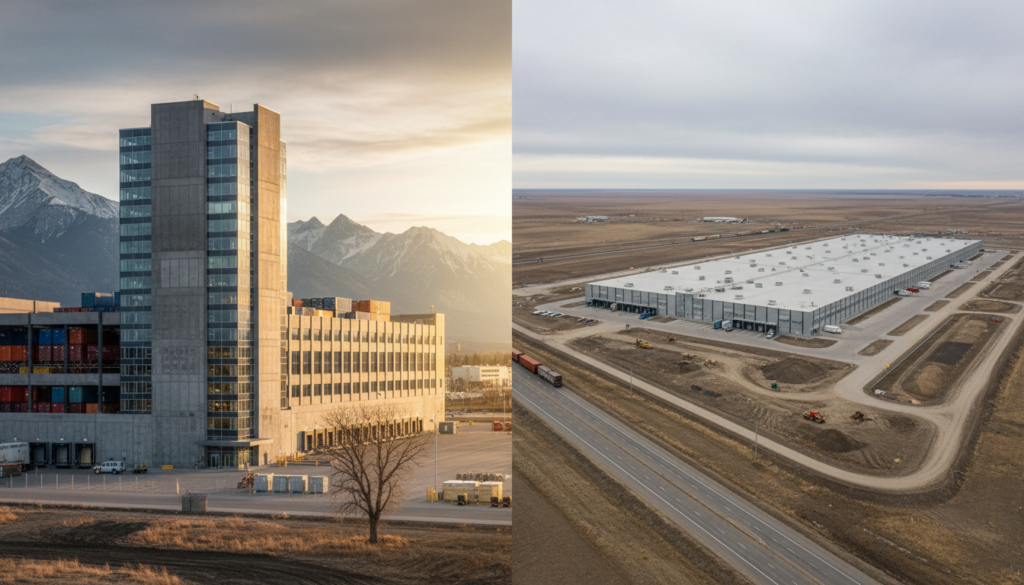

To understand the economic pulse of Alberta, one must look beyond the gleaming downtown office towers and turn their attention to the industrial parks on the fringes of its two major cities. A quiet but massive structural revolution is unfolding along the Queen Elizabeth II Highway corridor. Calgary and Edmonton, long considered twin engines of the provincial economy, are rapidly diverging in their commercial real estate strategies. Driven by distinct topographical constraints, land valuations, and logistical philosophies, Calgary developers are pioneering the construction of multi-story, vertical logistics hubs. Conversely, Edmonton is leaning into its geographic advantages, leveraging vast tracts of flat, easily zoned land to expand its industrial footprint outward horizontally. For potential residents, investors, business owners, and technical engineers, understanding this divergence is critical to navigating Alberta’s supply chain future. This is not merely a tale of two cities; it is a masterclass in how geography dictates economic engineering.
The following economic facts are based on current Alberta provincial data and market trends.
The Geographic and Economic Foundations
To comprehend why a logistics company would choose to build upward in one city and outward in another just three hundred kilometers away, we must first examine the foundational geography and historical zoning policies of both regions.
Calgary: The Constrained Foothills
Calgary is geographically constrained. Nestled in the foothills of the Rocky Mountains, the city’s topography is defined by rolling hills, deep river valleys, and significant elevation changes. Furthermore, Calgary’s physical expansion is naturally bordered by the Tsuut’ina Nation to the southwest and strictly managed agricultural reserves and topographical barriers to the west.
These physical constraints have a direct impact on land economics:
- Scarcity Drives Price: Usable, flat industrial land within a viable distance of Calgary’s urban core is increasingly scarce.
- High Acquisition Costs: As a result of this scarcity, the cost per acre for prime industrial land in Calgary, particularly near critical infrastructure like the Calgary International Airport or the CN Logistics Park in Conrich, has skyrocketed.
- Topographical Engineering Costs: Preparing land in the Calgary region often requires extensive grading, retaining walls, and soil stabilization, adding massive capital expenditures to the initial phases of horizontal development.
Edmonton: The Prairie Expanse
Edmonton represents the stark opposite. Situated on the relatively flat expanse of the northern prairies, the city is surrounded by vast tracts of agricultural land that can be more readily converted for industrial use. The Capital Region, encompassing municipalities like Leduc County, Parkland County, and Sturgeon County, offers a nearly limitless canvas for horizontal sprawl.
The economic realities of Edmonton’s geography include:
- Abundant Inventory: Industrial corridors such as Nisku, Acheson, and the Edmonton International Airport (EIA) perimeter offer massive, contiguous parcels of land.
- Lower Acquisition Costs: The sheer volume of available land keeps the cost per acre significantly lower than in the Calgary region.
- Frictionless Topography: The flat terrain requires minimal grading and site preparation, dramatically lowering the barrier to entry for large-scale, single-story developments.
Calgary’s Vertical Ascent: Engineering the Multi-Story Hub
Faced with high land costs and geographic boundaries, Calgary’s industrial developers are adopting a strategy long utilized in densely populated Asian and European cities: building upward. The multi-story warehouse is a marvel of modern structural engineering and represents a paradigm shift in North American logistics.

The Mechanics of Vertical Logistics
Building a warehouse on multiple levels is not as simple as adding a second floor to an office building. The structural requirements necessary to support heavy machinery, racking systems, and fully loaded transport trucks on elevated levels are immense.
Structural Load Capacities
In a traditional horizontal warehouse, the concrete slab rests directly on compacted earth. In a vertical warehouse, the upper floors must be suspended. Technical engineers must design these suspended slabs to handle extraordinary live loads.
- Floor Loading: Upper levels typically require load capacities exceeding two hundred and fifty pounds per square foot to safely support forklifts and dense inventory racking.
- Vibration Mitigation: Engineers must account for the dynamic forces of moving vehicles on suspended floors, requiring heavily reinforced concrete and specialized dampening systems.
Vertical Transportation Infrastructure
Moving goods—and the vehicles that carry them—between floors is the primary operational challenge.
- Helical Truck Ramps: Calgary’s vertical facilities are increasingly incorporating massive, spiraling ramps that allow full-sized, fifty-three-foot tractor-trailers to drive directly to loading docks on the second or third floors.
- Heavy Freight Elevators: For facilities where ramps are geometrically impossible, high-speed, heavy-capacity freight elevators are installed to move pallets seamlessly between levels.
The Economic Justification for Going Up
Why would an investor or business owner absorb the massive capital expenditure required to build a vertical warehouse? The answer lies in the concept of "Last-Mile Delivery."
In the e-commerce era, the speed of delivery is paramount. Consumers expect next-day or even same-day shipping. To achieve this, distribution centers must be located as close to the urban population core as possible.
- Transportation vs. Real Estate Costs: In the logistics industry, transportation accounts for roughly fifty to seventy percent of total supply chain costs, while real estate accounts for only five to ten percent.
- The Premium of Proximity: By paying a premium for vertical real estate close to Calgary’s urban center, logistics companies drastically reduce their daily transportation and fuel costs, ultimately achieving a lower total cost of operation.
Edmonton’s Horizontal Dominion: Sprawl as a Strategy
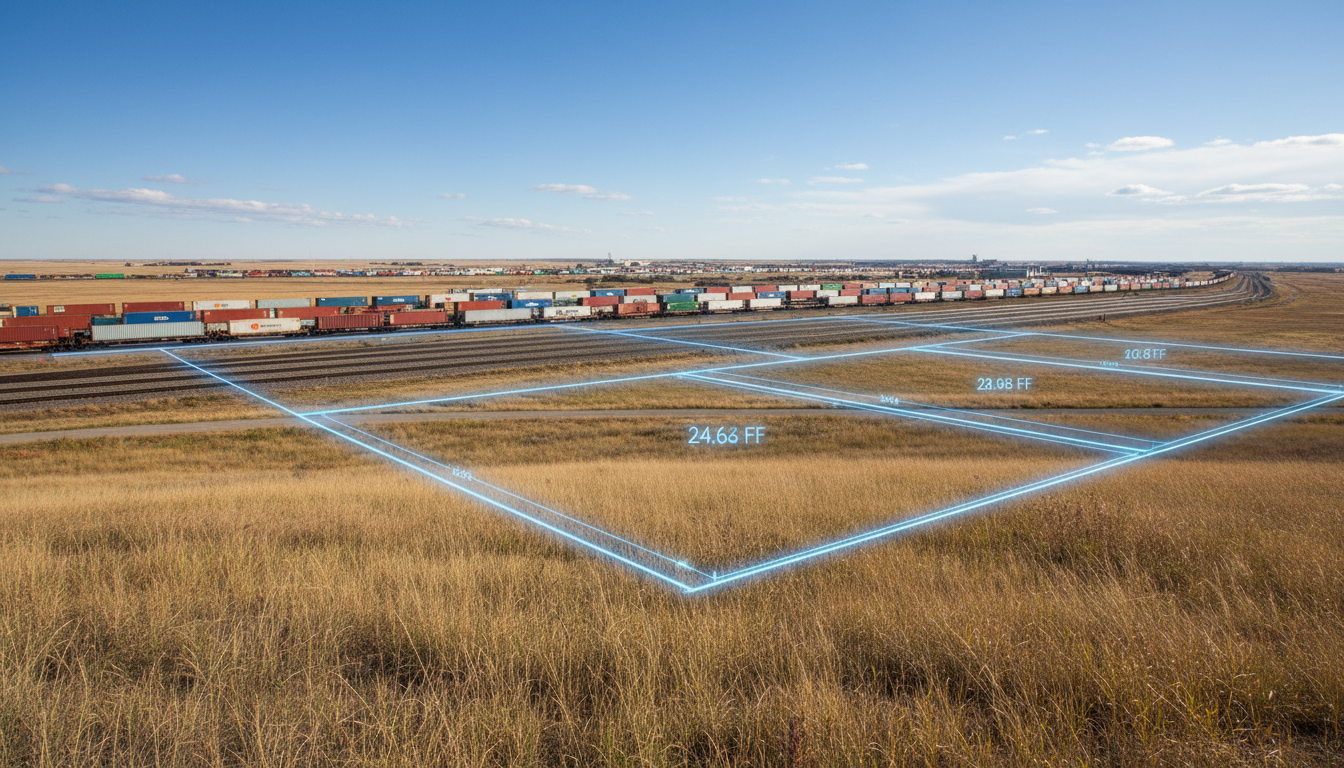
While Calgary engineers build upward to conquer land scarcity, Edmonton developers are leveraging their geographic abundance to build some of the largest single-story distribution centers in the country. Areas like Acheson to the west and Nisku to the south have become horizontal behemoths of supply chain efficiency.
The Economics of Cheap Dirt
For businesses focused on regional, national, or international distribution rather than localized last-mile delivery, Edmonton offers an unbeatable economic proposition.
Lower Capital Expenditures (CAPEX)
Building outward is fundamentally cheaper than building upward.
- Standardized Construction: Horizontal warehouses utilize standard tilt-up concrete panels and open-web steel joists. This construction method is highly commoditized, fast, and cost-effective.
- Zero Suspended Loads: Because the entire facility rests on a single ground-level slab, developers avoid the astronomical costs of structural steel and specialized concrete reinforcement required for vertical facilities.
- Economies of Scale: Edmonton’s geography allows for the construction of "mega-centers" exceeding one million square feet under a single roof. The cost per square foot drops dramatically as the footprint expands.
The Acheson and Nisku Advantage
Edmonton’s horizontal strategy is anchored by highly strategic industrial parks that operate as independent economic ecosystems.
Acheson Industrial Area
Located in Parkland County, immediately west of Edmonton, Acheson benefits from zero business taxes and lower property tax mill rates compared to the city proper. Its flat topography and immediate access to the Trans-Canada Yellowhead Highway make it an ideal location for heavy equipment, manufacturing, and massive horizontal distribution centers.
Nisku and the CANAMEX Corridor
Situated south of Edmonton in Leduc County, Nisku is one of the largest industrial parks in North America. It borders the Edmonton International Airport and sits directly on the CANAMEX trade corridor.
- Intermodal Connectivity: Nisku allows businesses to build sprawling horizontal facilities that integrate directly with rail spurs, major highways, and international air freight hubs.
- Operational Efficiency: In a horizontal facility, cross-docking (moving goods directly from an inbound truck to an outbound truck) is highly efficient. Forklifts operate on a single plane, reducing travel time and eliminating the bottleneck of freight elevators.
The Engineering Economics: Cost Per Square Foot Breakdown
To provide a comprehensive educational overview for investors and business owners, we must break down the comparative economics of these two strategies. The decision between a Calgary vertical hub and an Edmonton horizontal sprawl comes down to a rigorous analysis of Capital Expenditures (CAPEX) versus Operational Expenditures (OPEX).
Capital Expenditures (CAPEX) Analysis
The initial cost to construct a facility varies wildly between the two models.
- Land Acquisition:
- Calgary (Urban/Constrained): High cost per acre.
- Edmonton (Periphery/Sprawl): Low cost per acre.
- Structural Framing:
- Calgary Vertical: Requires heavy structural steel, massive concrete columns, and suspended load-bearing slabs. Cost is exponentially higher.
- Edmonton Horizontal: Utilizes standard tilt-up concrete and light steel roofing. Cost is strictly linear and predictable.
- Specialized Infrastructure:
- Calgary Vertical: Requires truck ramps, heavy freight elevators, and complex multi-zone HVAC and fire suppression systems.
- Edmonton Horizontal: Standard ground-level loading docks and uniform climate control systems.
Operational Expenditures (OPEX) Analysis
While horizontal facilities are cheaper to build, vertical facilities can offer unique operational savings depending on the business model.
- Transportation Logistics:
- Calgary Vertical: Situated close to urban centers, drastically reducing last-mile fuel, labor, and vehicle maintenance costs.
- Edmonton Horizontal: Situated on the periphery, requiring longer drive times to reach urban consumers, thereby increasing daily transportation costs.
- Facility Maintenance:
- Calgary Vertical: Higher maintenance costs due to elevator servicing, ramp upkeep, and complex structural monitoring.
- Edmonton Horizontal: Lower, highly predictable maintenance costs typical of standard single-story buildings.
- Throughput Efficiency:
- Calgary Vertical: Moving goods vertically can introduce bottlenecks if elevator systems fail or if ramp traffic is poorly managed.
- Edmonton Horizontal: Single-level operations allow for maximum velocity in cross-docking and inventory picking.
Strategic Implications for Investors and Business Owners
Understanding the divergence between Calgary and Edmonton is vital for anyone looking to invest in Alberta’s commercial real estate or establish a supply chain footprint in Western Canada. The choice between vertical and horizontal is not a matter of one being universally better than the other; it is a matter of aligning the real estate strategy with the specific operational goals of the business.

How to Choose the Calgary Vertical Strategy
Business owners and investors should look toward Calgary’s vertical warehousing model if their operations align with the following criteria:
- E-Commerce and Last-Mile Focus: If the primary business goal is delivering goods directly to consumers within a narrow time window (same-day or next-day delivery), proximity to the urban core is non-negotiable. The savings in transportation will offset the higher lease rates of a vertical facility.
- High-Value, Low-Volume Goods: Businesses dealing in electronics, pharmaceuticals, or high-end consumer goods benefit from the enhanced security and urban proximity of multi-story hubs.
- ESG and Urban Integration: Vertical warehouses have a smaller geographic footprint, preserving green space and reducing the overall environmental impact of urban sprawl. Companies with strict Environmental, Social, and Governance (ESG) mandates often prefer high-density, energy-efficient vertical facilities.
How to Choose the Edmonton Horizontal Strategy
Conversely, the Edmonton horizontal model is the optimal choice for businesses with different operational profiles:
- Heavy Industrial and Big-Ticket Logistics: Companies moving oversized goods, heavy machinery, automotive parts, or raw materials require the massive square footage and unconstrained ground-level access that only horizontal facilities can provide.
- Regional and National Distribution: If a facility serves as a central hub to supply retail stores across Western Canada, urban proximity is less important than immediate access to major highways, rail lines, and air freight. Acheson and Nisku excel in this regard.
- Cost-Conscious Scaling: For startups or expanding businesses where capital preservation is critical, the significantly lower per-square-foot lease rates in Edmonton’s industrial periphery offer a safer financial runway for growth.
The Role of Automation and Robotics in Both Models
Regardless of whether a facility goes up or out, the future of Alberta’s commercial real estate is inextricably linked to automation. Technical engineers are currently designing both vertical and horizontal facilities to accommodate the next generation of supply chain robotics.
Automating the Vertical Hub
In Calgary’s multi-story facilities, automation is used to solve the challenges of verticality.
- Automated Storage and Retrieval Systems (ASRS): These robotic systems operate within narrow aisles, retrieving inventory from towering racks and delivering it to human packers. In a vertical warehouse, ASRS can be designed to span multiple floors, effectively turning the entire building into a single, automated vending machine.
- Vertical Conveyors: Continuous vertical conveyor belts are replacing traditional freight elevators for smaller parcels, moving goods between floors in a constant, uninterrupted flow.
Automating the Horizontal Expanse
In Edmonton’s sprawling centers, automation is used to solve the challenge of distance.
- Autonomous Mobile Robots (AMRs): In a million-square-foot facility, human workers waste vast amounts of time simply walking. AMRs navigate the flat, single-level floors autonomously, carrying goods from distant storage zones to central packing stations.
- Automated Guided Vehicles (AGVs): Robotic forklifts and pallet jacks are heavily utilized in horizontal cross-docking operations, moving heavy pallets from inbound to outbound bays with mathematical precision.
Educational Glossary of Commercial Real Estate Terms
To further assist potential investors and technical professionals in understanding this market divergence, we have compiled a brief glossary of critical terms utilized in this analysis:
- Capital Expenditures (CAPEX): The initial, upfront funds used by a company to acquire, upgrade, and maintain physical assets such as property, industrial buildings, or equipment.
- Operational Expenditures (OPEX): The ongoing, day-to-day expenses a business incurs through its normal operations, including rent, utilities, transportation, and payroll.
- Cross-Docking: A logistics practice where materials are unloaded from an incoming semi-trailer truck or railroad car and loaded directly into outbound trucks, trailers, or rail cars, with little or no storage in between.
- Live Load: In structural engineering, a live load refers to the dynamic forces placed on a structure by moving objects, such as forklifts, transport trucks, and shifting inventory.
- Mill Rate: The amount of tax payable per dollar of the assessed value of a property. Lower mill rates in peripheral counties often drive horizontal sprawl.
- Tilt-Up Construction: A highly efficient building method where concrete wall panels are cast on-site and then lifted (tilted) into a vertical position by cranes. This is the primary method used in Edmonton’s horizontal warehouses.
The Future of Alberta’s Supply Chain Ecosystem
The divergence between Calgary’s vertical ascent and Edmonton’s horizontal dominion is not a sign of a fractured economy; rather, it is evidence of a highly sophisticated, maturing provincial supply chain. By embracing their unique geographic realities, both cities are optimizing their infrastructure to serve different, yet highly complementary, segments of the global market.
Calgary will continue to evolve as a high-density, rapid-response logistics hub, pioneering architectural and engineering innovations to serve an increasingly demanding urban consumer base. Meanwhile, Edmonton will solidify its position as the heavy-lifting distribution capital of Western Canada, utilizing its vast space to facilitate national and international trade flows at an unmatched scale.
For business owners, investors, and engineers, the lesson is clear: success in Alberta’s commercial real estate market requires a deep understanding of how topography dictates structural strategy. Whether you are pouring heavily reinforced concrete for a third-story truck ramp in Rocky View County or laying a million square feet of flat slab in Leduc, the foundation of economic growth begins with understanding the ground beneath your feet.
Sources and References
- Alberta Ministry of Jobs, Economy and Trade: Commercial Real Estate and Supply Chain Data Reports.
- The Capital Region Board (Edmonton): Industrial Corridor Zoning and Expansion Outlines.
- Real Estate Investment Network (REIN): Calgary and Edmonton Industrial Market Comparisons.
- Canadian Society for Civil Engineering: Technical guidelines on multi-story logistical structural loads.
- Leduc County and Parkland County Economic Development: Mill rate and land acquisition historical data.