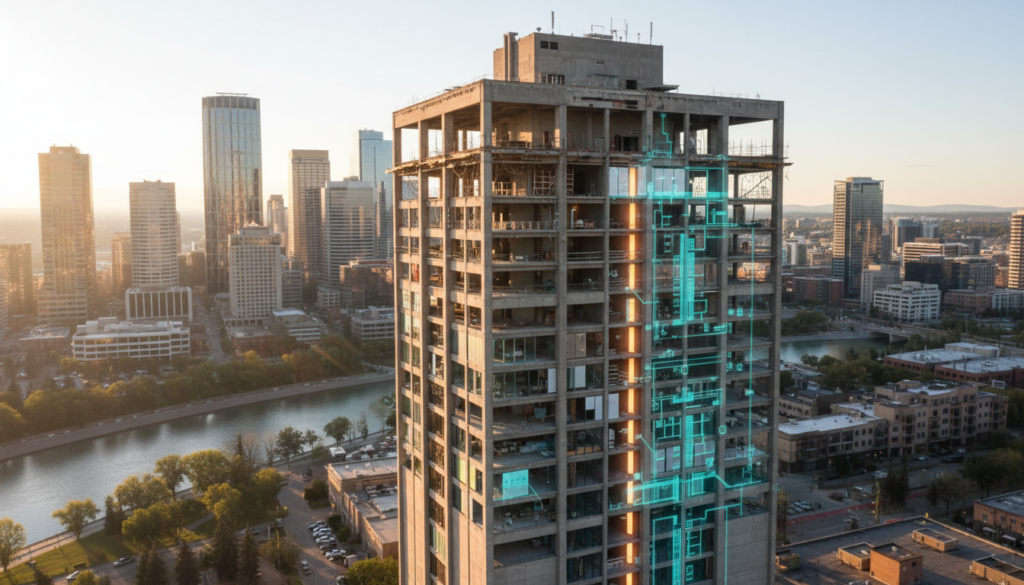

Walking through the core of downtown Calgary, one is struck by the towering monuments of glass, steel, and concrete that define the skyline. For decades, these structures were the undisputed engines of the Canadian energy sector, housing tens of thousands of corporate workers. However, structural shifts in the global energy market, compounded by the rise of remote work, left millions of square feet of this premium real estate entirely vacant. Today, a radical transformation is underway. Developers, backed by municipal incentives, are attempting a monumental feat of architectural alchemy: transforming hollowed-out commercial office towers into vibrant residential micro-apartments.
This is not merely a matter of erecting drywall and installing kitchen cabinets. It is a complex, high-stakes mathematical and engineering puzzle. This analysis pulls back the curtain on the structural, financial, and zoning realities facing developers in Alberta. We will explore why some of these ambitious projects successfully stabilize local rent inflation by injecting much-needed supply into the market, while others stall indefinitely, paralyzed by the hidden, exorbitant costs of plumbing and HVAC retrofitting.
The following economic facts are based on current Alberta provincial data and market trends.
The Genesis of the Empty Core and the Push for Residential
To understand the mechanics of commercial-to-residential conversions, one must first understand the historical context of Calgary’s real estate market. Following the oil price shock of late 2014, the city experienced a severe economic contraction. Energy companies downsized, consolidated, or shuttered entirely. This triggered a "flight to quality," where remaining businesses abandoned aging Class B and Class C office buildings in favor of highly amenitized, modern Class A towers.
By the early 2020s, downtown Calgary faced a commercial vacancy rate hovering near a staggering thirty percent. This represented roughly fourteen million square feet of empty space. Empty buildings generate lower property tax revenues, which shifts the municipal tax burden onto suburban homeowners. Furthermore, empty streets lead to a deterioration of the downtown social fabric.
In response, the City of Calgary launched the Downtown Development Incentive Program, offering developers a financial grant of seventy-five dollars per square foot to convert empty offices into residential units. While this subsidy is generous, the underlying math of the conversion process remains exceptionally rigorous.
The Structural Reality: Anatomy of an Office Tower
The fundamental challenge of converting an office building into an apartment complex lies in the fact that these structures were designed for fundamentally different human behaviors. Offices are designed for open-plan collaboration, centralized services, and daytime occupancy. Residential buildings require privacy, decentralized utilities, and twenty-four-hour life-safety systems.
The Floor Plate Dilemma
The most critical metric in a commercial conversion is the "core-to-window depth." This is the distance from the central elevator and utility core to the exterior glass of the building.
- Commercial Design: Office buildings typically feature massive floor plates with a core-to-window depth of forty to fifty feet. This allows for vast expanses of cubicles under artificial fluorescent lighting.
- Residential Design: Building codes mandate that every legal bedroom must have an operable window for natural light and emergency egress.
- The Conversion Challenge: If a developer attempts to place apartments in a building with a fifty-foot depth, they are left with a massive "dark interior" space near the core that cannot legally be used as a bedroom.
Successful conversions typically target older, 1960s and 1970s Class C buildings that feature narrower floor plates. When developers are forced to use buildings with deeper floor plates, they must often resort to expensive architectural interventions, such as cutting massive vertical courtyards directly through the center of the concrete building to create new internal windows.
The Plumbing Paradigm
Consider the plumbing infrastructure of a standard commercial floor.
- Centralized Wet Columns: Offices generally feature one men’s washroom and one women’s washroom clustered tightly around the central elevator core.
- Decentralized Residential Needs: A single floor converted into ten micro-apartments suddenly requires ten separate kitchens, ten full bathrooms, and ten in-suite laundry hookups.
To achieve this, engineers must core hundreds of new holes through the existing concrete floor slabs to run new water supply and sanitary drainage lines. This is a perilous process. Many Calgary office towers were built using post-tensioned concrete slabs. These slabs contain high-strength steel cables stretched to immense tension. If a drilling crew accidentally severs a post-tension cable while coring a new toilet drain, it compromises the structural integrity of the entire floor, leading to catastrophic repair costs and massive project delays.
[IMAGE: A minimalist vector illustration. Foreground: Stacks of raw building materials, copper plumbing pipes, and HVAC ducts arranged meticulously to resemble an ascending economic bar graph. Background: Faint, clean outlines of the Rocky Mountains. Lighting: Bright natural lighting casting soft, clean, educational shadows.]
HVAC and Climate Control Retrofitting
The heating, ventilation, and air conditioning systems represent another massive hurdle in the conversion equation.
- Commercial Systems: Office buildings usually utilize centralized Variable Air Volume systems or massive rooftop chillers. These systems treat the entire floor as a single climate zone, pushing vast amounts of air through large ceiling ducts.
- Residential Systems: Apartment tenants require individual climate control. One tenant may want their micro-apartment cooled to eighteen degrees Celsius, while their neighbor wants theirs heated to twenty-two degrees.
Developers must completely strip out the commercial HVAC infrastructure. They must install decentralized systems, such as individual heat pumps or four-pipe fan coil units, in every single apartment. Furthermore, residential units require separate exhaust venting for kitchen range hoods and bathroom humidity, requiring even more penetrations through the building envelope. The hidden costs of this mechanical retrofitting are often the primary reason why seemingly viable conversion projects stall out in the feasibility stage.
The Financial Equation: Subsidies, Costs, and Appraisals
To understand why developers take on these risks, we must examine the hard financial math. The City of Calgary’s incentive of seventy-five dollars per square foot is a vital catalyst, but it only covers a fraction of the total conversion cost.
A Hypothetical Financial Breakdown:
- Acquisition Cost: Empty Class C office buildings in Calgary can often be acquired at distressed pricing, sometimes as low as fifty to eighty dollars per square foot.
- Conversion Cost: The hard construction costs of demolition, asbestos abatement, structural coring, new plumbing, HVAC, and interior finishing typically range from two hundred and fifty to three hundred dollars per square foot.
- Total Investment: The developer is looking at a total basis of roughly three hundred to three hundred and eighty dollars per square foot.
With the municipal subsidy offsetting a portion of the construction costs, the developer’s net basis is lowered. If the finished residential building appraises at a value of four hundred to four hundred and fifty dollars per square foot based on projected rental income, the project is economically viable. However, if construction costs inflate due to supply chain issues, or if hidden structural problems are discovered during demolition, the profit margin evaporates instantly.
Navigating the Red Tape: Zoning and Building Codes
Before a single hammer swings, developers must navigate a labyrinth of municipal zoning laws and provincial building codes. A "Change of Use" permit triggers a requirement to bring an aging structure up to modern standards.
Life-Safety and Acoustic Upgrades
- Fire Separations: Commercial buildings have different fire rating requirements than residential buildings. Developers must install extensive fire-rated drywall assemblies between every single apartment unit to prevent the spread of flames.
- Sprinkler Systems: Existing commercial sprinkler grids must be entirely redesigned and relocated to match the new residential floor plans.
- Acoustic Insulation: Sound Transmission Class ratings are strictly enforced in residential developments. The concrete slabs of office buildings are excellent at transmitting impact noise. Developers must install specialized acoustic underlayments beneath the flooring of every unit to ensure tenants do not hear every footstep of the person living above them.
- Building Envelope: Many 1970s office towers feature single-pane glass or highly inefficient curtain walls. To meet modern energy codes and provide residential comfort, developers must often replace the entire exterior glass facade of the building, adding tens of millions of dollars to the project budget.

Market Impact: Rent Inflation and the Supply Squeeze
The ultimate goal of these engineering marvels is to address a pressing economic issue: Alberta’s housing supply shortage. Calgary has experienced a massive influx of interprovincial migration, driven by the province’s relatively lower cost of living and booming tech and energy sectors. This population surge has placed immense pressure on the local rental market, driving up rent inflation.
The Role of Micro-Apartments
Many commercial conversions focus on creating micro-apartments. These are highly efficient, small-footprint units ranging from three hundred and fifty to five hundred square feet.
- Target Demographic: These units cater specifically to young professionals, tech workers, and students who prioritize location and modern amenities over square footage.
- Density: By utilizing micro-apartment layouts, developers can maximize the unit yield of a converted floor plate, increasing their return on investment.
- Stabilizing Rents: By injecting thousands of new rental units directly into the downtown core, these conversion projects help to balance the supply-and-demand equation. While new builds are inherently expensive, increasing the aggregate housing supply is the most proven macroeconomic method for stabilizing long-term rent inflation across the broader municipal market.
Case Studies in Conversion: Triumphs and Pitfalls
The landscape of downtown Calgary provides real-time case studies of both the triumphs and the pitfalls of this real estate strategy.
The Blueprint for Success
Successful projects often share common characteristics. They typically involve buildings constructed prior to 1980, featuring narrow, rectangular floor plates. These buildings often have outdated, easily removable mechanical systems and lack complex post-tensioned concrete, making plumbing retrofits straightforward. Developers who succeed also engage in extensive pre-construction investigative work, utilizing ground-penetrating radar to map out concrete slabs before finalizing their architectural designs. By anticipating structural hurdles, they keep their financial models intact.
The Anatomy of a Stalled Project
Conversely, stalled projects serve as cautionary tales for the industry. These failures often involve newer, 1980s or 1990s buildings with massive, square floor plates. Developers who underestimate the cost of cutting internal courtyards to solve the "dark interior" problem quickly find their budgets exhausted. Furthermore, projects that uncover extensive, undocumented asbestos fireproofing during the demolition phase can face months of delays and millions of dollars in unbudgeted abatement costs. When the hard math of construction costs exceeds the projected appraisal value of the finished apartments, lenders pull their financing, and the building remains an empty shell.
[IMAGE: A cinematic 3D render in an educational style. Foreground: A transparent glass model of a city block showing internal residential units, complete with miniature plumbing and HVAC systems. Background: A sweeping, clean view of the Alberta foothills stretching to the horizon. Lighting: Bright natural lighting simulating high noon, emphasizing clarity and structure.]
The Long-Term Economic Outlook for Downtown Calgary
The conversion of commercial office towers into residential micro-apartments is more than just a real estate trend; it is a fundamental restructuring of the urban economy. The era of the monolithic, nine-to-five central business district is ending. In its place, municipal planners are trying to engineer a dynamic, twenty-four-hour neighborhood where people live, work, and consume locally.
When these conversions succeed, the economic multiplier effect is substantial. New residents attract new retail businesses, grocery stores, cafes, and entertainment venues to the ground floors of these buildings. This revitalizes the streetscape, increases public safety through increased foot traffic, and ultimately restores the property tax base, benefiting the entire province.
However, as the data clearly shows, this transformation is not guaranteed. It requires a delicate alignment of municipal policy, architectural ingenuity, and rigorous financial discipline. As developers continue to grapple with the hard math of floor plates, plumbing cores, and HVAC retrofits, the success of Calgary’s downtown revitalization will hinge on their ability to solve these complex structural equations. The buildings that once housed the corporate engines of the oil boom are slowly being rewired to house the workforce of Alberta’s future, one micro-apartment at a time.
Sources and References
- City of Calgary Downtown Strategy and Development Incentive Program Guidelines.
- CBRE Calgary Office Market and Vacancy Reports.
- Canada Mortgage and Housing Corporation Rental Market Reports.
- Alberta Real Estate Association Economic Trend Analysis.
- Provincial Building Code and Change of Use Regulations.