


The Alberta real estate landscape, long characterized by its “boom and bust” cycles, has entered a sophisticated and challenging new chapter. As we navigate the mid-point of 2026, the exuberant bidding wars and double-digit price appreciations of the 2024-2025 period have transitioned into a sobering period of consolidation. For a specific cohort of homeowners—those who entered the market at the height of the recent surge with minimum down payments—the term “negative equity” is no longer a theoretical risk discussed in textbooks; it is a balance sheet reality.
This guide serves as a comprehensive educational resource for homeowners, investors, and technical professionals looking to understand the mechanics of “underwater” mortgages in the Calgary and Edmonton markets, the macroeconomic drivers behind this shift, and the strategic pathways available to navigate this fiscal environment.
The following economic facts are based on current Alberta provincial data and market trends.
1. Understanding the 2024-2025 Peak: A Retrospective
To understand where we are in 2026, we must analyze the forces that drove the market to its recent zenith. The 2024-2025 period was marked by a “perfect storm” of economic factors that pushed Alberta’s housing prices to record highs.
The Migration Surge
Alberta experienced record-breaking interprovincial migration, primarily from Ontario and British Columbia. Driven by the “Alberta is Calling” campaign and a significant cost-of-living delta, thousands of buyers entered the Calgary and Edmonton markets with substantial equity from sold properties in the East and West. This influx created an artificial floor for prices that local wages struggled to support.
Supply Chain Lag and Inventory Scarcity
Post-pandemic supply chain issues lingered longer than anticipated in the construction sector. While housing starts were high, the completion time for new builds in suburban Calgary (e.g., Rangeview, Glacier Ridge) and Edmonton (e.g., River’s Edge) lagged behind demand. This scarcity led to “FOMO” (Fear Of Missing Out) buying, where purchasers frequently waived inspections and appraisals.
The Interest Rate Lag Effect
In 2024, many buyers were still utilizing rate holds or were under the impression that the Bank of Canada would aggressively cut rates by early 2025. When the “Higher for Longer” policy persisted, the cost of carrying these high-priced assets began to clash with household budgets.
2. The Mechanics of Negative Equity
Negative equity, colloquially known as being “underwater,” occurs when the outstanding balance of a mortgage loan exceeds the current market value of the property. For example, if a homeowner owes $520,000 on a home that is currently valued at $495,000, they possess $25,000 in negative equity.
The LTV Calculation
The Loan-to-Value (LTV) ratio is the primary metric used by lenders to assess risk.
- Initial LTV: A buyer with a 5% down payment starts with a 95% LTV.
- Market Correction: If the market value drops by 7%, and the principal has only been paid down by 1%, the LTV rises to 101%, triggering negative equity.
Why 2026 is the “Crunch Year”
The 2026 calendar year is significant because it represents the first major wave of renewals for those who took out short-term fixed rates or variable-rate mortgages during the 2023-2024 transition. As these terms expire, the combination of lower property valuations and higher interest rates creates a “double squeeze” on liquidity.
3. Calgary vs. Edmonton: A Comparative Analysis

While both cities are experiencing the cooling effect, the localized impact of negative equity varies significantly due to different economic drivers and inventory levels.
Calgary: The High-Volatility Hub
Calgary’s market is heavily influenced by the corporate energy sector and its status as a secondary tech hub.
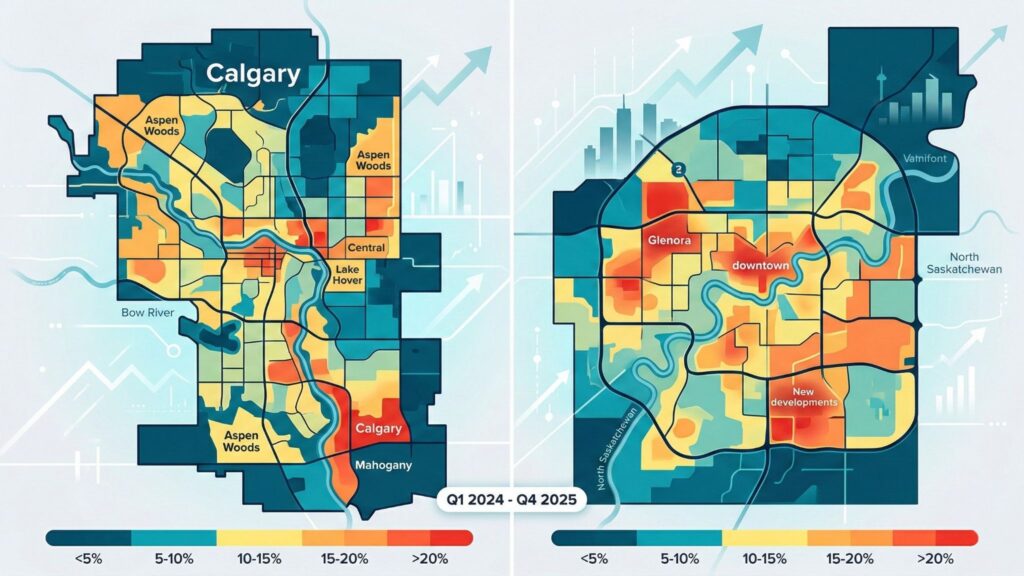
- The Detached Sector: Areas like Mahogany and Aspen Woods saw some of the highest price surges. Homeowners who bought detached properties at $850,000+ with low down payments are the most vulnerable to a 5-8% market correction.
- The Condo Market: Unlike the 2014 crash, the Calgary condo market remained relatively resilient in 2025 due to its affordability compared to detached homes. However, oversupply in the Beltline is starting to exert downward pressure on prices in 2026.
Edmonton: The Stability Play
Edmonton has historically been more affordable and less volatile than Calgary.
- The Infill Market: Significant development in mature neighborhoods (e.g., Glenora, Bonnie Doon) has led to a localized surplus of high-end skinny homes. This specific segment is seeing the most significant “underwater” occurrences in the city.
- Public Sector Influence: With a large portion of the workforce in healthcare, education, and government, Edmonton’s demand is more stable, meaning price drops are often shallower (3-5%) compared to Calgary’s more aggressive swings.
4. The Macroeconomic Backdrop: “Higher for Longer”
The primary catalyst for the 2026 equity crunch is the persistence of elevated interest rates. Central banks have maintained a restrictive stance to combat “sticky” inflation in service sectors and housing costs themselves.
The Yield Curve and Mortgage Pricing
In 2026, the 5-year Government of Canada bond yield remains elevated, keeping fixed-rate mortgages significantly higher than the 2-3% range seen in the early 2020s. For a homeowner renewing in 2026 who originally signed in 2021, the monthly payment increase can range from $600 to $1,200, depending on the principal.
Alberta’s Employment Landscape
While the energy sector remains profitable, it has become “capital intensive” rather than “labor intensive.” Automation and efficiency in the oil sands mean that high oil prices no longer trigger the massive hiring sprees of the early 2000s. Consequently, wage growth in Alberta has not fully kept pace with the increased cost of debt servicing.
5. Strategic Navigation for the “Underwater” Homeowner
If you find yourself with negative equity in 2026, it is crucial to move from emotional reaction to technical financial management. Negative equity is only a realized loss if you sell the property.

Option 1: The “Hunker Down” Strategy (Time Arbitrage)
Real estate is a long-term asset. Historically, Alberta markets recover over 7-10 year cycles.
- Action: Continue making payments and focus on principal reduction.
- Benefit: Avoids the crystallization of losses and the high costs of selling (commissions, legal fees).
Option 2: Accelerated Principal Payments
If cash flow allows, increasing your monthly payment or making annual lump-sum contributions can bridge the equity gap.
- The Math: A $10,000 lump sum payment on a $500,000 mortgage doesn’t just reduce debt; it effectively “buys back” 2% of your equity, potentially moving you out of negative territory.
Option 3: Strategic Rental Transition
If you must move for work (e.g., a move from Edmonton to Fort McMurray), consider renting out the property rather than selling at a loss.
- The “Cash Flow Neutral” Goal: In 2026, Alberta’s rental market remains tight due to high interest rates keeping people out of homeownership. You may be able to cover the mortgage, taxes, and insurance through rental income, allowing the tenant to pay down your principal until the market recovers.
Option 4: The “Jingle Mail” Myth vs. Reality
In the 1980s, Albertans famously mailed their keys back to the bank (“Jingle Mail”). In 2026, this is a dangerous path.
- Technical Note: Most mortgages in Alberta are “recourse” loans unless they are CMHC-insured high-ratio mortgages. Even with CMHC insurance, a strategic default will devastate your credit score for 7+ years and may lead to legal judgments for the deficiency.
6. Technical Insights for Investors and Engineers
For those looking at the market through an analytical lens, negative equity in the residential sector creates unique opportunities and risks.
Cap Rate Compression and Expansion
Investors who bought in 2024 at 4% cap rates are finding that their cost of capital (mortgage interest) now exceeds their cap rate. This “negative carry” is forcing some investors to liquidate, further increasing inventory and putting downward pressure on prices.
The Maintenance Trap
When equity is negative, homeowners are less likely to invest in capital improvements (roofing, HVAC, windows). For technical engineers and home inspectors, this means that properties sold in the 2027-2028 period may show signs of “deferred maintenance.”
Valuation Modeling
Professional appraisers in Calgary are now placing higher weight on “Income Approach” valuations even for residential properties, as the “Comparable Sales” approach is skewed by distressed sales and low volume.
7. The Psychological Impact: Market Sentiment in 2026
Economics is as much about psychology as it is about math. The “Wealth Effect” is currently reversing in Alberta. When home values were rising, Albertans felt wealthier and spent more on discretionary items (new trucks, travel, renovations). In 2026, the “Negative Wealth Effect” is leading to a contraction in local consumer spending, which in turn impacts the broader provincial economy.
8. Historical Context: Is This 1982 All Over Again?
Many long-time Albertans draw parallels to the 1982 crash following the National Energy Program (NEP). However, the 2026 context is fundamentally different:
1.Diversification: Alberta’s economy is more diversified into tech, aviation, and hydrogen than it was in the 80s.
2.Banking Regulations: Stress testing (B-20 guidelines) ensured that most buyers had a buffer, even if that buffer is now being fully utilized.
3.Population Growth: Unlike the 80s, people are still moving to Alberta for the lower cost of living relative to Vancouver and Toronto, providing a “soft landing” floor for housing demand.
9. Conclusion: The Path Forward

Negative equity is a challenging phase of the economic cycle, but it is not a permanent state. For the 2026 homeowner in Calgary or Edmonton, the key to financial survival is liquidity management and patience. By understanding the macroeconomic forces at play—from the Bank of Canada’s terminal rates to provincial migration patterns—Albertans can make informed decisions that protect their long-term financial health.
The “Alberta Advantage” has always been rooted in resilience. While the 2024-2025 boom created an equity bubble for some, the underlying fundamentals of the province remain strong. As we look toward the late 2020s, the market will likely return to a state of equilibrium, rewarding those who had the foresight to weather the current storm.
Sources and References
1.Alberta Real Estate Association (AREA): 2025-2026 Quarterly Market Reports.
2.Bank of Canada: Monetary Policy Reports (January 2026 Update).
3.Statistics Canada: Interprovincial Migration Data, Alberta (2024-2025).
4.CMHC (Canada Mortgage and Housing Corporation): Housing Market Outlook – Prairie Region.
5.Calgary Real Estate Board (CREB): Historical Price Index Data.
6.University of Calgary School of Public Policy: Research on Alberta’s Economic Diversification and Housing Affordability.
7.Government of Alberta: Treasury Board and Finance Economic Outlook.