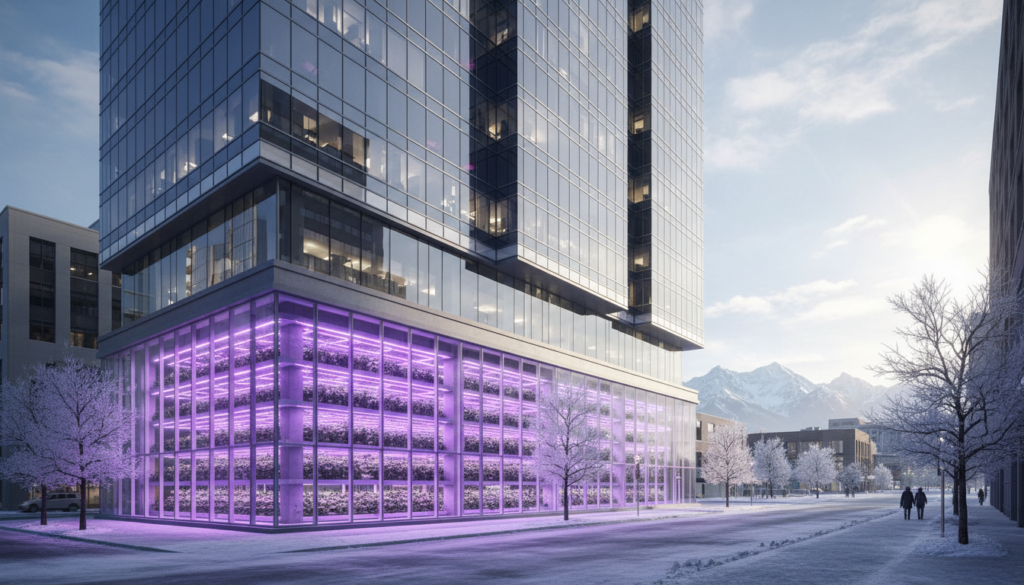

It is mid-January in Calgary, Alberta. The temperature outside has plummeted to a bone-chilling minus thirty degrees Celsius, and the sprawling agricultural fields surrounding the city are buried under a thick blanket of snow. Yet, deep beneath the concrete sidewalks, inside a repurposed underground parkade, the climate is a balmy twenty-two degrees. Here, thousands of heads of butterhead lettuce, vibrant basil, and nutrient-dense microgreens are thriving under the precise glow of specialized light-emitting diodes.
This is not a science fiction scenario; it is the new frontier of Alberta’s commercial real estate and agricultural sectors. As a direct sequel to the recent “Cubicles to Condos” phenomenon—which saw millions of square feet of vacant office space transformed into residential units—a new wave of entrepreneurs is targeting the spaces that residential developers left behind. The windowless interior rooms, the abandoned server floors, and the subterranean parking garages are being reborn as high-tech, high-yield vertical farms. For potential investors, business owners, and technical engineers looking at the Alberta market, this intersection of distressed real estate and advanced agricultural technology presents a fascinating, multi-layered economic opportunity.
The following economic facts are based on current Alberta provincial data and market trends.
The Core Problem: Alberta’s Agricultural Paradox
To understand the economic driver behind urban vertical farming in Alberta, one must first examine the province’s fundamental agricultural paradox. Alberta boasts some of the most vast and productive farmland in North America. However, the province is severely constrained by its climate. The traditional growing season in the Calgary-Edmonton corridor is notoriously short, offering a frost-free window of merely one hundred to one hundred and twenty days.
Consequently, for eight months of the year, Alberta relies almost entirely on complex, thousands-of-kilometers-long supply chains to import fresh produce from California, Arizona, and Mexico.
The Cost of the Supply Chain
This heavy reliance on imports creates significant economic and logistical vulnerabilities:
- Price Volatility: Droughts in the Colorado River basin and atmospheric rivers in British Columbia have historically caused the retail price of imported leafy greens to spike dramatically, sometimes exceeding eight dollars for a single head of romaine.
- Shrinkage and Spoilage: Transporting delicate greens across the continent results in a high rate of product loss—often referred to as “shrink”—which is ultimately priced into the consumer’s grocery bill.
- Carbon Footprint: The diesel fuel required to transport low-calorie, high-water-content vegetables across thousands of miles represents an enormous environmental and economic cost.
By shifting production to the urban core, vertical farming aims to collapse this massive supply chain, offering “Calgary-Grown” greens year-round while insulating the local market from macroeconomic shocks and climate events occurring thousands of miles away.
The Spatial Arbitrage: Capitalizing on the “Unleasable”
The “Cubicles to Condos” trend has been highly successful in absorbing excess vacancy in Calgary’s downtown core, but it has a distinct structural limitation. Residential building codes require bedrooms and living spaces to have access to natural light and operable windows.
Many of Calgary’s office towers, built during the oil booms of the 1970s and 1980s, feature massive, deep floor plates. When developers convert the perimeter of these floors into apartments, they are often left with a dark, cavernous interior core. Furthermore, as remote work reduces the daily commuter influx, multi-level underground parking garages find themselves operating at fractional capacity.
The Real Estate Equation
For commercial landlords, these windowless cores and empty parkades are effectively “dead zones” generating zero revenue. This dynamic creates a unique opportunity for spatial arbitrage.
- Discounted Lease Rates: Because vertical farms do not require windows, street-level foot traffic, or premium aesthetics, operators can negotiate commercial leases at deeply discounted rates—often fractions of what traditional retail or office tenants would pay.
- Symbiotic Infrastructure: Deep underground spaces are naturally insulated by the surrounding earth. This geothermal buffering significantly reduces the heating costs during Alberta’s harsh winters and the cooling costs during the summer, creating a naturally stable ambient baseline for controlled environment agriculture.
The Mechanics of Controlled Environment Agriculture (CEA)
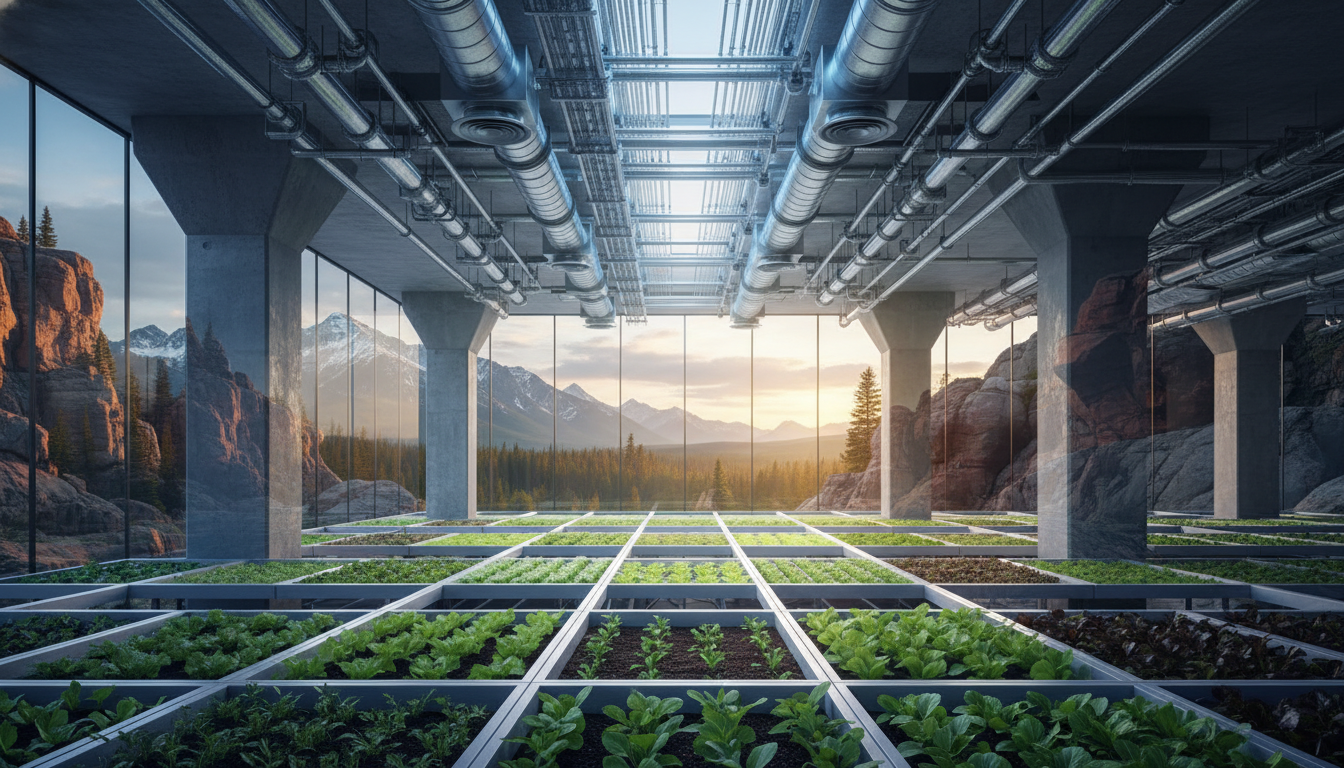
For technical engineers and prospective investors, understanding the viability of these concrete canopies requires a deep dive into the mechanics of Controlled Environment Agriculture (CEA). Moving a farm indoors is an exercise in complex industrial engineering.
Hydroponics and Aeroponics
Unlike traditional soil farming, urban vertical farms primarily utilize hydroponic or aeroponic systems.
- Hydroponics: Plant roots are submerged in a continuously circulating, nutrient-rich water solution.
- Aeroponics: Plant roots are suspended in the air and periodically misted with a precise nutrient fog.
Both methods use up to ninety percent less water than traditional field agriculture. In Southern Alberta, a region that frequently faces summer drought conditions and strict water allocation limits, this exceptional water efficiency is a major economic and regulatory advantage.
Managing the Microclimate: HVAC and Thermodynamics
The most critical engineering challenge in vertical farming is not the plumbing, but the air. Plants constantly transpire, releasing massive amounts of water vapor into the air.
- Latent Heat Load: Engineers must design robust Heating, Ventilation, and Air Conditioning (HVAC) systems capable of handling massive latent heat loads (humidity) to prevent mold, mildew, and crop failure.
- Sensible Heat Load: Simultaneously, the thousands of LED lights required to simulate the sun generate sensible heat.
The economic success of a facility hinges on the energy-efficient management of these thermal dynamics. Advanced facilities utilize sophisticated heat recovery ventilators and desiccant dehumidification systems to recapture the transpired water, clean it, and cycle it back into the irrigation system, creating a nearly closed-loop ecosystem.
The Economic Blueprint: CapEx vs. OpEx
To evaluate the long-term growth mechanics of urban farming in Alberta, investors must meticulously analyze the Capital Expenditures (CapEx) and Operating Expenditures (OpEx).
The Capital Expenditure (CapEx) Barrier
Building a high-tech vertical farm is highly capital intensive. The buildout costs for commercial-scale CEA facilities can range from one hundred and fifty dollars to over three hundred dollars per square foot.
- Lighting Systems: High-efficiency, spectrum-tunable LED arrays.
- Racking: Automated, multi-tiered aluminum racking systems.
- Climate Control: Industrial-grade HVAC and fertigation (fertilizer + irrigation) dosing computers.
To overcome these high initial barriers, many Alberta entrepreneurs are leveraging provincial grants through agencies like Alberta Innovates, which fund agricultural technology and economic diversification initiatives.
The Operating Expenditure (OpEx) Challenge
Once operational, the economics shift to managing monthly overhead.
- Labor: Historically, vertical farming has been labor-intensive (planting, harvesting, packaging). However, the industry is rapidly adopting robotics and computer vision to automate these tasks, driving down long-term labor costs. Furthermore, Alberta’s talent pool of former oil and gas process engineers and instrumentation technicians translates perfectly into the automated systems management required for CEA.
- Electricity: This is the most critical OpEx variable. Plants require massive amounts of photons to grow. Because Alberta operates a deregulated electricity market, power prices can fluctuate. To maintain profitability, operators often negotiate long-term Power Purchase Agreements (PPAs) to lock in rates, or they run their lighting cycles during off-peak nighttime hours when electricity grid demand—and cost—is at its lowest.
Market Demand: The “Calgary-Grown” Premium
Even with optimized engineering and cheap real estate, vertical farms must sell their product at a price point that supports their CapEx and OpEx. Fortunately, the market demand for premium, locally grown produce is robust.
The Revenue Model
Vertical farms cannot compete on price with massive outdoor farms growing low-margin crops like potatoes, wheat, or iceberg lettuce. Instead, the economic model relies on high-margin, highly perishable crops.
- Microgreens and Herbs: Crops like basil, cilantro, and specialized microgreens command premium prices per ounce and have very fast growth cycles (often just two to three weeks from seed to harvest).
- Leafy Greens: Arugula, kale, and specialized butterhead lettuces.
While a traditional Alberta farm might achieve one harvest per year, a climate-controlled vertical farm can achieve fifteen to twenty harvests annually.
Consumer and B2B Willingness to Pay
Consumers and local businesses are willing to pay a premium for this “Calgary-Grown” produce for several reasons:
- Hyper-Freshness: Produce can be harvested in the morning and plated at a downtown restaurant by the afternoon, offering vastly superior taste and nutritional value compared to greens that have spent a week in a refrigerated transport truck.
- Pesticide-Free: Because the environment is sealed and controlled, there is no need for chemical pesticides or herbicides.
- Supply Chain Resilience: Restaurants and grocery chains are increasingly eager to sign off-take agreements with local vertical farms to guarantee a consistent, year-round supply of greens at a fixed price, shielding themselves from the volatility of the import market.
Policy, Zoning, and the Regulatory Horizon
For this sector to scale, municipal policy must keep pace with technological innovation. The City of Calgary has recognized the potential of urban agriculture and is actively working to streamline the regulatory process.
Navigating the Building Code
Transforming an office or a parkade into an agricultural facility involves navigating complex change-of-use permits. The building code historically did not have a classification for “indoor high-tech farm.”
Municipal planners are now adapting, creating clearer pathways for zoning approvals, fire code compliance, and structural load assessments (water is incredibly heavy, and engineers must ensure office floor plates can support the weight of commercial hydroponic vats).
The ESG Advantage for Landlords
For large institutional real estate owners, leasing dead space to a vertical farm offers a massive Environmental, Social, and Governance (ESG) advantage. Some advanced setups are exploring circular economies within the building itself. For example, the excess heat generated by the vertical farm’s LED lights can be captured and routed into the office tower’s primary heating system, lowering the overall natural gas consumption and carbon footprint of the entire skyscraper.
[IMAGE: A clean isometric view of a futuristic HVAC and water filtration system. Foreground: polished steel pipes, water tanks, and glowing digital control panels. Background: a stark, minimal concrete wall. Lighting: bright natural lighting casting sharp, educational architectural shadows.]
Scaling Up: The Future of Alberta’s Concrete Canopies
The transformation of repurposed urban spaces into vertical farms is more than just a clever use of vacant real estate; it is a vital step toward economic diversification and food security in Alberta.
While the industry faces undeniable hurdles—most notably the high capital costs of entry and the ongoing management of electrical operating expenses—the underlying mechanics are sound. By leveraging deeply discounted, structurally obsolete real estate, integrating advanced process engineering from the energy sector, and capitalizing on the consumer demand for hyper-local food, Alberta’s urban farmers are building a resilient new industry.
As automation technology becomes cheaper and more accessible, and as climate change continues to disrupt traditional outdoor agriculture in the southern latitudes, the economic viability of indoor farming will only strengthen. The concrete canopies beneath Calgary’s streets are proving that with the right application of capital and engineering, the province’s short growing season is no longer a limitation, but an invitation to innovate.
Sources and References
- Alberta Agriculture and Irrigation: Provincial data on traditional crop yields, frost-free days, and agricultural import statistics.
- Calgary Economic Development: Reports on downtown commercial real estate vacancy rates, adaptive reuse initiatives, and the “Downtown Development Incentive Program.”
- Alberta Electric System Operator (AESO): Historical data on wholesale electricity pool prices and off-peak demand trends.
- Alberta Innovates: Documentation regarding provincial grant funding for agri-food innovation and controlled environment agriculture technologies.