


In the shadow of the Rocky Mountains, a quiet but profound shift is occurring within the checkout aisles and digital shopping carts of Wildrose Country. For decades, the Alberta economy was defined by its outward-facing nature—exporting energy to the world and importing virtually everything else from the lowest-cost global provider. However, the tides of globalization are receding, replaced by a robust, provincial protectionism driven not by government mandate, but by the conscious choices of the Alberta consumer. Recent data indicates that nearly 80% of Albertans are now prioritizing local goods over imports, even when faced with a “support local” premium. This transition represents more than a sentimental preference; it is a strategic response to global trade volatility and a fundamental reimagining of the provincial supply chain.
The following economic facts are based on current Alberta provincial data and market trends.
I. The Macroeconomic Catalyst: From Globalization to Localization
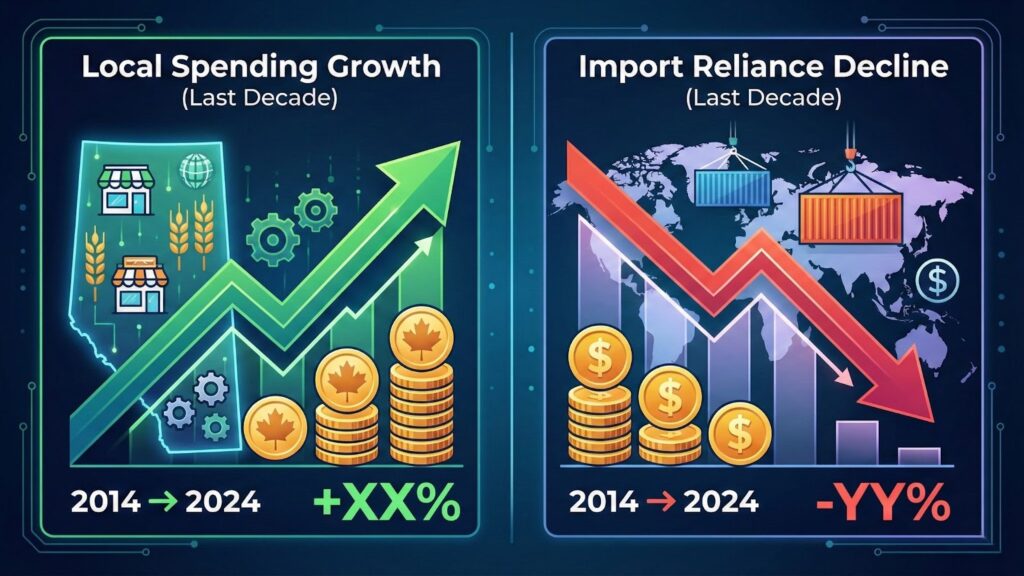
To understand why an Edmontonian is willing to pay 15% more for a locally processed jar of honey or a Calgarian is opting for a domestically manufactured winter parka, one must first examine the breakdown of the global “just-in-time” delivery model.
1. The Volatility of International Trade
Over the last five years, Alberta businesses have faced unprecedented disruptions. From the logistical bottlenecks of the post-pandemic era to the geopolitical tensions affecting shipping lanes in the Red Sea and the volatility of North American trade agreements, the “cheap import” has become increasingly unreliable. When a shipment of components is delayed by six months, the “low cost” is negated by the loss of business continuity.
2. Inflation and the Currency Hedge
While inflation has impacted all sectors, the cost of importing goods is often tethered to the strength of the Canadian Dollar (CAD) against the US Dollar (USD). By sourcing locally, Alberta businesses and consumers create a natural hedge against currency fluctuations. Buying Canadian means the price on the tag isn’t subject to the whims of the forex market to the same degree as an imported item from a foreign manufacturing hub.
II. The 80% Shift: Analyzing the Alberta Consumer Sentiment
Recent surveys and retail data suggest that 78.4% of Albertans intentionally seek out “Made in Canada” or “Made in Alberta” labels. This is not merely a trend among the “elite” or high-income brackets; it is a cross-demographic movement.
Demographic Breakdown of Local Support:
- The Urban Millennial/Gen Z: Driven by sustainability and the carbon footprint of long-range shipping.
- The Rural Consumer: Driven by community survival and the preservation of local agricultural legacies.
- The Industrial Sector: Procurement officers in the oil patch and construction firms are increasingly looking for local fabricators to ensure “on-time” delivery, prioritizing reliability over the lowest bid.
III. Case Study: Calgary’s Boutique Manufacturing Renaissance
Calgary, traditionally known as the corporate head office of Canada’s energy sector, is seeing a surge in “micro-manufacturing.” Nowhere is this more evident than in the apparel and textile industry.
The Challenge of Higher Inputs
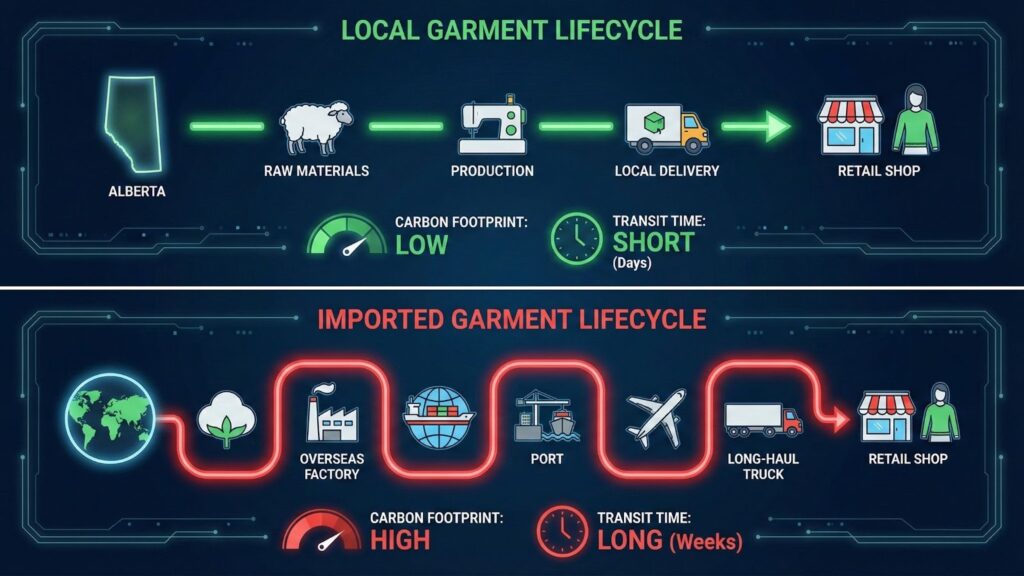
For a Calgary-based clothing brand, the cost of labor and energy is significantly higher than in Southeast Asian manufacturing hubs. However, these businesses are surviving—and thriving—through Community Loyalty and Niche Quality.
1.Transparency as a Product: Local brands use their “Made in Calgary” status as a transparency tool. Consumers can see the factory, meet the makers, and verify ethical standards.
2.Agile Design: Local manufacturers can pivot their designs in weeks, whereas large-scale importers must plan seasons in advance. This agility allows Calgary businesses to respond to local trends and weather patterns (e.g., a sudden cold snap) faster than global competitors.
IV. Case Study: Edmonton’s Agri-Food Powerhouse
Edmonton and its surrounding municipalities have become the epicenter of value-added food processing. Historically, Alberta exported raw commodities (wheat, cattle) and imported processed goods (bread, packaged beef). Today, the “Support Local” movement is flipping this script.
Survival Through Vertical Integration
Edmonton-based food processors are mitigating higher costs by:
- Direct Sourcing: Bypassing international commodity brokers to buy directly from Alberta farmers.
- Circular Economies: Using waste products from one process (e.g., spent grain from a brewery) as input for another (e.g., artisanal sourdough or livestock feed).
The “Premium” paid by the consumer at an Edmonton grocery store for local beef or flour directly funds the expansion of these facilities, creating a feedback loop of provincial wealth.
V. Explaining the “Support Local” Premium: An Educational Breakdown
Why does it cost more to buy local? As an economic analyst, it is vital to explain the mechanics of this price difference so investors and consumers understand what they are “buying” with that extra 10-20%.
1. The Scale Disadvantage
Global corporations benefit from “Economies of Scale.” When you produce 10 million units, the cost per unit drops. An Alberta firm producing 10,000 units cannot compete on raw price.
2. Fair Wage Standards
Alberta has some of the highest labor standards and minimum wages in North America. The premium reflects the “living wage” paid to the Albertan neighbor who manufactured the product.
3. Regulatory Compliance
Canadian environmental and safety regulations are rigorous. Buying local is a guarantee that the product was made under strict environmental oversight, which carries an inherent cost.
4. The Multiplier Effect (The “Hidden” Discount)
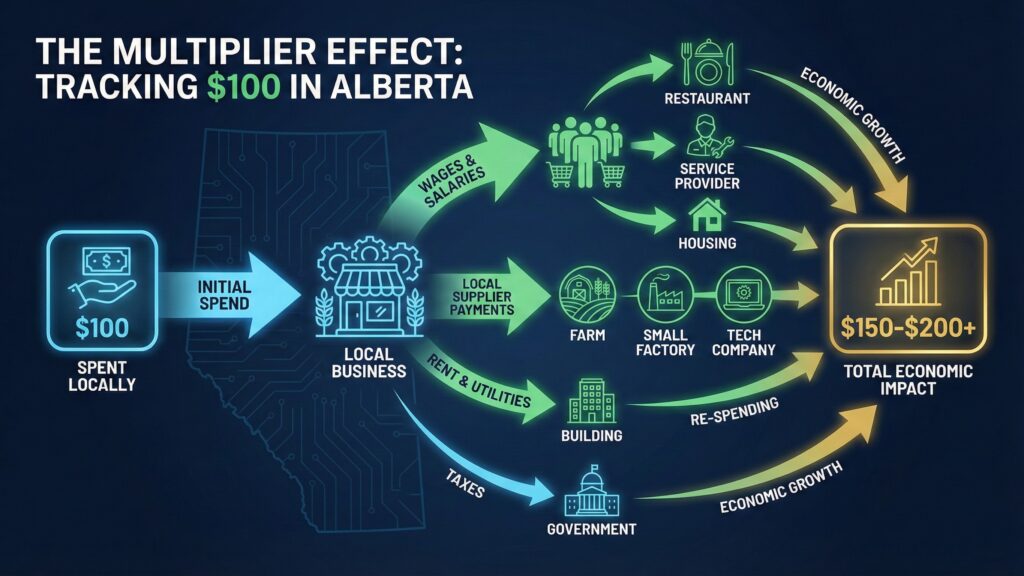
This is the most critical educational point. For every $100 spent at a local Alberta business, approximately $45 to $60 stays within the provincial economy. In contrast, $100 spent at a multinational big-box retailer or an international online marketplace may leave as little as $14 in the local economy.
The Multiplier Equation:
- Direct Impact: The business owner’s profit and employee wages.
- Indirect Impact: The business buying local accounting, legal, and cleaning services.
- Induced Impact: The employees spending their wages at other local shops.
VI. The Role of Technology in Local Resilience
The “Support Local” movement would not be sustainable without the integration of modern technology. Alberta’s tech sector is developing tools that allow small businesses to bridge the gap with global giants.
- Localized E-commerce Platforms: Tools that allow Edmonton and Calgary retailers to offer “same-day local delivery” that rivals the speed of major global platforms.
- Blockchain for Traceability: Local food processors are using blockchain to prove the provenance of their ingredients, justifying the premium price through verified “Alberta-grown” data.
- AI-Driven Inventory: Small businesses are using AI to predict local demand, reducing the waste that often kills small-scale margins.
VII. Risks and Challenges: The Skeptic’s Corner
While the 80% prioritization is a positive indicator for provincial resilience, several risks remain:
- The “Elasticity” of Demand: If inflation continues to outpace wage growth, the “Support Local” premium may become a luxury few can afford. There is a “breaking point” where even the most loyal consumer must choose the cheaper import.
- Labor Shortages: Alberta’s success is often its own enemy. High demand for labor in the energy sector can drive up wages so high that local manufacturers cannot find staff, forcing them to raise prices further.
VIII. How to Invest in the “Local Premium” (A Guide for Business Owners)
For entrepreneurs looking to capitalize on this 80% consumer preference, the strategy must be more than just putting a maple leaf on the box.
1.Focus on “Import Substitution”: Identify a product that is currently 100% imported but could be made here using Alberta’s raw materials (e.g., hemp-based building materials or specialized oilfield chemicals).
2.Lean into the Narrative: Education is part of the product. Tell the story of the supply chain.
3.Collaborate, Don’t Just Compete: Form “Local Clusters” where multiple businesses share shipping or marketing costs to reduce the overhead that creates the premium.
IX. Conclusion: The New Alberta Economic Identity
The shift toward buying Canadian and supporting local is not a temporary reaction to a pandemic or a trade war. It is the maturation of the Alberta economy. By prioritizing the “Support Local” premium, Albertans are essentially buying “Economic Insurance.” They are ensuring that when the next global supply chain crisis hits, the province has the internal capacity to feed, clothe, and provide for itself.
As we move toward the middle of the decade, the strength of the Alberta economy will be measured not just by the volume of oil we ship out, but by the resilience of the local networks we build within our own borders.
Sources and References
- Statistics Canada: Consumer Price Index and Retail Trade Reports (Alberta Focus).
- ATB Financial Economics: The Alberta Economic Outlook 2024.
- Calgary Chamber of Commerce: Small Business Impact Study.
- University of Alberta – Department of Resource Economics: The Multiplier Effect in Regional Agri-Food Systems.
- Alberta Economic Development and Trade: Provincial Import/Export Data (2020-2023).



it explains why more Albertans are choosing Canadian-made products, even at higher prices, because of trust, local economic support, and growing concerns about global supply chain uncertainty.