

Introduction: The Silicon Prairie Awakens
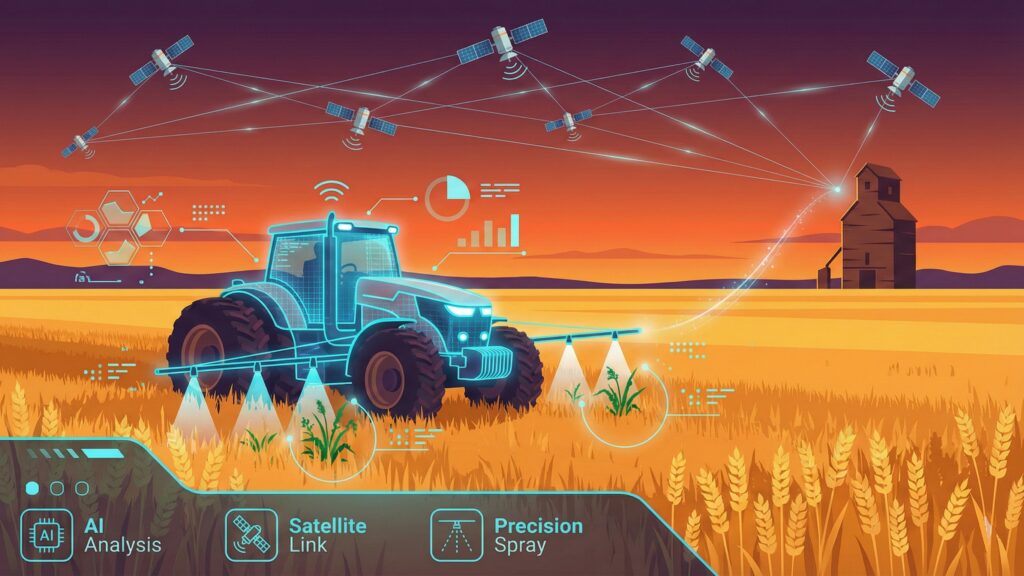
For over a century, the silhouette of the Alberta grain elevator stood as the lone sentinel of the Canadian prairies—a symbol of a rugged, manual industry dictated by the whims of the weather and the grit of the producer. However, as we move into 2026, the horizon of the Alberta Grain Belt is being redefined. The hum of a tractor is no longer just the sound of internal combustion; it is the sound of a mobile data center processing terabytes of information in real-time.
In Southern Alberta, from the irrigation districts of Lethbridge to the vast dryland stretches near Medicine Hat, a technological revolution is unfolding. Driven by necessity—rising input costs, labor shortages, and climate volatility—Alberta’s farmers are pivoting toward “Precision Agriculture.” This isn’t merely the adoption of new gadgets; it is a fundamental shift in the economic engine of the province. By integrating Artificial Intelligence (AI), satellite constellations, and autonomous robotics, the “Texas of the North” is rapidly becoming the “Silicon Valley of Ag-Tech.”
This article explores the mechanics of this transition, the economic ripples felt across the province, and why 2026 marks the definitive tipping point for AI in the Alberta Grain Belt.
The following economic facts are based on current Alberta provincial data and market trends.
1. The 2026 Pivot: Why Agri-Tech is Surging Now
The year 2026 has emerged as a landmark date for Alberta’s agricultural sector. Several converging factors have moved AI from a “luxury experiment” to a “commercial necessity.”
The Convergence of 5G and Low-Earth Orbit (LEO) Satellites
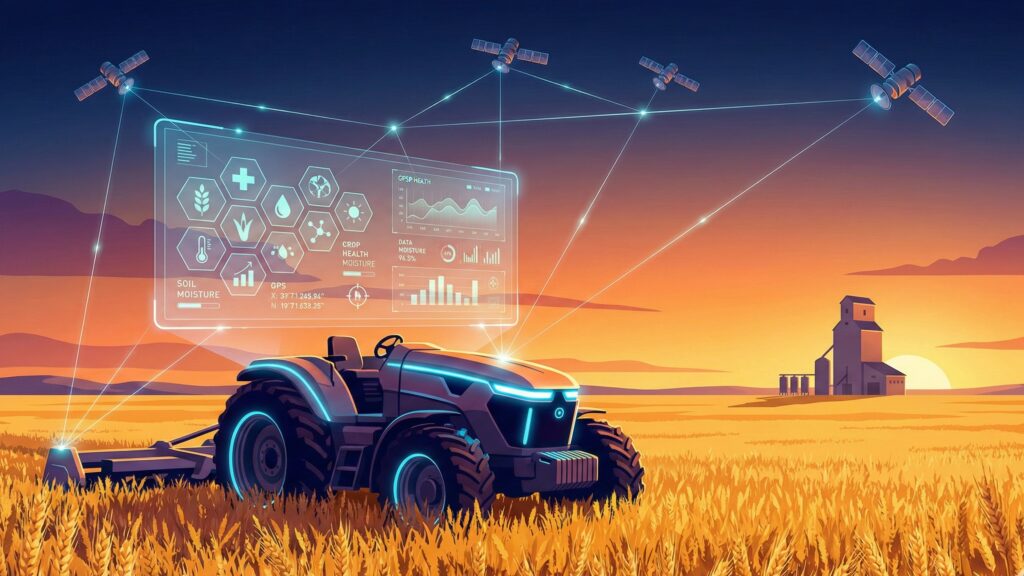
Historically, the greatest barrier to high-tech farming in rural Alberta was the “digital divide.” Massive swaths of the Grain Belt suffered from “dead zones” where data transmission was impossible. By 2026, the maturation of LEO satellite clusters (such as Starlink and its competitors) and the provincial government’s “Alberta Broadband Strategy” have effectively eliminated these gaps. Real-time data streaming from a combine in the middle of a 2,000-acre field is now a reality.
The Economic Pressure Cooker
Input costs—specifically fertilizer, fuel, and specialized herbicides—have seen significant volatility over the last five years. Alberta producers, who operate on thin margins, have realized that “blanket application” (spraying an entire field uniformly) is no longer economically viable. Precision is the only path to profitability.
2. The Mechanics of Precision: Satellite Data and GIS
At the heart of precision agriculture is the ability to see what the human eye cannot. Alberta farmers are now utilizing a multi-layered approach to field management.
Multispectral Imaging
Satellites equipped with multispectral sensors capture data across different wavelengths, including near-infrared (NIR). This allows for the calculation of the Normalized Difference Vegetation Index (NDVI).
- How it works: Healthy plants reflect more NIR light. By analyzing these maps, an AI can identify areas of a crop that are under “stress” (due to pests, drought, or nutrient deficiency) weeks before the damage is visible to a farmer walking the field.
- Economic Impact: Early detection allows for “surgical” intervention, preventing total crop loss and reducing the need for broad-spectrum chemical applications.
Geographic Information Systems (GIS) Integration
GIS technology allows farmers to create “prescription maps.” These digital maps divide a single field into thousands of small zones, each with a specific data profile regarding soil pH, moisture levels, and historical yield.
1.Soil Mapping: High-resolution sensors pulled by ATVs map the electrical conductivity of the soil.
2.Data Layering: The AI overlays satellite health data with soil maps to determine exactly how much nitrogen or phosphorus is needed in a specific square meter.
3.Variable Rate Technology (VRT): This data is fed into the tractor’s onboard computer, which automatically adjusts the flow of the air seeder or sprayer in real-time.
3. AI-Driven Robotics: The Rise of “See-and-Spray”
The most significant technological leap in Southern Alberta in 2026 is the widespread adoption of AI-driven “precision spraying” robotics.
Green-on-Green Detection
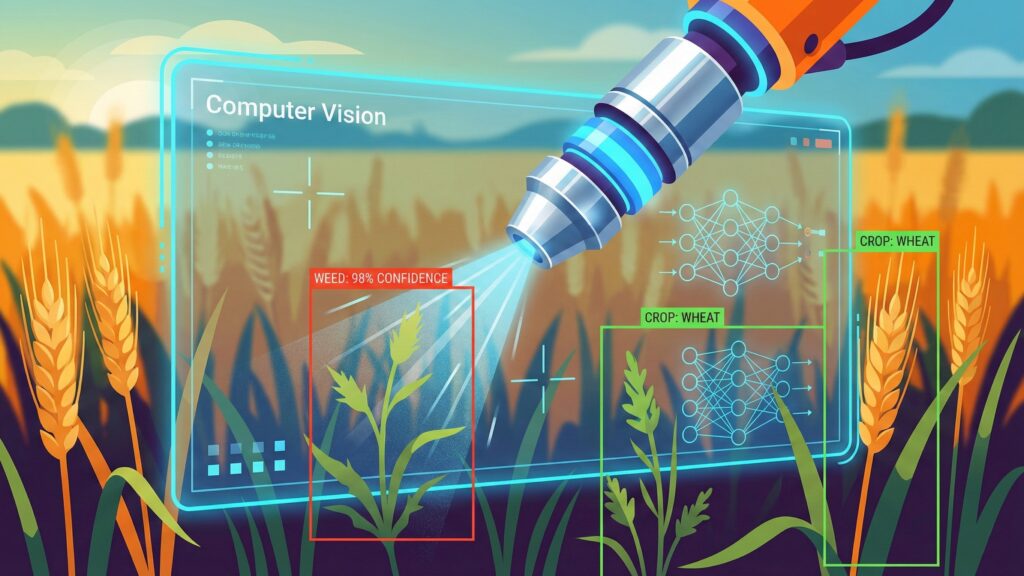
In the past, “See-and-Spray” technology was limited to “Green-on-Brown”—detecting a green weed on bare soil. The new generation of AI models, trained on millions of images of Alberta-specific crops (like canola, durum wheat, and pulses), can now perform “Green-on-Green” detection.
- The Process: High-speed cameras mounted on 120-foot sprayer booms scan the ground at 20 mph.
- The AI: Convolutional Neural Networks (CNNs) identify the difference between a wheat leaf and a Canada Thistle leaf in milliseconds.
- The Action: Only the nozzle directly above the weed fires.
Economic and Environmental Benefits
The shift from blanket spraying to precision spraying is a game-changer for the Alberta Grain Belt:
- Chemical Reduction: Farmers report a 60% to 80% reduction in herbicide use.
- Cost Savings: For a large-scale operation, this can equate to hundreds of thousands of dollars saved annually.
- Environmental Stewardship: Reduced chemical runoff protects Alberta’s groundwater and aligns with global ESG (Environmental, Social, and Governance) standards, making Alberta grain more attractive to premium international markets.
4. The Labor Market Shift: From Farmhands to Data Scientists
The “Educational” aspect of this transition involves a massive shift in the provincial labor market. The traditional image of the farm laborer is being replaced by a new breed of technical professional.
New Career Paths in the Grain Belt
- Agricultural Data Analysts: Professionals who can interpret GIS data and refine AI “prescriptions.”
- Drone Pilots & Technicians: Used for high-resolution field scouting and localized spraying in difficult terrain.
- Robotics Maintenance Engineers: Specialized mechanics who can service autonomous platforms and sensor arrays.
The Role of Alberta Post-Secondary Institutions
Universities and colleges in Lethbridge, Olds, and Edmonton have overhauled their agricultural programs. “Ag-Tech” is now a multidisciplinary degree combining agronomy, computer science, and mechanical engineering. This ensures that the next generation of Alberta producers is as comfortable with Python script as they are with a wrench.
5. Investment Opportunities and Economic Multipliers
For investors and business owners, the Alberta Grain Belt represents a burgeoning tech corridor.
The “Silicon Prairie” Ecosystem
The demand for localized AI solutions has birthed a cluster of startups in Calgary and Edmonton. These companies are developing:
- Edge Computing Hardware: Ruggedized sensors that can withstand Alberta’s extreme temperature swings (-40°C to +35°C).
- Localized Weather Modeling: AI that uses hyper-local sensor data to predict “micro-climates” across the Palliser’s Triangle.
Venture Capital and Government Incentives
The Alberta government has introduced various tax credits for “Agri-Innovation.” This has attracted international venture capital, positioning Alberta as a testing ground for global agricultural technologies. If a piece of AI-driven hardware can survive an Alberta winter and a Southern Alberta windstorm, it can survive anywhere in the world.
6. Challenges, Risks, and the Path Forward
While the outlook is overwhelmingly positive, the transition to AI-integrated farming is not without its hurdles.
Data Sovereignty and Security
As farms become digitized, “Data is the new oil.” There are significant concerns regarding who owns the data generated by a farmer’s field—the farmer, the equipment manufacturer (e.g., John Deere), or the AI software provider? In 2026, the industry is still navigating the legal frameworks of data privacy and protection against agricultural cyber-espionage.
The Initial Capital Barrier
The “Buy-in” cost for autonomous robotics and AI-integrated machinery is high. While the ROI (Return on Investment) is clear over a 5-to-10-year period, small-to-medium-sized family farms may struggle with the initial debt load. This is leading to a trend of “Equipment as a Service” (EaaS), where farmers lease the technology or hire specialized tech-spraying firms.
Rural Infrastructure
Despite improvements, the “Last Mile” of connectivity remains a challenge for some remote areas. Continuous provincial investment in rural infrastructure is required to ensure that the benefits of precision agriculture are distributed equitably across the province.
7. Conclusion: Alberta’s New Harvest
The integration of AI in the Alberta Grain Belt is more than a trend; it is the “Third Industrial Revolution” of the prairies. By 2026, the province has proven that traditional industries do not have to be replaced—they can be evolved.
For potential residents, Alberta offers a high-tech frontier where engineering meets the earth. For investors, it offers a stable, resource-rich environment backed by cutting-edge intellectual property. And for the farmers of Southern Alberta, AI provides the tools to feed a growing global population while preserving the land for the generations that follow.
The grain elevators may still stand, but the intelligence driving the harvest is now invisible, binary, and more powerful than ever.
Sources and References
1.Alberta Agriculture and Irrigation: “2025-2026 Strategic Crop Report.”
2.Olds College Centre for Innovation: “Autonomous Systems in Prairie Farming: A Five-Year Study.”
3.Statistics Canada: “Agricultural Technology Adoption Rates in Western Canada (2024-2026).”
4.Journal of Precision Agriculture: “AI-Driven Herbicide Reduction in Semi-Arid Climates.”5.Alberta Broadband Strategy: “Progress Report on Rural Connectivity 2026.”