


For decades, Alberta has been defined by its ability to extract value from the earth. However, as we move toward the mid-2020s, a new kind of extraction is taking place in the Foothills—the mining of blocks and the securing of digital sovereignty. The province is currently undergoing a quiet but profound legislative shift. While the global conversation around cryptocurrency often fluctuates between hype and skepticism, Alberta is building a concrete, regulated foundation. With the Canadian Investment Regulatory Organization (CIRO) signaling a major shift in digital asset custody rules for 2026, Alberta has positioned itself as the premier “Regulatory Sandbox” in North America. This article explores how the *Financial Innovation Act* and the upcoming 2026 mandates are creating a unique economic corridor for tech startups, investors, and engineers.
The following economic facts are based on current Alberta provincial data and market trends.
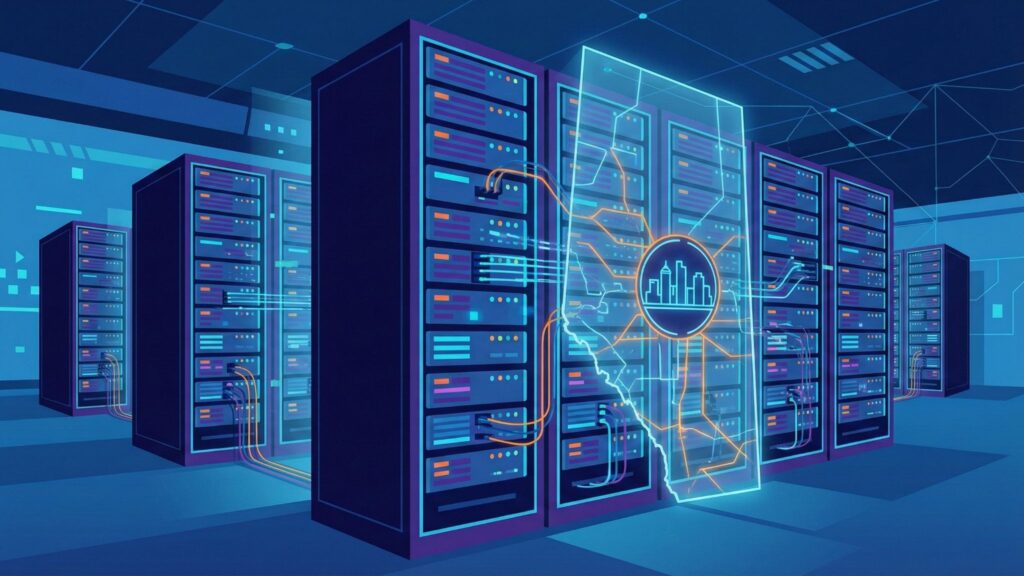
1. The 2026 Horizon: Understanding CIRO’s New Custody Mandates
To understand where Alberta is going, we must first understand the federal guardrails being established by the Canadian Investment Regulatory Organization (CIRO). CIRO, the national self-regulatory organization that oversees all investment dealers and mutual fund dealers in Canada, has been tasked with bringing “Institutional Grade” security to the wild world of digital assets.
The Shift from “Wild West” to “Fort Knox”
By 2026, the grace period for “creative” custody solutions will end. CIRO’s upcoming rules focus on three primary pillars:
1.Qualified Custodianship: Firms will no longer be able to hold significant client assets in “hot wallets” managed by internal software. They must use “Qualified Custodians”—entities that meet stringent capital requirements and are subject to regular regulatory oversight.
2.Segregation of Assets: A strict legal wall must exist between the firm’s operating capital and the clients’ digital assets. This is designed to prevent “FTX-style” collapses where user funds are used for corporate leverage.
3.Insurance and Auditing: By 2026, any firm operating in the digital asset space must provide proof of SOC 2 Type II compliance and maintain specific insurance tiers for “cold storage” (offline) assets.
For a startup in Toronto or Vancouver, these rules might feel like a barrier to entry. In Alberta, however, they are being viewed as the “Rules of the Road” that provide the certainty necessary for institutional investment.
2. The Alberta Advantage: The Financial Innovation Act
While CIRO sets the national standards, Alberta has created a unique “on-ramp” for companies to meet those standards. In 2022, Alberta passed the *Financial Innovation Act* (FIA), the first of its kind in Canada.
What is a “Regulatory Sandbox”?
An economic “sandbox” is a controlled environment where businesses can test new products, services, or delivery models without immediately meeting every single regulatory requirement that a major bank would face.
- Exemptions: Under the FIA, the President of Treasury Board and Minister of Finance can grant a “certificate of acceptance.” This allows a startup to operate for up to two years (with a possible extension) with tailored regulatory requirements.
- Speed to Market: In Ontario, a crypto startup might spend 18 months in legal limbo with the Ontario Securities Commission (OSC). In Alberta, the sandbox is designed to get companies operational in a fraction of the time.
- Direct Feedback: Startups in the Alberta sandbox work directly with provincial regulators. This means that as the 2026 CIRO custody rules approach, Alberta firms are actually helping *shape* how those rules are applied locally.
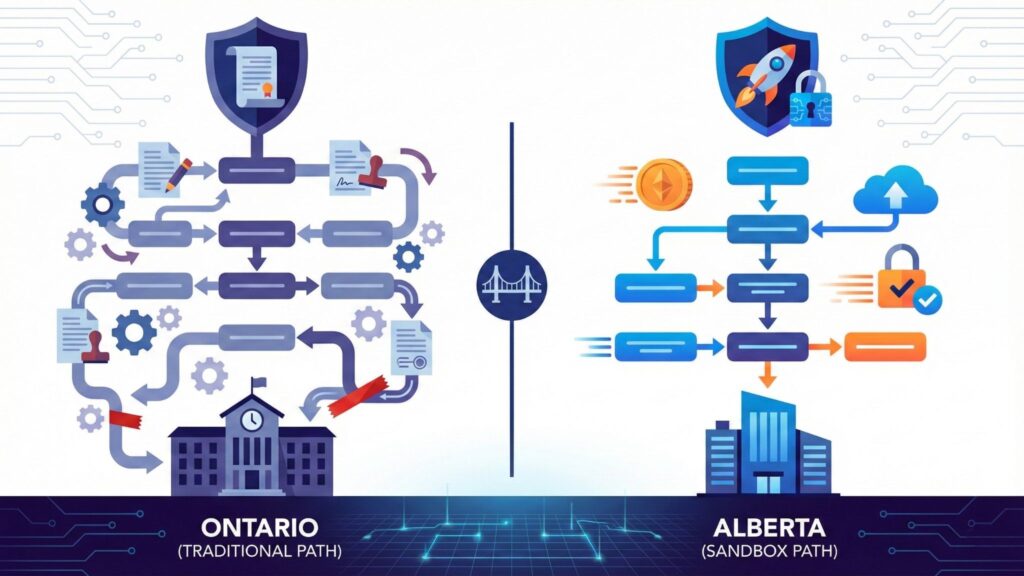
3. Why Alberta Wins Over Ontario and British Columbia
For a technical engineer or a fintech founder, the choice of jurisdiction is often a matter of “Regulatory Friction.”
Alberta vs. Ontario (The OSC)
Ontario is the financial heart of Canada, but it is also the most heavily regulated. The Ontario Securities Commission (OSC) has taken an “enforcement-first” approach to crypto. Many global exchanges have exited the Canadian market specifically citing the OSC’s rigid interpretation of “investment contracts.”
- Alberta’s Approach: Alberta views crypto custody as a technical and logistical challenge rather than a purely speculative one. The provincial government sees digital assets as a way to diversify the economy away from a 100% reliance on oil and gas.
Alberta vs. British Columbia (The BCSC)
While BC has a thriving tech scene, it faces significant challenges regarding power costs and real estate. Crypto firms require two things: cheap power for mining/validation and affordable office space for engineers.
- The Power Factor: Alberta’s deregulated electricity market allows for “behind-the-meter” power agreements. Startups can partner directly with natural gas producers to use “stranded gas” for their data centers, lowering costs to levels that BC or Ontario simply cannot match.
4. The Technical Mechanics of 2026 Custody
For the technical engineers reading this, the 2026 rules aren’t just about “laws”—they are about architecture. To be compliant in Alberta by 2026, a startup must solve for several technical hurdles.
Multi-Party Computation (MPC)
The new rules will likely favor MPC over traditional single-signature cold storage. MPC allows a private key to be split into “shards” distributed across multiple parties. No single person in the company can move funds, which satisfies CIRO’s requirements for internal controls.
Proof of Reserves (PoR)
Alberta-based firms are already leading the way in “Proof of Reserves” technology. This involves using Merkle Trees to allow users to verify that their funds are held in the firm’s custody without compromising the privacy of other users.

5. Economic Impact: Jobs and Investment
The move toward regulated custody is a massive job creator for the province. We are seeing a shift in the labor market:
- Compliance Officers: Demand for individuals who understand both CIRO regulations and blockchain forensics.
- Cybersecurity Engineers: As firms move toward “Qualified Custodian” status, the need for SOC 2 auditors and penetration testers in Calgary and Edmonton is skyrocketing.
- Data Center Operators: With the 2026 rules requiring physical “Air-Gapped” storage facilities within Canadian borders, Alberta’s industrial parks are becoming the “vaults” of the digital age.
Estimated Economic Multiplier
For every $1 million invested in a crypto-custody startup in Alberta, there is an estimated $1.4 million in local economic spinoffs, ranging from commercial real estate to specialized legal services.
6. How to Enter the Alberta Crypto Sandbox
If you are a founder or an investor looking to capitalize on the 2026 rules, the process in Alberta is structured into four phases:
1.Pre-Application: Determine if your financial product is “innovative” enough to qualify under the *Financial Innovation Act*.
2.The Proposal: Submit a detailed plan to the Alberta Treasury Board. This must include your plan for meeting the 2026 CIRO custody requirements.
3.Testing Phase: Operate under a “Certificate of Acceptance.” This is your time to build your user base while maintaining a direct line to regulators.
4.Exit/Transition: By 2026, you must either transition to full regulatory compliance (using the systems you built in the sandbox) or cease operations.
7. Risks and Skepticism: The Other Side of the Coin
While the “Educational” focus of this article highlights the growth, a prudent analyst must acknowledge the risks.
- Federal Overreach: There is always the risk that federal regulators could override provincial sandbox rules, though the *Financial Innovation Act* was specifically designed to withstand jurisdictional challenges.
- Market Volatility: A downturn in the crypto market could reduce the “appetite” for new startups, regardless of how friendly the regulations are.
- Energy Prices: While Alberta has cheap power now, a sudden shift in carbon pricing or grid regulations could impact the bottom line for data centers.
8. Conclusion: The Future is Decentralized but Regulated

Alberta is no longer just a place that ships physical commodities in pipelines. By 2026, it aims to be the place where the world’s digital wealth is secured. The combination of the *Financial Innovation Act* and the impending CIRO custody rules creates a “Goldilocks Zone”—not too unregulated to be dangerous, but not too regulated to stifle innovation.
For the investor, it offers security. For the engineer, it offers a playground. For Alberta, it offers a seat at the head of the global digital economy table.
Sources and References
1.Government of Alberta: *Financial Innovation Act* (Bill 13) Official Documentation.
2.Canadian Investment Regulatory Organization (CIRO): “Position Paper on Digital Asset Custody Standards 2024-2026.”
3.Alberta Treasury Board and Finance: Annual Economic Outlook (Digital Economy Section).
4.University of Calgary School of Public Policy: “The Impact of Regulatory Sandboxes on Fintech Growth in Western Canada.”
5.Chainalysis: “Regional Report on North American Crypto Adoption and Regulatory Trends.”



Wonderful site. Plenty of useful info here. I am sending
it to a few pals ans also sharing in delicious. And obviously, thank you on your sweat!
There’s certainly a lot to find out about this topic.
I like all of the points you’ve made.
Thank you! I’m glad you found the breakdown helpful.
The intersection of Alberta’s energy sector and these new 2026 CIRO mandates is a fascinating space to watch. We’re essentially seeing the “Wild West” of crypto transition into a highly regulated, institutional-grade financial frontier.
If there’s a specific part of the 2026 mandate or the MPC technology you’d like to dive deeper into in a future post, let me know. Thanks for reading and for the support!
With havin so much written content do you ever run into any issues of plagorism or copyright infringement?
My website has a lot of exclusive content I’ve either written myself or outsourced but it appears
a lot of it is popping it up all over the internet without my permission. Do you know
any solutions to help protect against content from being ripped off?
I’d definitely appreciate it.
That is a frustratingly common challenge, especially when you’re producing high-quality, exclusive content. In the digital economy, your intellectual property is as much an asset as the “digital vaults” I mentioned in the article!
Here are a few strategies I use and some industry standards to help protect your work:
1-Digital Fingerprinting: Use tools like Copyscape or Grammarly’s Plagiarism Checker to scan the web periodically. If you find a “rip-off,” you can issue a formal DMCA Takedown Notice to the hosting provider of the offending site.
2-Canonical Tags: Ensure your technical SEO is set up so that search engines recognize your URL as the original source. This prevents scrapers from outranking you in search results.
3-Watermarking & Internal Linking: If you use original charts or data visualizations, watermark them. Also, weave internal links back to your own articles within the text; scrapers often copy these links, inadvertently giving you a backlink and making it obvious where the content originated.
4-Legal Warnings: Sometimes a clearly visible “Terms of Use” or a “Copyright © 2026” notice in the footer is enough to deter casual copycats.
It’s a bit of a “cat and mouse” game, but being proactive is key to maintaining your site’s authority!
Hi! I just want to offer you a huge thumbs up for your
great info you have right here on this post. I am coming back to your web site for more soon.