
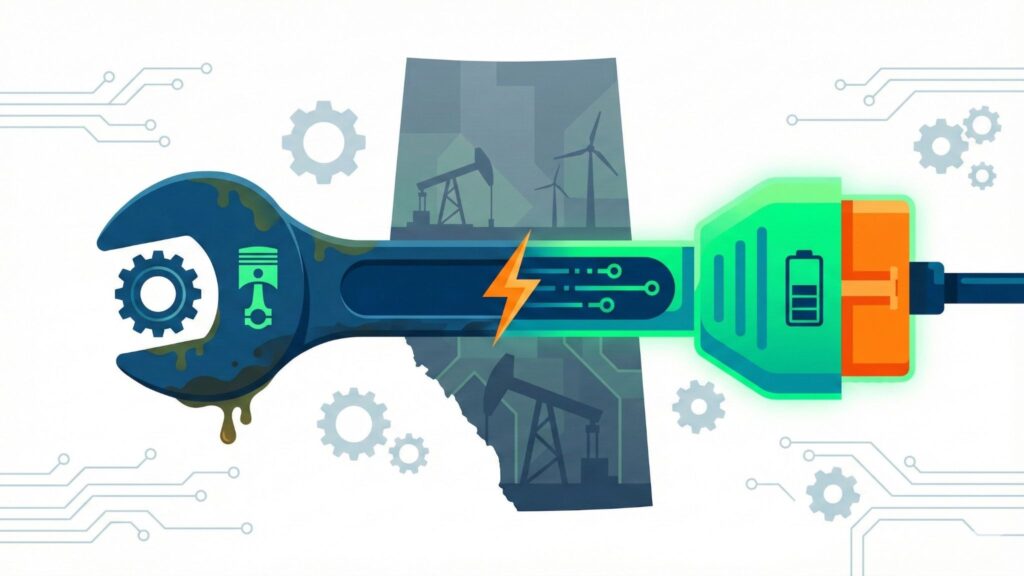

For decades, the rhythmic thrum of the internal combustion engine (ICE) has been the heartbeat of Alberta’s economy. From the heavy-duty haulers in the Athabasca oil sands to the lifted pickups navigating the gravel backroads of the Peace Country, liquid fuel has been the undisputed king. However, a quiet revolution is humming through the service bays of Calgary, Edmonton, and Red Deer. As the federal government pushes toward a 100% zero-emission vehicle (ZEV) mandate by 2035, the “street-level” economy of Alberta’s automotive repair sector is facing a reckoning. The transition is no longer a futuristic concept discussed in boardroom meetings; it is a tangible, expensive, and technically daunting reality for the thousands of independent mechanics who keep the province moving.
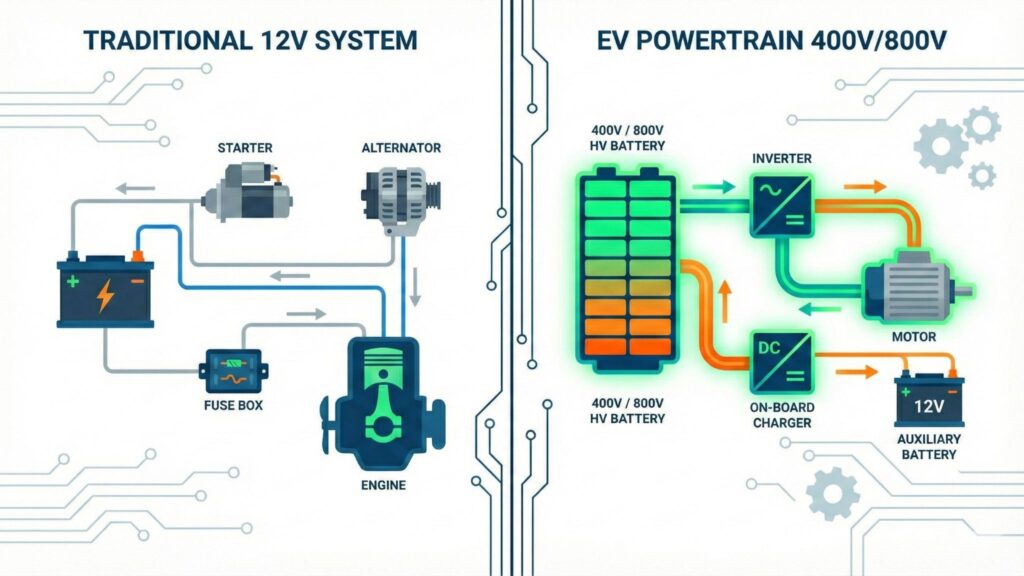
The “Tech Gap” is not merely a lack of knowledge; it is a structural economic divide. On one side stands the traditional mechanic, armed with a lifetime of experience in fluid dynamics, combustion timing, and exhaust systems. On the other side is the Electric Vehicle (EV) technician, requiring proficiency in high-voltage DC systems, thermal management software, and advanced mechatronics. For Alberta’s small-to-medium-sized automotive businesses, bridging this gap requires more than just a new set of wrenches—it requires a complete overhaul of their business models, capital expenditure (CapEx) strategies, and workforce training.
The following economic facts are based on current Alberta provincial data and market trends.
1. The Current State of the Alberta Fleet
While Alberta remains the stronghold of the internal combustion engine in Canada, the data suggests a shifting tide. As of 2023, ZEV registrations in Alberta have seen a year-over-year increase, albeit from a smaller baseline than British Columbia or Quebec.
Market Composition and Growth
- ICE Dominance: Approximately 95% of light-duty vehicles currently registered in Alberta are gasoline or diesel-powered.
- Hybrid Surge: Plug-in Hybrid Electric Vehicles (PHEVs) and traditional hybrids are seeing faster adoption rates in Alberta than pure Battery Electric Vehicles (BEVs), largely due to “range anxiety” associated with extreme cold and long distances between charging hubs.
- The Federal Mandate: The “Electric Vehicle Availability Standard” requires 20% of new light-duty vehicle sales to be ZEVs by 2026, scaling to 60% by 2030 and 100% by 2035.
2. The Economic Burden of Re-Tooling
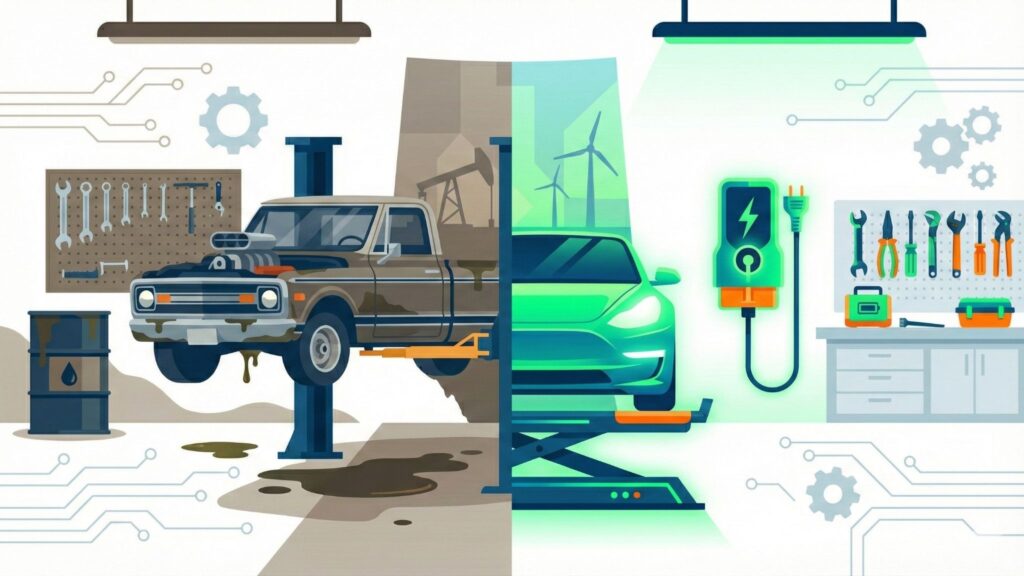
For an independent shop owner in Medicine Hat or Grande Prairie, the decision to service EVs is a massive financial gamble. Unlike ICE vehicles, which share a relatively standardized set of tools, EVs require specialized, high-cost equipment that cannot be improvised.
The Specialized Tooling List
1.High-Voltage Safety Gear: Mechanics can no longer work in standard coveralls. They require Class 0 rated rubber insulated gloves (tested every six months), face shields, and insulated floor matting.
2.Insulated Hand Tools: A standard socket set is a conductor. EV-certified toolsets—insulated to 1,000 volts—can cost between $3,000 and $7,000 for a basic kit.
3.Diagnostic Scanners: While OBD-II remains the standard, the software required to communicate with a Tesla, Rivian, or Ford F-150 Lightning battery management system (BMS) often requires proprietary subscriptions costing upwards of $5,000 annually.
4.Heavy-Duty Lifts: EVs are significantly heavier than their ICE counterparts due to battery weight. Many older hydraulic lifts in Alberta shops are rated for 7,000–9,000 lbs. A Ford Lightning weighs over 6,500 lbs empty; once loaded with tools or mud, it pushes the limits of traditional shop infrastructure, necessitating upgrades to 12,000-lb capacity lifts.
The CapEx Reality
A typical independent shop owner faces an initial “entry fee” of $50,000 to $100,000 just to be “EV-capable.” In a high-interest-rate environment, financing this equipment is a significant hurdle for businesses already operating on thin margins.
3. The Training Gap: SAIT, NAIT, and the Red Seal
The most significant bottleneck in Alberta’s EV transition is not hardware—it’s human capital. The province’s world-class polytechnic institutes, such as the Southern Alberta Institute of Technology (SAIT) and the Northern Alberta Institute of Technology (NAIT), are currently racing to update curricula that have remained largely unchanged for decades.
The Red Seal Challenge
The “Automotive Service Technician” (AST) Red Seal trade is the gold standard in Canada. However, the current Red Seal curriculum is heavily weighted toward internal combustion. While modules on sensors and basic electronics exist, the deep-dive into high-voltage DC-to-DC converters and three-phase AC motors is often treated as an elective or a post-journeyman specialty.
- The “Old Guard” Resistance: There is a demographic challenge within the trade. Alberta has a high percentage of veteran mechanics who are 10–15 years from retirement. For these professionals, the ROI on learning a completely new propulsion system is low, leading to a potential “brain drain” as they opt to stick exclusively to ICE repairs until they exit the workforce.
- The New Curriculum: NAIT and SAIT have introduced “EV Maintenance and Repair” micro-credentials. These programs focus on:
- De-energizing high-voltage systems (The “Safe-to-Work” procedure).
- Battery pack health diagnostics.
- Thermal management (coolant loops for batteries).
4. Street-Level Economics: Evolve or Die
The traditional “Oil, Lube, and Filter” (LOF) business model is the bread and butter of the Alberta shop. It creates a recurring touchpoint with the customer every 5,000 to 10,000 kilometers.
The Death of the Oil Change
EVs do not require oil changes, spark plugs, timing belts, or emissions tests. This eliminates approximately 30-40% of the traditional service revenue for a local garage. To survive, Alberta shops must pivot their revenue streams toward:
- Tire Services: EVs are heavier and produce instant torque, leading to 20% faster tire wear.
- Cabin Air and Thermal Systems: Complex cooling systems for batteries require specialized flushes.
- Suspension and Braking: While regenerative braking saves pads, the extra weight of EVs puts higher stress on bushings, ball joints, and struts—components that take a beating on Alberta’s pothole-ridden spring roads.
The “Right to Repair” Battle
A significant economic risk for Alberta’s independent shops is the “walled garden” approach taken by EV manufacturers. Unlike GM or Ford, who have historically shared service data with the aftermarket, newer EV players often restrict parts and diagnostic software to “Authorized Service Centers.” If local shops cannot access parts, the economic benefit of the EV transition will bypass small Alberta towns and stay concentrated in corporate flagship stores in major cities.
5. Rural vs. Urban: The Great Divide
The economic pulse of Alberta is often split between its two major metropolitan areas and its vast rural network. This divide is nowhere more apparent than in EV readiness.
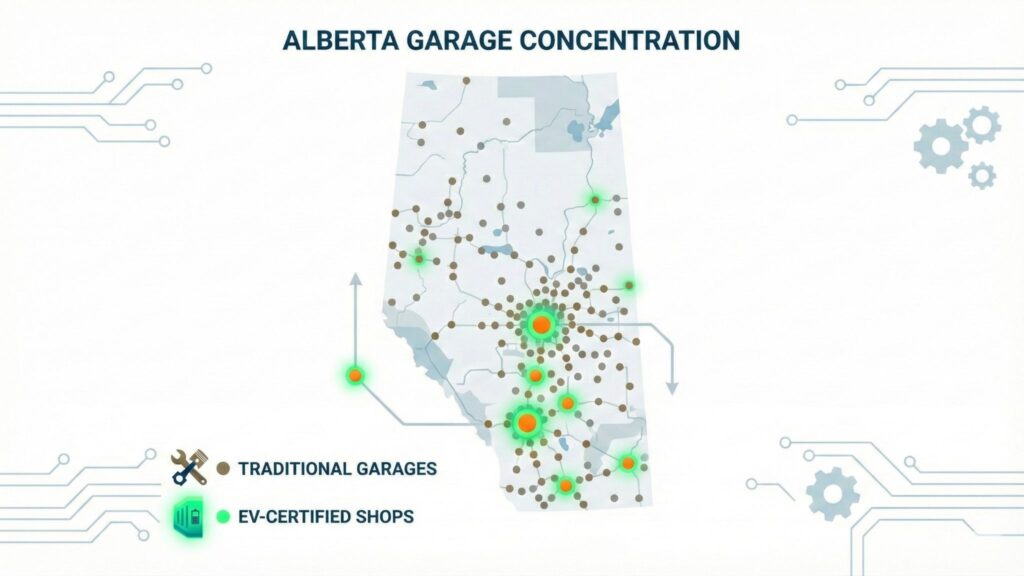
- Urban Centers (Calgary/Edmonton): High density makes EV ownership viable. Shops here are seeing enough volume to justify the $100k investment in tooling.
- Rural Alberta: In places like Brooks or Peace River, the “Tech Gap” is a chasm. If a rancher’s electric truck breaks down, the nearest qualified technician might be 300 kilometers away. This creates a “service desert” that could devalue property and hinder economic mobility in rural zones.
6. The Role of Government and Industry Incentives
To prevent a mass closure of independent shops, the provincial and federal governments are being pressured to provide “Transition Grants.”
Potential Economic Levers
1.Tax Credits for Tooling: Allowing shop owners to immediately write off 100% of EV-specific equipment.
2.Apprenticeship Subsidies: Increasing the “Canada Apprentice Loan” or provincial grants for students pursuing EV-specific certifications.
3.Infrastructure Grants: Helping small shops install Level 2 and Level 3 chargers on-site so they can test vehicles after repair.
7. Conclusion: The Road Ahead
The transition to EVs in Alberta is not just an environmental policy; it is a massive industrial restructuring. For the Alberta mechanic, the “Tech Gap” represents the greatest challenge since the shift from carburetors to fuel injection in the 1980s. However, it also represents an opportunity. Those who bridge the gap early will become the “specialists of the future,” commanding higher labor rates and capturing a market that is currently underserved.
Alberta has always been a province of builders and fixers. Whether it’s a pumpjack in Drayton Valley or a Tesla in a Calgary garage, the fundamental economic truth remains: the machines that move us require skilled hands to keep them running. The evolution of the Alberta mechanic is a microcosm of the province’s larger journey toward a diversified, high-tech energy future.
Sources and References
- Statistics Canada: Vehicle Registrations by Fuel Type, Alberta (2023).
- NAIT (Northern Alberta Institute of Technology): Automotive Service Technician Program Curriculum Updates.
- SAIT (Southern Alberta Institute of Technology): Green Building and Future Transportation Lab Reports.
- Alberta Labor Market Information (LMI): Trade Profile for Automotive Service Technicians.
- Automotive Industries Association (AIA) of Canada: “The Outlook for the Canadian Aftermarket.”
- Transport Canada: Zero-Emission Vehicle (ZEV) Sales Mandate Guidelines.
Canadian Automobile Association (CAA): EV Operating Costs and Maintenance Study.