


For decades, the silhouette of the Alberta economy was defined by the pumpjack and the drilling rig. But as the global economy shifts toward high-precision technology and autonomous systems, a new silhouette is emerging against the vast prairie horizon: the fixed-wing aircraft, the unmanned aerial vehicle (UAV), and the sophisticated satellite communication array. Alberta is currently undergoing a massive structural pivot, transforming its industrial base from a primary focus on resource extraction to a high-tech powerhouse in aerospace and defense. With a sector valuation now exceeding $4.7 billion, the province is no longer just “Texas of the North”—it is rapidly becoming Canada’s answer to the Silicon Valley of aerospace.
The following economic facts are based on current Alberta provincial data and market trends.
1. The Great Canadian Industrial Divide: Cars vs. Clouds
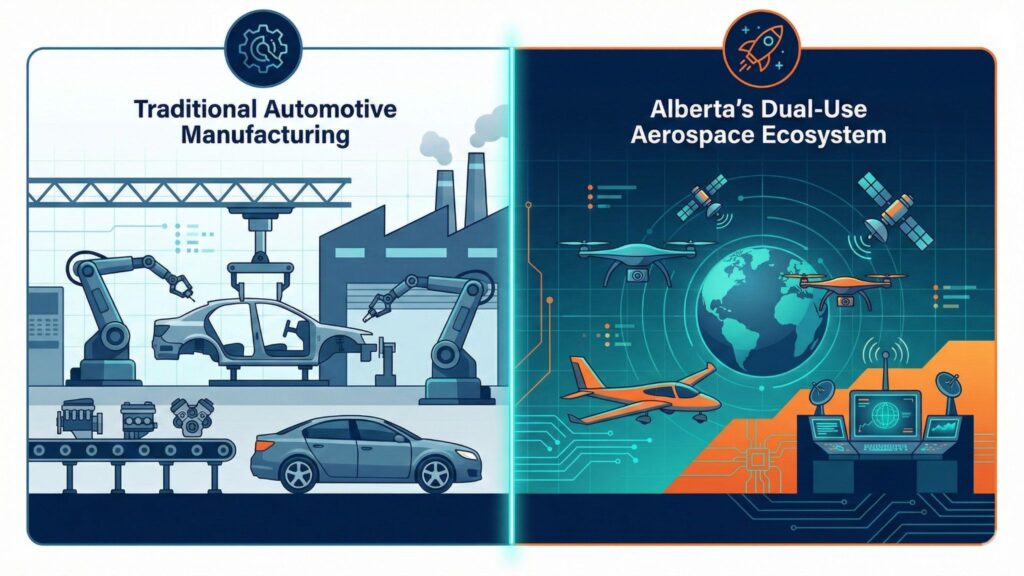
While Ontario has historically been the heartbeat of Canada’s manufacturing sector through the automotive industry, Alberta is carving out a niche that is arguably more future-proof: Dual-Use Technology.
The distinction is critical for investors and engineers alike. While an automotive assembly line is tethered to consumer spending cycles and global supply chains for parts, Alberta’s aerospace sector focuses on “dual-use” applications—technologies that serve both civilian and military purposes.
The “Dual-Use” Advantage
In Alberta, a drone designed to inspect a pipeline in the Wood Buffalo region is often built with the same hardened sensors and AI-pathfinding capabilities required for reconnaissance in a conflict zone. This crossover creates a unique economic resilience. When the oil and gas sector slows down, the defense contracts provide a steady floor. When global defense spending stabilizes, the commercial applications in agriculture, forestry, and energy provide the growth ceiling.
2. Calgary: The Epicenter of the New Horizon
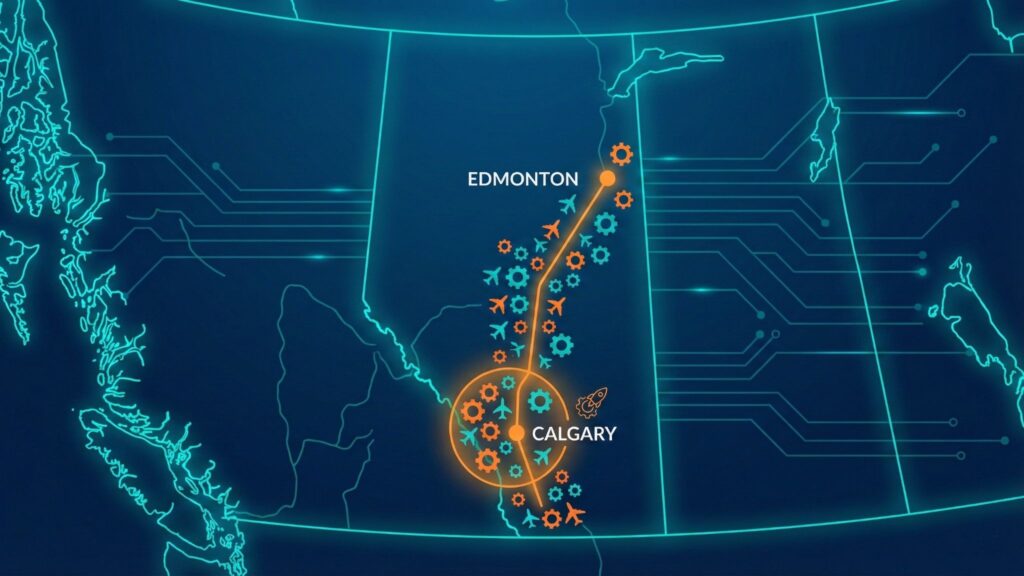
Data reveals a startling concentration of high-tech growth in Southern Alberta. Calgary now hosts approximately 60% of Alberta’s 400+ aerospace and defense organizations. This concentration has created a “cluster effect,” where the proximity of firms leads to rapid knowledge transfer and a specialized labor pool.
Why Calgary?
1.Geospatial Legacy: Calgary has long been a global leader in geomatics and GPS technology (thanks to companies like NovAtel). This expertise is the foundational “brain” of any modern aerospace system.
2.Testing Grounds: The vast, uncongested airspace surrounding the Calgary region provides an ideal environment for Beyond Visual Line of Sight (BVLOS) drone testing.
3.Logistics Hub: With the YYC International Airport and the proximity to the CPKC rail headquarters, Calgary offers the multimodal logistics required for heavy aerospace manufacturing.
3. The Xpand Commercialization Zone: Bridging the “Valley of Death”
One of the most significant developments in the Alberta ecosystem is the emergence of the Xpand Commercialization Zone in Calgary. In the world of tech startups, the “Valley of Death” refers to the gap between a successful laboratory prototype and a commercially viable product.
Xpand is designed specifically to bridge this gap for aerospace and defense startups. It provides:
- Rapid Prototyping Facilities: Access to high-end 3D printing, CNC machining, and composite labs.
- Regulatory Navigation: Assistance with Transport Canada and Department of National Defence (DND) certifications.
- The Battlefield-to-Oilfield Pipeline: Xpand helps companies take AI-driven sensor tech developed for the military and recalibrate it for the specific, harsh environments of the Alberta oil patch.
For an engineer, this means the work being done in Xpand isn’t just theoretical. It is being stress-tested in -40°C temperatures to ensure it can survive both a northern winter and a high-altitude deployment.
4. The Engineering Core: Electronics Manufacturing Services (EMS)
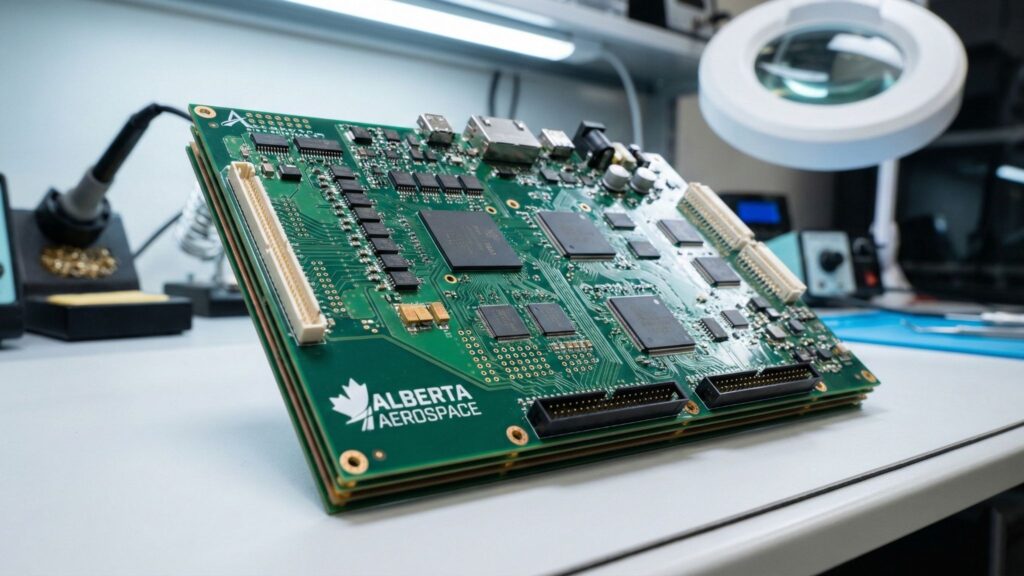
For technical professionals, the most exciting part of Alberta’s pivot is the massive demand for Electronics Manufacturing Services (EMS).
Historically, high-end electronics were outsourced to Southeast Asia. However, the aerospace and defense sectors require a level of precision, security, and traceability that offshore commodity manufacturers cannot provide. This has led to Alberta becoming a leader in:
- PCB Assembly (PCBA): The assembly of Printed Circuit Boards that act as the nervous system for avionics.
- Avionics Integration: The complex task of ensuring communication, navigation, and flight control systems work in perfect harmony.
- Hardened Electronics: Manufacturing components that can withstand the extreme vibration, electromagnetic interference, and thermal cycling found in aerospace environments.
Why EMS is “Recession-Proof”
Unlike consumer electronics (smartphones, tablets), which are subject to the whims of the retail market, EMS for aerospace is driven by long-term government contracts and essential infrastructure needs. An aircraft or a defense system has a lifecycle of 20 to 40 years, requiring constant maintenance, repair, and overhaul (MRO) services. For an engineer, this translates to high job security and a demand for specialized skills in AS9100 quality management systems.
5. The Investor Insight: An Export-Oriented Powerhouse
From an investment perspective, the Alberta aerospace sector offers a unique hedge against local market volatility.
Key Stat: Roughly 80% of the revenue generated in this sector is export-oriented.
While the local Alberta housing market or retail sector might fluctuate based on provincial migration or oil prices, the aerospace sector is plugged into the global market. Alberta-made components are found in Boeing aircraft, Lockheed Martin defense systems, and European satellite constellations.
Hedging Against the Cooling Housing Market
As interest rates and inventory levels impact the traditional “safe” investment of Alberta real estate, institutional and private investors are looking toward high-growth manufacturing. The aerospace sector offers:
1.High Barriers to Entry: The certification requirements (controlled goods, security clearances) prevent overnight competition.
2.Intellectual Property (IP) Value: Alberta firms are filing patents at an accelerated rate in the fields of autonomous flight and satellite signal processing.
3.Government Backing: Both provincial and federal governments have identified aerospace as a “strategic industry,” resulting in significant grants and tax credits for R&D.
6. Looking Forward: The 2026 Alberta Aviation, Aerospace & Defence Summit
The momentum of this sector is set to culminate in the 2026 Alberta Aviation, Aerospace & Defence Summit. This event is expected to be a watershed moment for the province, drawing global OEMs (Original Equipment Manufacturers) and Tier 1 suppliers to Calgary.
The summit will focus on three main pillars:
1.Decarbonization of Flight: Highlighting Alberta’s work in hydrogen-powered propulsion and sustainable aviation fuels (SAF).
2.Autonomous Systems: Showcasing the latest in UAV technology and AI-driven navigation.
3.Space 2.0: Discussing Alberta’s role in the growing commercial space economy, particularly in Low Earth Orbit (LEO) satellite communications.
For those looking to enter the market, the 2026 Summit represents the ultimate networking and procurement opportunity, signaling that Alberta has officially arrived on the world stage.
7. Conclusion: The New Alberta Advantage
The narrative of Alberta is changing. The “Alberta Advantage” used to be defined solely by low taxes and high oil prices. Today, it is defined by a highly educated workforce, a specialized manufacturing base, and a strategic pivot into the high-margin world of aerospace and defense.
For the engineer, it is a land of technical challenge and “recession-proof” innovation. For the investor, it is a high-yield export engine. And for the resident, it is the promise of a diversified, stable, and high-tech future. In Alberta, the sky is no longer a limit; it is the new frontier of economic growth.
Sources and References
1.Alberta Economic Development and Trade: 2023 Aerospace and Defence Sector Report.
2.Calgary Economic Development: Aerospace & Logistics Cluster Analysis (2024).
3.Statistics Canada: Manufacturing sales by industry and province, 2023-2024 data.
4.Aero-Montréal/Alberta Aerospace Association: Inter-provincial collaboration study on dual-use technology.
5.University of Calgary Schulich School of Engineering: Annual Report on Electronics Manufacturing Services and Geospatial Research.
6.Government of Canada: Industrial and Technological Benefits (ITB) Policy impacts on Western Canada.