
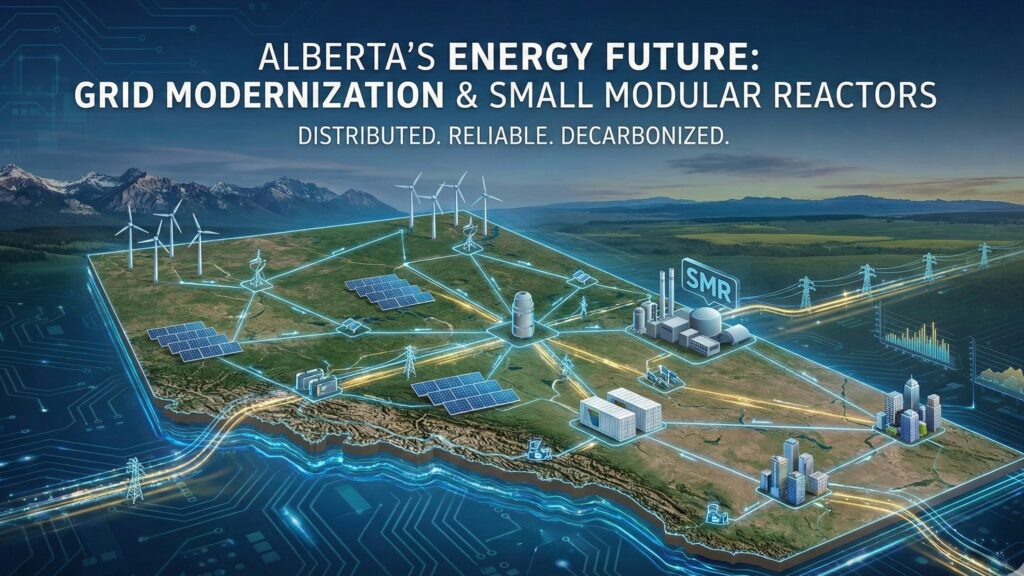

For over a century, Alberta’s economic identity has been forged in the crucible of energy. From the first flare at Turner Valley to the massive industrial complexes of the Athabasca oil sands, the province has functioned as the engine room of the Canadian economy. However, the engine is undergoing a fundamental overhaul. As the world pivots toward decarbonization, Alberta finds itself at a unique crossroads. The challenge is no longer just about extracting resources; it is about managing an increasingly complex, decentralized, and digitalized electricity ecosystem.
The transition is moving beyond the initial “gold rush” of large-scale wind and solar farms. While these intermittent resources have provided a surge of clean electrons, they have also exposed the limitations of a mid-20th-century power grid. To maintain the “Alberta Advantage”—characterized by low costs and high reliability—the province is now spearheading a revolution in grid modernization, Small Modular Reactors (SMRs), and advanced storage solutions. This is the story of how Alberta is building the most sophisticated, reliable, and investor-friendly energy market in North America.
The following economic facts are based on current Alberta provincial data and market trends.
1. The Digital Backbone: Grid Modernization and Distributed Energy Resources (DERs)
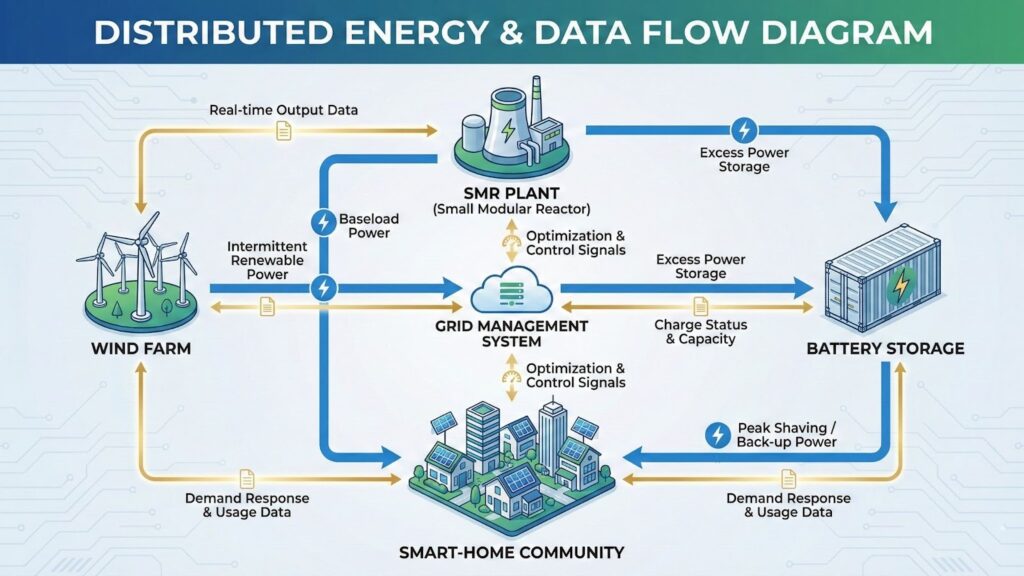
The traditional electricity model was a one-way street: massive coal or gas plants generated power, which was then pushed through high-voltage lines to passive consumers. Today, that model is obsolete. Alberta is transitioning to a “two-way” grid where consumers are also producers (prosumers), and data is as valuable as the electricity itself.
The Shift to a Decentralized Architecture
Grid modernization refers to the suite of technologies—sensors, software, and hardware—that allow the Alberta Electric System Operator (AESO) and distribution companies like FortisAlberta and ATCO to manage a more volatile supply. As of 2024, Alberta’s grid must account for thousands of small-scale inputs, from residential rooftop solar to industrial co-generation units.
Key Components of Alberta’s Modernized Grid:
- Advanced Metering Infrastructure (AMI): This is the foundational layer. Smart meters provide real-time data on consumption patterns, allowing for “demand response” programs where industrial users can be incentivized to reduce load during peak pricing events.
- Distributed Energy Resource Management Systems (DERMS): This software acts as the “air traffic control” for the grid. It integrates small-scale solar, batteries, and even electric vehicle (EV) fleets into a cohesive whole, ensuring that localized surges in production don’t overwhelm neighborhood transformers.
- Automated Switching and Self-Healing: Modernized distribution lines can now detect faults—such as a tree branch falling during a Chinook wind—and automatically reroute power to minimize outages.
The Economic Case for Modernization
For investors, grid modernization reduces “curtailment” risk. In a primitive grid, when wind production is too high for the lines to handle, the power is simply wasted. A modernized grid uses data to find homes for those electrons, whether in a utility-scale battery or a hydrogen electrolyzer, thereby protecting the Internal Rate of Return (IRR) for renewable energy developers.
2. The Nuclear Renaissance: Small Modular Reactors (SMRs) in Alberta
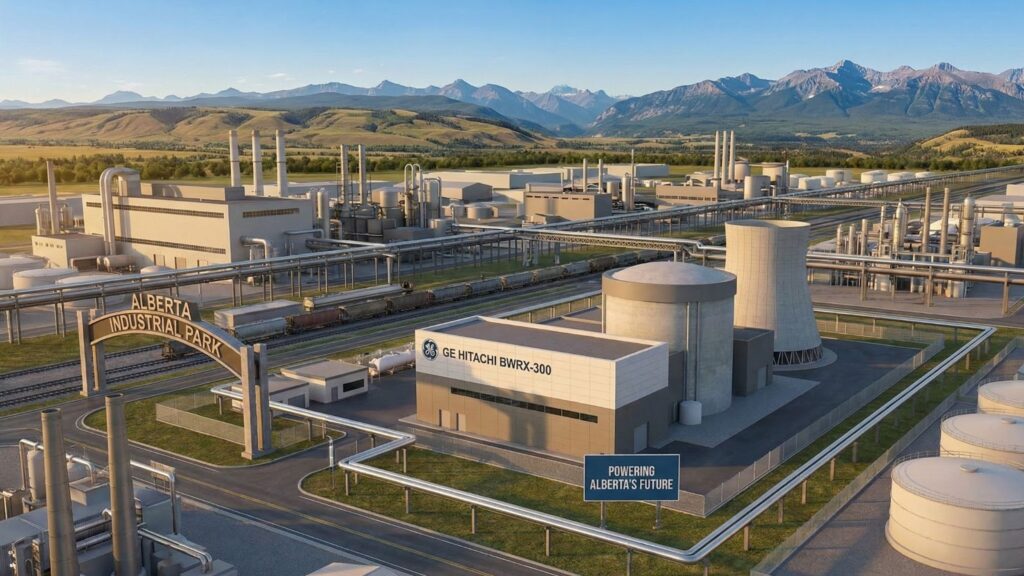
While wind and solar are essential, they lack the “baseload” characteristics required by Alberta’s heavy industry. The retirement of coal-fired power—completed years ahead of schedule—left a gap that natural gas has filled. However, to reach net-zero goals by 2050 (or 2035 for the grid, as per federal aspirations), Alberta needs a non-emitting source of firm, 24/7 power. Enter the Small Modular Reactor.
What Makes SMRs Different?
Unlike the massive, multi-billion-dollar nuclear projects of the past (like Ontario’s Darlington or Bruce Power), SMRs are designed to be smaller, safer, and factory-built.
- Capacity: Typically 300 MW or less per unit.
- Modularity: Components are manufactured in a controlled factory setting and shipped to the site, drastically reducing construction timelines and cost overruns.
- Safety: Many SMR designs utilize “passive safety” features, meaning they can shut down safely without human intervention or external power in the event of an emergency.
SMRs and the Oil Sands
The most compelling use case for SMRs in Alberta isn’t just the power grid—it’s industrial process heat. The oil sands require massive amounts of steam for In-Situ extraction. Currently, this steam is produced by burning natural gas. By deploying SMRs directly at oil sands sites, producers can eliminate the majority of their Scope 1 emissions. This “decarbonized barrel” is essential for Alberta’s oil to remain competitive in an ESG-conscious global market.
The Strategic Policy Framework
Alberta has joined the Strategic Plan for the Deployment of SMRs alongside Ontario, Saskatchewan, and New Brunswick. This inter-provincial cooperation ensures a unified regulatory front and a shared supply chain. Capital Power and TransAlta are already exploring feasibility studies for SMR deployment, with the first units expected to be operational in the mid-2030s.
3. Bridging the Intermittency Gap: Utility-Scale Storage Solutions
The Achilles’ heel of Alberta’s world-class wind and solar resources is intermittency. The wind doesn’t always blow, and the sun doesn’t shine at 6:00 PM in January when demand peaks. To solve this, Alberta is seeing a massive influx of capital into Energy Storage Systems (ESS).
The Rise of Battery Energy Storage Systems (BESS)
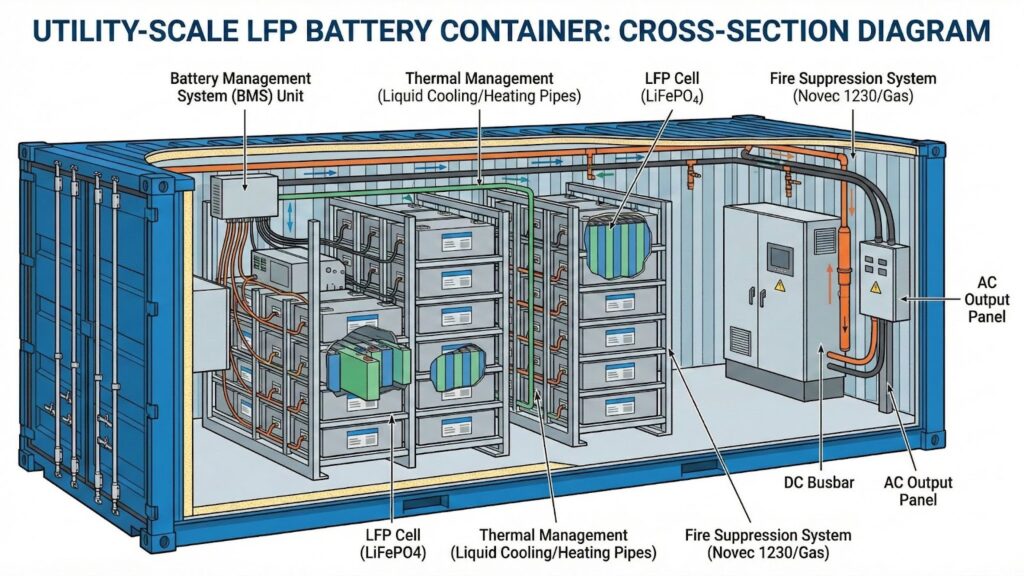
Alberta has become the hottest market in Canada for utility-scale batteries. These are not the batteries in your remote control; they are shipping-container-sized units filled with lithium-ion or flow-battery cells.
Why Alberta?
Alberta’s “Energy-Only Market” structure is uniquely suited for storage. In this market, electricity prices can fluctuate from $0/MWh to $1,000/MWh. Batteries thrive on this volatility: they charge when prices are low (excess supply) and discharge when prices are high (high demand), providing a vital service known as “arbitrage” while stabilizing the grid frequency.
Key Projects to Watch:
- The eReserve Projects: Several large-scale battery sites are already operational or in development across southern Alberta, providing instantaneous “spinning reserve” that was previously provided by gas plants.
- Pumped Hydro Storage: Beyond lithium-ion, projects like the Brazeau Pumped Storage are being evaluated. These act like giant water batteries, pumping water uphill when power is cheap and releasing it through turbines when the grid needs a boost.
Long-Duration Storage: The Next Frontier
As Alberta aims for a net-zero grid, the focus is shifting toward storage that can last days, not just hours. Technologies like compressed air energy storage (CAES) and hydrogen storage in salt caverns are being researched to ensure that even during a week-long “cold snap” with no wind, the lights stay on.
4. Economic Implications: Jobs, Investment, and Reliability
The transition to a modernized, SMR-supported grid is an economic multiplier for the province. It is not merely an environmental initiative; it is an industrial strategy.
Attracting the “Data Economy”
High-tech industries, specifically Data Centers and AI processing hubs, require massive amounts of reliable, 24/7 clean energy. By integrating SMRs and advanced storage, Alberta can position itself as a preferred destination for tech giants like Amazon, Google, and Microsoft, who have committed to carbon-neutral operations.
Workforce Evolution
The “Energy Revolution” is creating a demand for a new kind of worker. While traditional trades remain vital, there is a growing need for:
- Power Systems Engineers who understand digital grid architecture.
- Nuclear Technicians to operate and maintain the coming SMR fleet.
- Data Scientists to optimize the AI algorithms that manage the two-way flow of the grid.
The University of Calgary and the University of Alberta are already pivoting their curricula to address this shift, ensuring that the next generation of Albertans is equipped for the “Digital Patch.”
5. Challenges and the Path Forward
No revolution is without its friction. The transition to a distributed energy model faces three primary hurdles:
1.Regulatory Speed: The Alberta Utilities Commission (AUC) and the AESO must move quickly to update market rules that were designed for a centralized gas/coal era. This includes how “behind-the-meter” resources are compensated.
2.Capital Intensity: Building SMRs and upgrading thousands of kilometers of distribution lines requires tens of billions of dollars. Maintaining a stable, predictable investment climate is paramount.
3.Public Perception: While Albertans are generally energy-literate, the introduction of nuclear technology requires a robust, transparent dialogue regarding safety and waste management.
Conclusion: Securing the Alberta Advantage
Alberta’s electricity grid is evolving from a mechanical system into a biological one—adaptive, intelligent, and decentralized. By embracing grid modernization, the province is ensuring that its infrastructure can handle the complexity of the 21st century. By leading the charge on SMRs, it is securing the baseload power needed for its industrial heartland. And by scaling up storage, it is making its renewable resources truly reliable.
For the investor, the message is clear: Alberta is not just an oil and gas province; it is a total energy province. The “Alberta Economic Pulse” is strong, beating with the rhythm of a high-tech, low-carbon future that remains rooted in the pragmatic, results-driven spirit of the West.
Sources and References
- Alberta Electric System Operator (AESO): 2023 Long-term Outlook and Reliability Requirements.
- Government of Alberta: Strategic Plan for the Deployment of Small Modular Reactors.
- Canadian Nuclear Association (CNA): SMR Technology Roadmap for Canada.
- International Energy Agency (IEA): Canada 2024 Energy Policy Review.
- Alberta Utilities Commission (AUC): Inquiry into the ongoing economic, orderly, and efficient development of electricity generation.
- Conference Board of Canada: The Economic Impact of Nuclear Power in Alberta.