
The “Alberta Advantage” has historically been defined by the province’s ability to leverage its natural resource wealth into global industrial leadership. While oil and gas remain foundational, a new frontier is emerging at the intersection of two of Alberta’s most vital sectors: Agriculture and Technology.
As global food systems face mounting pressure to decarbonize, Alberta is positioning its 50 million acres of farmland as more than just a source of caloric output. Today, these fields are being transformed into massive, tech-enabled carbon sinks. This article explores how precision farming is moving from a niche engineering concept into a core pillar of Alberta’s economic diversification strategy.
1. The “Theory to Reality” Framework: From Lab to Land
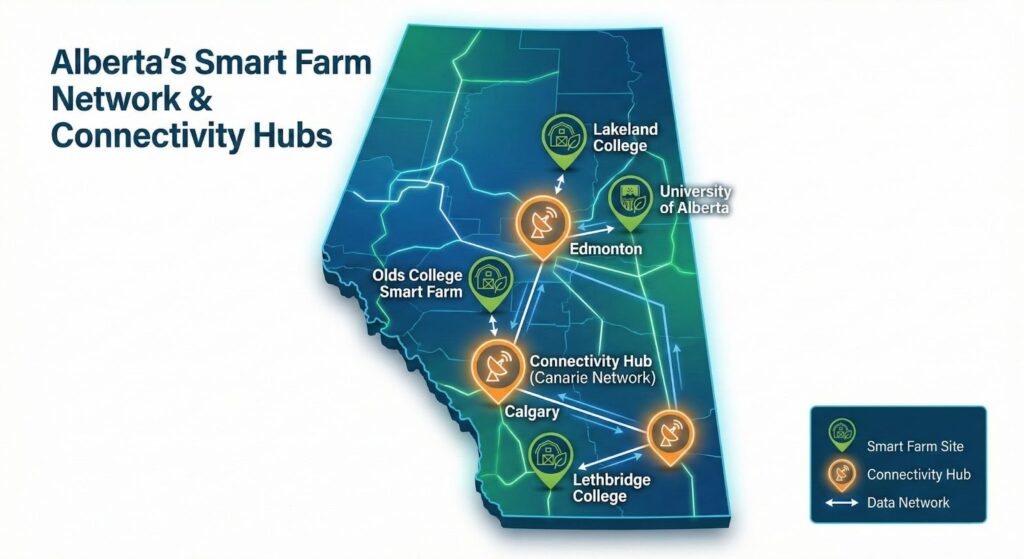
For decades, “carbon sequestration” was a buzzword often confined to industrial carbon capture and storage (CCS) at energy sites. However, in 2026, the strategy has moved into the open field. This is no longer a theoretical pursuit; it is an active operational shift driven by Alberta’s “Living Labs” and 2025 cleantech milestones.
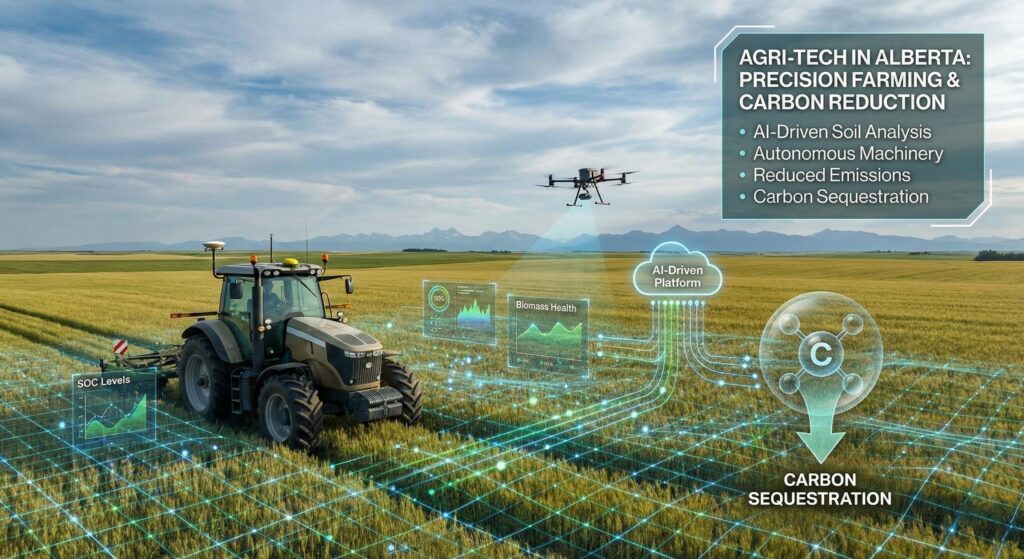
The transition is powered by Regenerative Precision Agriculture (RPA). Unlike traditional farming, which views a field as a uniform unit, RPA treats every square meter as a distinct data point. By using GPS-guided equipment and AI-driven soil analysis, Alberta producers—supported by initiatives like the Alberta AgriSystems Living Lab—are proving that environmental stewardship and profitability are not mutually exclusive.
Operational Insight: Recent data from central Alberta farms shows that the adoption of variable-rate technology (VRT) for fertilizer application has reduced nitrous oxide emissions—a greenhouse gas 300 times more potent than CO2 —by up to 25% while simultaneously increasing yield stability.
2. Structural Backbone: The Infrastructure of Innovation
The success of agri-tech in Alberta rests on a robust physical and digital infrastructure. This “Structural Backbone” consists of three primary layers:
The Digital Prairie
High-speed rural connectivity is now as essential as irrigation. The deployment of Low Earth Orbit (LEO) satellite constellations has enabled real-time data transmission from remote sensors to cloud-based AI platforms. These platforms analyze:
- Soil Organic Carbon (SOC) Levels: Proximal sensing spectroscopy and satellite imagery now allow for granular SOC mapping without the cost of manual lab testing.
- Biomass Health: Hyperspectral imaging from drones detects early signs of crop stress, allowing for targeted intervention.
- Autonomous Machinery: Driverless tractors, increasingly common on larger Alberta operations, optimize pathfinding to reduce soil compaction—a key factor in preserving soil carbon.
Regulatory and Academic Anchors
The Technology Innovation and Emissions Reduction (TIER) regulation provides the carbon pricing backbone that makes these tech investments viable. Furthermore, institutions like Olds College of Agriculture & Technology and the University of Alberta serve as the province’s R&D engines. The Olds College Smart Farm, for instance, acts as a 3,600-acre “giant laboratory” where 2025-2026 trials for automated emissions monitoring are currently underway.
3. Fiscal & Policy Drivers: De-Risking the Green Transition
Precision farming requires significant upfront capital. To bridge this “innovation gap,” federal and provincial governments have launched targeted fiscal instruments that de-risk the environment for early adopters and tech developers.
The Agricultural Clean Technology (ACT) Program
The ACT Program remains a primary engine for adoption, providing non-repayable contributions (up to $2 million per project) for the purchase of equipment that reduces GHG emissions. In Alberta, this has translated into:
- High-Efficiency Grain Dryers: Reducing natural gas consumption during harvest.
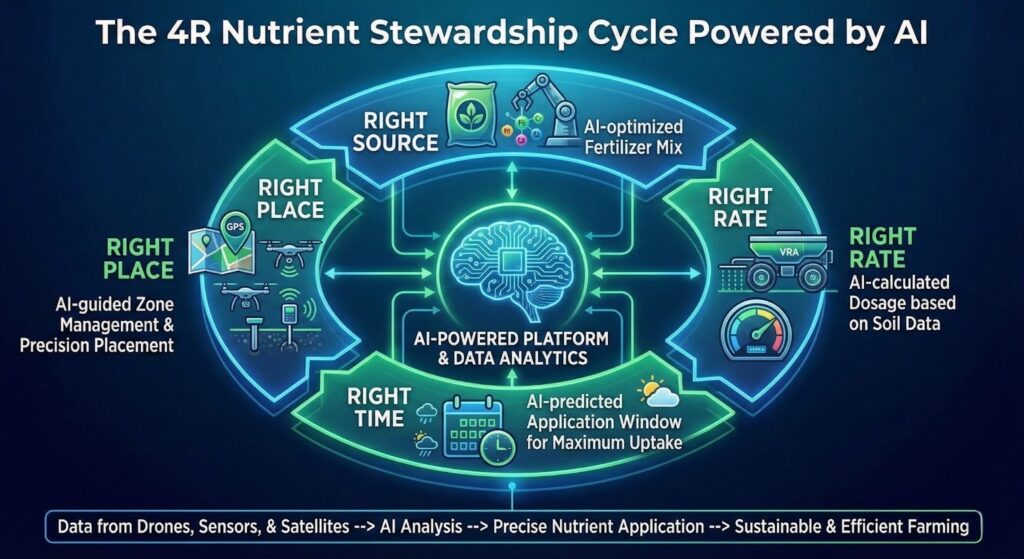
- Precision Fertilizer Drills: Utilizing 4R Nutrient Stewardship (Right Source, Right Rate, Right Time, Right Place).
Sustainable Canadian Agricultural Partnership (Sustainable CAP)
In 2025-2026, the Sustainable CAP has allocated over $500 million toward strategic programs in Alberta. The “On-Farm Efficiency Program” and the “Resilient Agricultural Landscape Program” specifically incentivize practices that sequester carbon, such as rotational grazing and no-till seeding.
Alberta Innovates and the Tech2Farm Initiative
Locally, Alberta Innovates has championed the “Tech2Farm” program, which provides up to $500,000 for SMEs to validate and commercialize agri-tech innovations. This program ensures that Alberta-based startups have the runway to pilot their technologies on home soil before scaling globally.
4. Data and AI: The 2025 Cleantech Revolution
The 2025 Alberta Cleantech Awards (ASTech) highlighted a significant shift: data is the new “green” fertilizer.
Winners and finalists, such as Viresco Solutions and Cropmind Inc., are at the forefront of this revolution. Their AI-powered platforms do not just “monitor” fields; they “predict” them. By integrating weather forecasts, historical yield data, and real-time sensor inputs, these systems can:
- Optimize Nitrogen Use: Nitrogen fertilizer is energy-intensive to produce. AI models now calculate the precise amount needed for specific soil zones, preventing excess runoff and nitrous oxide volatilization.
- Water Management: Smart irrigation sensors have shown water savings of up to 40% in Alberta’s irrigation districts, preserving a critical resource during increasingly dry summers.
- Soil Sequestration Accounting: Perhaps most importantly, AI is solving the “Measurement, Reporting, and Verification” (MRV) challenge. For farmers to sell carbon credits, they must prove the carbon is in the soil. Startups are now using machine learning to correlate satellite data with soil probes, creating a transparent “Carbon Ledger” for investors.
5. Comparative Analysis: Pathways to Progress
Short-Term vs. Long-Term Impacts
- Short-Term (1-3 years): The focus is on Efficiency Gains. Reducing input costs (fuel, fertilizer, seed) provides immediate relief to farm balance sheets amidst inflationary pressures.
- Long-Term (5-15 years): The focus shifts to Asset Appreciation and Market Access. As global supply chains (e.g., General Mills, McCain Foods) demand “Scope 3” emission reductions from their suppliers, Alberta’s carbon-negative farms will command a premium.
Urban vs. Rural Economic Synergy
- Rural Alberta: Benefits from job creation in high-tech field services, sensor maintenance, and data analysis, helping to stem the “brain drain” to major cities.
- Urban Hubs (Calgary/Edmonton): Benefit from the “Software-as-a-Service” (SaaS) and hardware engineering clusters developing these tools. This synergy is a textbook example of Alberta’s diversification: the tech sector finds a massive, captive customer in the ag sector.
6. Stakeholder Value Propositions: The Alberta Competitive Edge
Alberta is uniquely positioned to lead the global agri-tech race due to its scale, regulatory maturity, and the presence of world-class technical talent.
| Stakeholder | Value Proposition |
| Investors | Access to a “Dual-Yield” asset: high-quality agricultural commodities paired with verified, high-integrity carbon offsets in a stable, TIER-regulated market. |
| Technical Engineers | An “Applied AI” playground. Alberta offers the opportunity to build and test hardware-software integrations in some of the most challenging climatic conditions on earth. |
| Alberta Residents | A more resilient food system and a diversified economy that is less sensitive to the boom-bust cycles of global oil prices. |
| Business Owners | Early adoption of precision tools provides a “Future-Proof” shield against carbon taxes and changing consumer preferences for low-carbon products. |
Conclusion
Precision farming is not merely “greening” the fields of Alberta; it is reinforcing the very foundation of the province’s economic future. By bridging the gap between the prairie’s agricultural heritage and the digital future, Alberta is proving that the path to a low-carbon economy runs directly through the farmhouse. For the engineer, the investor, and the resident, the message is clear: the next “Alberta Advantage” is being programmed, one acre at a time.
Resource List for Stakeholders
Funding & Grants
- Agricultural Clean Technology (ACT) Program: Agriculture and Agri-Food Canada – ACT
- Sustainable Canadian Agricultural Partnership (Sustainable CAP) – Alberta: Alberta.ca Sustainable CAP
- Alberta Innovates – Smart Agriculture: Alberta Innovates Programs
- Emissions Reduction Alberta (ERA): ERA Funding Opportunities
Research & Innovation Hubs
- Olds College Smart Farm: Olds College Centre for Innovation
- University of Alberta – Faculty of Agricultural, Life & Environmental Sciences: U of A ALES
- Alberta AgriSystems Living Lab: Living Labs Initiative
Industry & Regulatory Bodies
- Technology Innovation and Emissions Reduction (TIER) Regulation: Alberta TIER System Details
- Alberta Ag-Tech Association: Industry Networking and Support
Fertilizer Canada – 4R Nutrient Stewardship: 4R Certification Information