
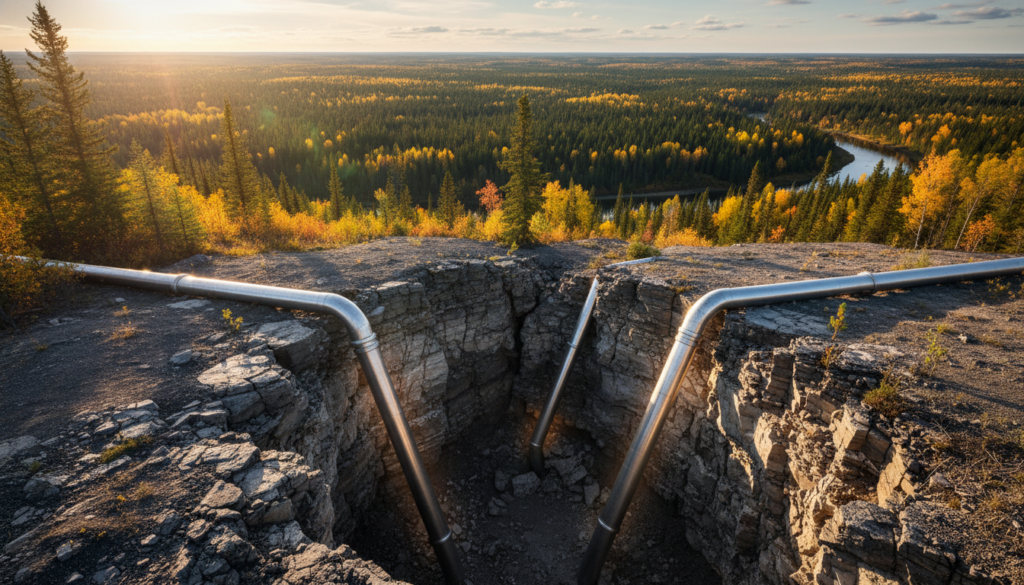

The province of Alberta is standing on the precipice of a modern resource revolution. Beneath the boreal forests and active pumpjacks of the Fox Creek region lies an ancient, subterranean ocean known as the Leduc Formation. This geological marvel is saturated with lithium-enriched brine, the critical component required to power the global transition toward electric vehicles and grid-scale battery storage. However, as junior mining outfits and ambitious energy transition startups rush to stake their claims, they are colliding with a severe, invisible barrier. The bottleneck threatening to stall Alberta’s lithium boom is not the extraction of the mineral itself, but rather the logistical and regulatory nightmare of putting the water back underground.
Welcome to the lithium-brine disposal wall.
For technical engineers, investors, and business owners looking to capitalize on Alberta’s energy diversification, understanding the mechanics of subsurface disposal is no longer optional; it is the fundamental linchpin of project viability. Direct Lithium Extraction (DLE) requires moving astronomical volumes of fluid. Once the lithium is stripped from the brine, the depleted saltwater must be safely returned to the earth. Yet, the infrastructure required to do this—deep disposal wells—is largely controlled by legacy oil and gas operators who are fiercely protective of their subsurface real estate.
The following economic facts are based on current Alberta provincial data and market trends.
The Geography and Geology of the Fox Creek Advantage
To comprehend the scale of the disposal challenge, one must first understand the geological canvas of the Fox Creek area. Located in west-central Alberta, Fox Creek has historically been a prolific producer of oil and natural gas, drawing immense wealth from the Duvernay and Montney formations. Beneath these layers lies the Leduc Formation, a Devonian-era reef complex.
Unlike traditional hard-rock lithium mining (spodumene) found in Australia, or the massive evaporative brine pools of South America’s Lithium Triangle, Alberta’s lithium is dissolved in deep, pressurized aquifers. This presents a unique set of educational and engineering parameters.
Key Geological Parameters of the Leduc Formation:
- Depth: Ranging from 2,000 to 3,000 meters below the surface.
- Temperature: Elevated temperatures (often exceeding 70 to 90 degrees Celsius), which is highly beneficial for the kinetic efficiency of Direct Lithium Extraction processes.
- Porosity and Permeability: Exceptional natural reservoir characteristics, allowing for high-volume fluid flow.
- Lithium Concentration: Ranging from 50 to 130 milligrams per liter (mg/L).
While these concentrations are highly economic given modern DLE advancements, they are relatively dilute compared to South American salars. This dilution is the exact mathematical reason why disposal has become the industry’s most pressing bottleneck.
The Mathematics of Direct Lithium Extraction and Volumetric Load
Direct Lithium Extraction (DLE) is an umbrella term for a variety of chemical engineering processes—ranging from ion exchange and adsorption to solvent extraction—designed to selectively pull lithium ions out of saltwater while leaving other minerals behind.
To educate potential investors and project managers on the sheer scale of the disposal wall, we must run the volumetric mathematics of a standard commercial DLE operation in Alberta.
If a junior mining company aims to produce 10,000 tonnes of Lithium Carbonate Equivalent (LCE) per year, and the native brine possesses a concentration of 75 mg/L, the fluid dynamics are staggering.
The Volumetric Breakdown:
- Extraction Efficiency: Assuming a highly efficient DLE sorbent captures 80 percent of the lithium, the effective yield is 60 mg/L.
- Fluid Requirement: To produce one single tonne of LCE, the facility must process approximately 3.1 million liters of brine.
- Annual Load: To hit the 10,000-tonne commercial target, the facility must pump, process, and subsequently dispose of over 31 billion liters of brine annually.
- Daily Flow Rates: This translates to moving roughly 85,000 cubic meters of water every single day.
Once the lithium is extracted, this immense volume of "barren brine" cannot be discharged into surface waters. Environmental regulations and basic ecological stewardship dictate that it must be injected back into a deep, geologically isolated formation to maintain reservoir pressure and prevent surface contamination.
This requires high-capacity Class Ib or Class II disposal wells. The engineering challenge is not simply drilling a hole; it is finding a geological zone with enough "pore space" (the microscopic voids in the rock) to accept tens of billions of liters of fluid over a twenty-year project lifespan without causing over-pressurization or induced seismicity.
The Subsurface Real Estate Squeeze
This brings us to the core conflict. Junior lithium producers are hitting a wall because they do not operate in a vacuum. The subsurface of Fox Creek is already incredibly crowded.
For decades, traditional oil and gas operators have utilized deep disposal wells to manage their own "produced water"—the naturally occurring saltwater that comes up alongside hydrocarbons. These legacy producers hold the surface leases, the wellbore infrastructure, and the operational licenses for the region’s prime disposal real estate.
When a new lithium startup attempts to secure disposal capacity, they face several systemic hurdles:
- Infrastructure Monopolies: Existing disposal wells are capitalized assets owned by oil and gas companies. These companies prioritize their own hydrocarbon production. They are highly reluctant to lease excess disposal capacity to a third-party lithium company, fearing that the lithium operator’s massive volumes will prematurely fill the reservoir, leaving the oil company stranded with their own wastewater.
- Capital Expenditure (CAPEX) Barriers: If a junior miner cannot lease existing wells, they must drill their own. Drilling and completing a high-capacity, deep disposal well in the Fox Creek region can cost between $5 million and $10 million CAD. A commercial-scale DLE facility may require a network of five to ten of these wells, adding up to $100 million in upfront CAPEX before a single ounce of lithium is sold.
- Geochemical Compatibility: Even if a well is secured, engineers must ensure the barren brine is chemically compatible with the disposal reservoir. DLE processes can alter the pH or temperature of the brine. If injected without careful treatment, the barren brine can react with the native rock, causing mineral scaling (precipitation) that permanently plugs the microscopic pores of the disposal well, rendering a multi-million-dollar asset useless.
Navigating the Regulatory Labyrinth: Alberta Energy Regulator (AER) Directives
For business owners and legal teams operating in Alberta, understanding the regulatory framework governing subsurface disposal is paramount. The Alberta Energy Regulator (AER) is the governing body that oversees all energy development, and their rules are stringent.
The primary regulatory hurdle is AER Directive 051: Injection and Disposal Wells. This directive outlines the strict engineering and geological requirements for injecting fluids underground.
Key Educational Components of Directive 051 Compliance:
- Hydraulic Isolation: Operators must prove, through rigorous cementing and casing logs, that the injected brine will not migrate upward into shallow, fresh groundwater aquifers.
- Maximum Injection Pressures (MIP): The AER assigns a strict pressure limit to every disposal well. Engineers must conduct step-rate tests to determine the fracture gradient of the rock. If a lithium company attempts to pump 85,000 cubic meters a day into a well, they risk exceeding the MIP, which can lead to regulatory shut-ins or, in worst-case scenarios, induced seismic events (earthquakes).
- Pore Space Ownership: This is a uniquely complex facet of Alberta law. Under the Mines and Minerals Act, the Crown (the provincial government) owns the pore space. However, the right to access and utilize that pore space is practically tied to the operator who holds the mineral lease and the surface infrastructure. A lithium company cannot simply drill a disposal well into Crown pore space if it interferes with the legitimate hydrocarbon operations of a neighboring oil company.
This regulatory environment creates a scenario where early-stage lithium companies must engage in complex, multi-party negotiations. They must prove to the AER that their massive disposal volumes will not sterilize future oil and gas recovery, will not cause seismic hazards, and will perfectly maintain hydraulic isolation.
Strategic Solutions: How Engineers and Investors Can Break the Wall
Despite the formidable nature of the lithium-brine disposal wall, the Alberta economy is renowned for its engineering ingenuity. For potential investors and technical operators, there are several strategic pathways to navigate this bottleneck and ensure project continuity.
1. Co-Production and Joint Ventures
The most viable short-term solution is the establishment of symbiotic joint ventures between traditional oil and gas operators and junior lithium miners. Instead of drilling new source and disposal wells, lithium companies can attach their DLE modules directly to the existing water-handling infrastructure of an oil battery.
In this "co-production" model, the oil company pumps the fluid to the surface, separates the oil, and passes the wastewater through the lithium company’s DLE facility. The lithium company extracts the battery metals, and the oil company takes the barren brine back and injects it down their existing, permitted disposal wells. This eliminates the CAPEX of new drilling and bypasses the regulatory delays of permitting new disposal sites.
2. Advanced Reservoir Engineering and Unitization
For standalone lithium projects, engineers must employ advanced reservoir modeling. By utilizing 3D seismic data and sophisticated fluid dynamic software, engineers can identify deep, highly permeable "thief zones" within the Leduc or Elk Point formations that are hydrodynamically disconnected from active oil and gas pools.
Furthermore, legal teams can pursue "unitization" agreements. This involves pooling the subsurface rights of multiple leaseholders in a specific area, ensuring that the massive injection of barren brine is managed cooperatively, sweeping the reservoir in a way that maintains pressure without negatively impacting neighboring operators.
3. Closed-Loop Geothermal Integration
An emerging, highly educational approach is the integration of DLE with geothermal energy production. Because the Leduc brines are naturally hot, engineers can pass the brine through a heat exchanger to generate zero-emission electricity before it enters the DLE facility. Once the heat and the lithium are extracted, the cooled, barren brine is injected back into the reservoir. The temperature differential helps manage the thermodynamics of the reservoir, and the dual revenue stream (lithium plus baseload geothermal power) drastically improves the project’s economics, helping to offset the high CAPEX of drilling proprietary disposal wells.
4. Regulatory Evolution
The Government of Alberta and the AER are actively recognizing this bottleneck. Investors should monitor ongoing policy shifts aimed at streamlining the permitting process for pure-play critical mineral extraction. Legislative updates that clarify the hierarchy of pore space rights between critical minerals and legacy hydrocarbons will be the ultimate catalyst for unlocking Fox Creek’s full potential.
[IMAGE: A clean isometric view. Foreground: Interlocking mechanical gears carved from pristine white limestone, representing the cooperation between oil infrastructure and mining sectors. Background: Deep underground caverns mapped with structural gridlines. Lighting: Bright natural lighting.]
The Long-Term Growth Mechanics of Alberta’s DLE Sector
The economic reality of Alberta’s lithium ambitions is that the sector will not be defined by who possesses the best extraction chemistry, but by who controls the subsurface plumbing. The disposal wall is the ultimate filter separating viable commercial enterprises from speculative ventures.
For business owners and investors evaluating junior miners in the Fox Creek region, due diligence must extend beyond the pilot plant’s lithium recovery rates. The critical questions must be: Where is the barren brine going? Who owns the disposal well? And is the pore space legally secured?
Companies that proactively secure their disposal infrastructure—whether through strategic oil and gas partnerships, aggressive capital deployment for proprietary wells, or innovative geothermal integration—will control the pace of the market.
Alberta possesses the geological endowment, the skilled workforce, and the capital markets to become a North American powerhouse in the critical minerals supply chain. By educating stakeholders on the complex mechanics of subsurface disposal rights, the province can transition from a legacy hydrocarbon giant into a diversified energy leader, ensuring that the billions of liters of brine flowing beneath Fox Creek power the future without stalling at the regulatory wall.
Sources and References
- Alberta Energy Regulator (AER). Directive 051: Injection and Disposal Wells. Government of Alberta.
- Alberta Geological Survey (AGS). Lithium Potential in Alberta’s Deep Saline Aquifers. Provincial Geological Assessment.
- Government of Alberta. Mines and Minerals Act: Tenure and Pore Space Ownership. Legislative Framework.
- Canadian Society of Petroleum Geologists (CSPG). Reservoir Characterization of the Leduc Formation for Commercial Brine Production.