
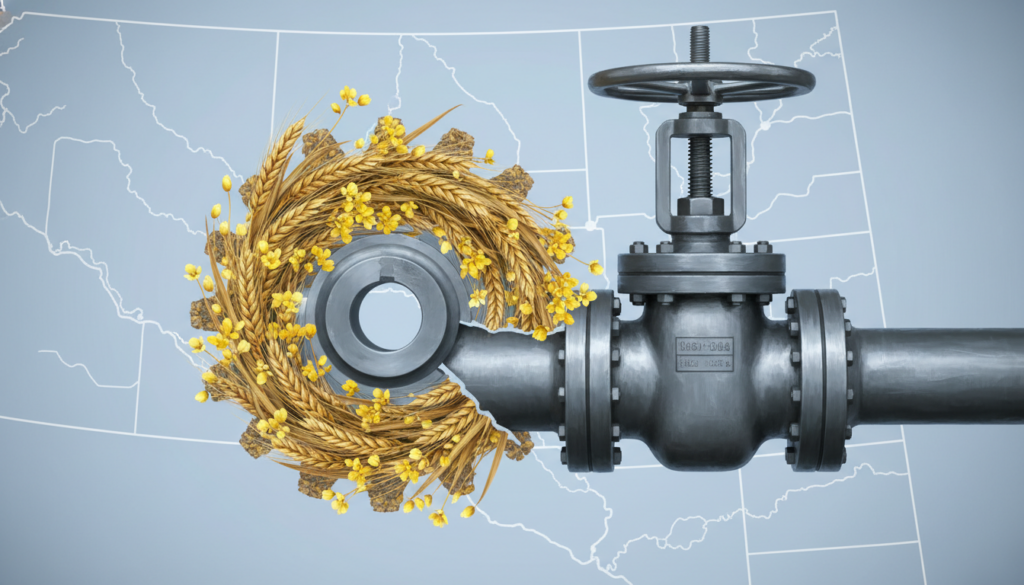

For generations, the economic narrative of Alberta has been defined by two distinct, parallel pillars: the sweeping, golden agricultural belts of the prairies and the deep, subterranean hydrocarbon reservoirs of the energy patch. Historically, these two colossal industries operated independently, intersecting only when a pumpjack shared a lease road with a combine harvester. Today, however, a profound structural shift is rewriting the provincial economy. Driven by aggressive federal decarbonization policies and rapid advancements in chemical engineering, agriculture and energy are violently colliding.
At the epicenter of this transformation is Lloydminster, the bi-provincial border city that is rapidly evolving into a global hub for renewable energy manufacturing. Here, massive biofuel super-refineries are scaling up operations to convert millions of tonnes of agricultural output into lower-carbon transportation fuels. But this industrial triumph has triggered an unforeseen economic consequence: a fierce, localized bidding war for canola oilseeds. As energy conglomerates leverage their deep capital reserves to secure feedstock, they are inadvertently pricing out traditional international food-export markets. For potential residents, investors, business owners, and technical engineers, understanding the mechanics of this “Canola Carbon Collision” is critical to navigating the next decade of Alberta’s economic evolution.
The following economic facts are based on current Alberta provincial data and market trends.
Understanding the Catalyst: The Federal Clean Fuel Regulations
To comprehend the sheer scale of the feedstock bidding war, one must first deconstruct the policy engine driving the demand: the federal Clean Fuel Regulations. Implemented to reduce the carbon intensity of transportation fuels produced and sold in Canada, the Clean Fuel Regulations mandate a gradual, year-over-year reduction in the lifecycle emissions of gasoline and diesel.
The mechanics of this policy are rooted in a credit-based market system. Fuel suppliers who fail to meet the mandated carbon intensity reduction targets must purchase compliance credits. Conversely, companies that produce fuels with a carbon intensity below the baseline—such as renewable diesel derived from canola oil—generate credits that can be sold at a premium.
This regulatory framework completely alters the fundamental economics of fuel production.
Key economic drivers initiated by the Clean Fuel Regulations include:
- Artificial Margin Expansion: The revenue generated from selling carbon compliance credits artificially inflates the profit margins of renewable diesel, allowing biofuel refiners to pay significantly higher premiums for raw feedstock than traditional food processors.
- Guaranteed Domestic Demand: Because the regulations mandate compliance within the domestic fuel pool, super-refineries have a guaranteed, captive market for their output, insulating them from certain global macroeconomic shocks.
- Carbon Intensity Scoring: Not all feedstocks are treated equally. The carbon intensity score of the agricultural product dictates the volume of credits generated. Canola, particularly when grown using sustainable farming practices, yields a highly favorable score, making it the most coveted feedstock in the prairie region.
For economic analysts and investors, the takeaway is clear: the Clean Fuel Regulations have effectively monetized carbon reduction, transforming canola from a simple food commodity into a highly strategic energy asset.
Lloydminster’s Strategic Advantage: The Bi-Provincial Heavyweight
The selection of Lloydminster as the nexus for this biofuel revolution is not a geographic accident; it is a masterclass in industrial logistics and infrastructure leveraging. Straddling the border of Alberta and Saskatchewan, Lloydminster sits precisely at the geographic center of the Western Canadian sedimentary basin and the prime canola-growing belt.
From an engineering and urban planning perspective, Lloydminster offers a unique confluence of historical energy infrastructure and agricultural proximity. The city has long been a heavy oil upgrading and refining hub. This means the region already possesses the specialized workforce, the complex rail and pipeline takeaway capacity, and the heavy industrial zoning required to operate mega-refineries.
Strategic advantages of the Lloydminster hub:
- Feedstock Proximity: By locating crush plants and refineries in the heart of the growing region, operators drastically reduce the logistical costs and carbon footprint associated with transporting raw seed via rail or truck.
- Brownfield Integration: Many biofuel projects are leveraging existing “brownfield” sites—integrating renewable diesel processing units into or adjacent to traditional petroleum refineries. This allows for the sharing of utilities, hydrogen production facilities, and distribution pipelines.
- Regulatory Arbitrage: Operating on the border allows companies to strategically navigate and optimize between Alberta and Saskatchewan’s distinct provincial tax incentives, labor pools, and agricultural grants.
The Anatomy of a Super-Refinery: From Seed to Renewable Diesel
To understand why the demand for canola is so voracious, technical engineers and investors must examine the chemical processes utilized by these new super-refineries. It is vital to distinguish between traditional “biodiesel” and the modern “renewable diesel” being manufactured in Lloydminster.
Traditional biodiesel, known chemically as Fatty Acid Methyl Ester, is produced through a relatively simple process called transesterification. While effective, traditional biodiesel has limitations: it can freeze at low temperatures and can only be blended into petroleum diesel in small percentages without damaging standard internal combustion engines.
The super-refineries in Lloydminster are deploying a vastly superior, capital-intensive technology: hydrotreating.
The Mechanics of Hydrotreating Canola Oil:
- Extraction and Degumming: Raw canola seed is crushed, and the oil is extracted and purified to remove gums and impurities that could foul refinery catalysts.
- Hydrodeoxygenation: The purified canola oil is introduced into a high-pressure reactor alongside hydrogen gas and specialized metallic catalysts. This process strips the oxygen atoms from the triglyceride molecules of the oil.
- Isomerization: The resulting hydrocarbon chains are then restructured to improve their cold-flow properties, ensuring the fuel performs flawlessly in harsh Canadian winters.
The end product is Hydrogenated-Derived Renewable Diesel. Chemically, it is virtually indistinguishable from petroleum diesel. It is a “drop-in” fuel, meaning it can be pumped directly into existing pipelines, storage tanks, and heavy-duty truck engines at a one-hundred-percent concentration with zero modifications.
Because the end product is so versatile and valuable, these super-refineries are being built at a massive scale, requiring millions of metric tonnes of canola seed annually just to maintain baseline operational efficiency. This insatiable, continuous demand for throughput is the mechanical trigger for the current feedstock bidding war.
The Core Conflict: The Canola Feedstock Bidding War
The collision between agricultural food exports and domestic energy production is a classic study in supply and demand elasticity. For decades, the primary buyers of Western Canadian canola were international food conglomerates and foreign crushers who utilized the oil for human consumption and the residual meal for livestock feed. The profit margins in the international food market are historically tight, governed by global commodity pricing and fierce competition from substitute oils like soy and palm.
Enter the biofuel super-refineries. Backed by the massive balance sheets of the energy sector and subsidized by the lucrative carbon credit market created by the Clean Fuel Regulations, these refineries operate on a completely different margin structure.
The Dynamics of the Bidding War:
- Inelastic Demand from Energy: A billion-dollar super-refinery cannot afford to sit idle. The capital depreciation and operational fixed costs require continuous, 24/7 processing. Therefore, refinery procurement teams are instructed to secure canola feedstock almost regardless of short-term price spikes. Their demand is highly inelastic.
- Margin Superiority: Because a barrel of renewable diesel generates both wholesale fuel revenue and carbon compliance credits, the energy sector can comfortably outbid food exporters for raw seed. If a food exporter can pay a maximum of X dollars per tonne before losing their profit margin, the biofuel refinery can easily pay X plus twenty percent and still remain highly profitable.
- The Squeeze on Local Crushers: Independent agricultural crushers who traditionally sold exclusively to the food market are finding themselves squeezed. To survive, many are signing long-term offtake agreements with the energy sector, effectively pivoting their entire business model from food production to energy feedstock supply.
This bidding war is dramatically reshaping the agricultural economy of Alberta and Saskatchewan. Farmers are seeing record premiums for their crops, but the downstream effect is a radical reallocation of where that crop ultimately ends up.
Impact on Alberta’s Agricultural Export Markets
The consequence of this domestic bidding war is a phenomenon economists refer to as an “agricultural export cap.” As more raw canola is consumed domestically by Lloydminster’s super-refineries, the volume of raw seed available for international export shrinks.
Historically, Canada exported the vast majority of its raw canola seed to markets in Asia and the United States. This raw export model, while reliable, represented a loss of potential value-add for the Canadian economy. The rise of domestic biofuel refining is fundamentally reversing this trend, prioritizing domestic value-added processing over raw resource extraction.
Mechanics of the Export Shift:
- From Seed to Oil: Instead of loading raw seeds onto bulk freighters in Vancouver, the industry is crushing the seed domestically. The oil is routed to the energy sector, while the byproduct—high-protein canola meal—is exported as a premium dairy and livestock feed.
- Loss of Traditional Buyers: Traditional international buyers who rely on cheap Canadian seed to run their own foreign crush facilities are being priced out. They are being forced to substitute Canadian canola with cheaper, higher-carbon alternatives from other global regions.
- Supply Chain Reconfiguration: The rail networks that once prioritized east-to-west movement for oceanic export are being reconfigured to support localized, circular supply chains, moving seed from rural elevators directly to domestic industrial hubs like Lloydminster.
While the reduction in raw seed exports may appear as a negative metric on traditional trade balance sheets, economic analysts view this shift as a massive net positive for Alberta. Retaining the processing, refining, and manufacturing stages within provincial borders multiplies the economic impact of every acre of canola grown, generating higher-paying engineering jobs and substantial industrial tax bases.
Long-Term Growth Mechanics and Solutions
For potential investors, business owners, and technical engineers looking at the Alberta economy, the Canola Carbon Collision presents a landscape rich with opportunity, provided the structural challenges of supply can be solved. The ultimate ceiling on the biofuel boom in Lloydminster is the physical yield limit of prairie agriculture.
To prevent the feedstock bidding war from hyper-inflating commodity prices to a breaking point, the industry is investing heavily in long-term growth mechanics.
Future Engineering and Agricultural Solutions:
- Yield Optimization: Agricultural engineers and agronomists are developing advanced, drought-resistant canola varietals designed to increase the oil yield per acre without requiring additional land or carbon-intensive fertilizers.
- Alternative Feedstocks: To alleviate the pressure on canola, super-refineries are retrofitting their hydrotreating units to accept a wider variety of lower-grade feedstocks, including rendered animal tallows, used cooking oil, and camelina—a cover crop that does not compete with primary food production.
- Precision Agriculture: The integration of satellite imagery, drone mapping, and AI-driven soil analysis is allowing Alberta farmers to maximize their output, ensuring that the supply of feedstock can steadily grow to meet the demands of the energy transition.
The transformation occurring in Lloydminster is not a temporary boom; it is a permanent structural realignment of the Alberta economy. By understanding the intricate mechanics of the Clean Fuel Regulations, the chemistry of renewable diesel, and the economic forces driving the feedstock bidding war, stakeholders can strategically position themselves at the most lucrative intersection of agriculture and energy in the modern world.
Sources and References
- Government of Canada, Environment and Climate Change Canada: Regulatory framework and compliance mechanics of the national Clean Fuel Regulations.
- Alberta Ministry of Agriculture and Irrigation: Provincial crop yield data, domestic crush capacity expansions, and historical export volumes.
- Canadian Oilseed Processors Association (COPA): Industry reports on the shift from raw seed exportation to domestic value-added processing and biofuel integration.
- Natural Resources Canada (NRCan): Technical data regarding hydrotreating processes, Hydrogenated-Derived Renewable Diesel (HDRD) specifications, and carbon intensity lifecycle analysis.
- Alberta Energy Regulator (AER): Infrastructure data concerning brownfield refinery integration and pipeline takeaway capacity in the Lloydminster heavy oil corridor.