
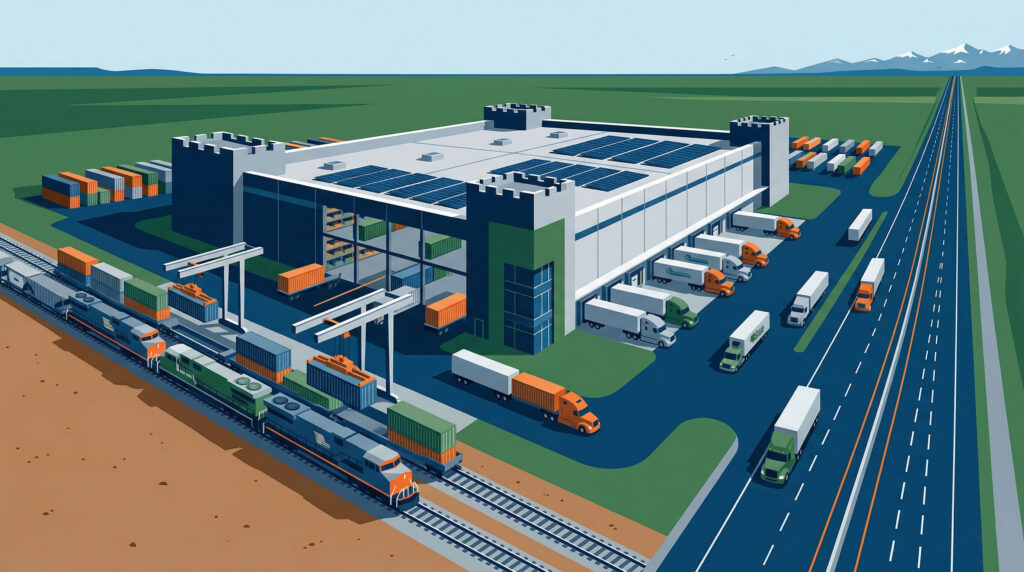

Imagine a massive container ship idling in the Pacific Ocean, its multi-million-dollar cargo held hostage by a blend of labor strikes, port congestion, and geopolitical friction. Now, contrast that image with a sprawling, ultra-modern, one-million-square-foot facility rising from the flat, stable prairie dirt just off Alberta’s Highway 2. For decades, the global economy operated on a razor-thin margin of efficiency, assuming that goods would always flow seamlessly from overseas factories to local store shelves. Today, that assumption has been shattered. In response to unprecedented global supply chain volatility, major retailers, third-party logistics (3PL) providers, and industrial manufacturers are fundamentally rewriting their operational playbooks.
They are moving away from the vulnerable coastlines and establishing a massive, highly engineered logistical fortress in the heart of the Canadian Prairies. The Edmonton-Calgary Corridor—anchored by the Queen Elizabeth II (QEII) Highway—is rapidly transforming into the “Inland Empire” of the North. This transformation is not merely a real estate boom; it is a structural evolution of Canadian commerce. By hoarding inventory in massive Alberta warehouses, utilizing advanced inland ports, and leveraging strategic transportation networks, businesses are building resilience into their supply chains. This comprehensive analysis will educate potential residents, investors, business owners, and technical engineers on the mechanics, economics, and future trajectory of Alberta’s booming logistics corridor.
The following economic facts are based on current Alberta provincial data and market trends.
The Anatomy of a Supply Chain Shift: From “Just-in-Time” to “Just-in-Case”
To understand why millions of square feet of concrete and steel are being poured along the QEII corridor, we must first examine the macroeconomic and historical forces driving modern supply chain theory.
The Fall of the “Just-in-Time” Model
Since the 1970s, global manufacturing and retail have been dominated by the “Just-in-Time” (JIT) inventory management system, pioneered by the Toyota Production System. The goal of JIT was to minimize holding costs by receiving goods only as they were needed in the production process or on the retail floor. While highly efficient in a perfectly predictable world, JIT possesses a fatal flaw: it has zero tolerance for disruption.
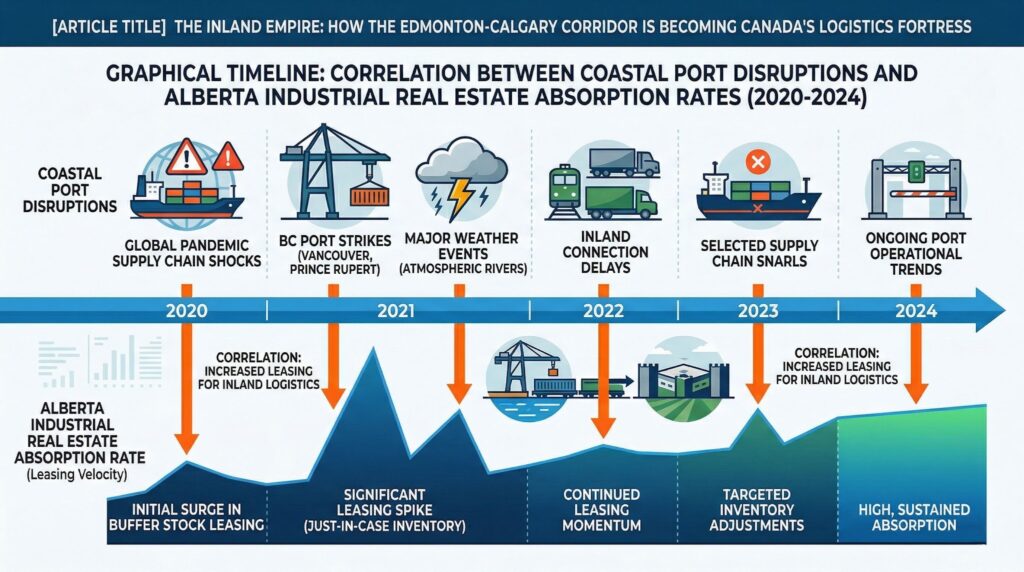
When the COVID-19 pandemic hit, followed by severe weather events in British Columbia that washed out critical rail lines, and subsequent labor strikes at the Ports of Vancouver and Montreal, the JIT model collapsed. Companies experienced the “bullwhip effect,” where small fluctuations in retail demand caused massive disruptions up the supply chain.
The Rise of “Just-in-Case” Inventory
The educational takeaway for business owners and supply chain engineers is the paradigm shift toward “Just-in-Case” (JIC) inventory management. To mitigate the risk of stockouts—which cost companies far more in lost revenue and damaged customer trust than warehouse leases do—corporations are now holding buffer stock.
However, storing buffer stock in coastal cities like Vancouver or Toronto is economically prohibitive due to severe geographic constraints and astronomical land prices. Therefore, logistics planners looked inland. Alberta, with its business-friendly regulatory environment, lack of provincial sales tax, and abundance of developable land, emerged as the ultimate hedge against coastal volatility. The strategy is simple: import goods in bulk through the ports when the gates are open, immediately rail them over the Rocky Mountains, and warehouse them safely in Alberta for gradual distribution across Western Canada and the American Midwest.
The Geographic and Infrastructural Advantage of the QEII Corridor
The Edmonton-Calgary Corridor is a roughly 300-kilometer stretch of land connected by the Queen Elizabeth II Highway. This corridor is the economic engine of Alberta, housing over 70% of the province’s population and generating the vast majority of its GDP. But from a logistics perspective, its value lies in its connectivity.
The CANAMEX Trade Route
The QEII is a critical segment of the CANAMEX Corridor, a series of highways linking Canada, the United States, and Mexico. This designation ensures that infrastructure along this route is maintained to handle high-volume, heavy-haul commercial trucking. For logistics companies, this means uninterrupted, high-speed access to a market of over 50 million consumers within a 24-hour drive, extending deep into the US Pacific Northwest and the Midwest.
Dual-Class I Railway Integration
A logistics fortress cannot survive on asphalt alone; it requires the heavy lifting capacity of rail. The corridor is uniquely serviced by Canada’s two Class I railways:
1.Canadian National Railway (CN): With massive intermodal yards in both Edmonton and Calgary, CN provides direct linkage to the Port of Prince Rupert and the Port of Vancouver, offering a continuous ribbon of steel from Asia to Alberta.
2.Canadian Pacific Kansas City (CPKC): CPKC’s network not only connects Alberta to the West Coast but also offers a singular, uninterrupted rail network stretching from Calgary down through the United States and into Mexico, bypassing highly congested transfer points in Chicago.
Air Cargo Capabilities
For high-value, time-sensitive goods (such as pharmaceuticals, electronics, and specialized engineering components), the corridor is anchored by two major international airports: Edmonton International Airport (YEG) and Calgary International Airport (YYC). Both have invested heavily in dedicated cargo aprons, cold-storage facilities, and 24/7 customs clearance capabilities, ensuring that the corridor can handle multi-modal freight operations.
The Industrial Real Estate Boom: Market Mechanics and Metrics
For commercial real estate investors and business owners looking to establish a footprint, understanding the underlying economics of Alberta’s industrial real estate market is crucial. The growth here is characterized by massive absorption rates and the development of master-planned industrial parks.
Comparative Market Economics
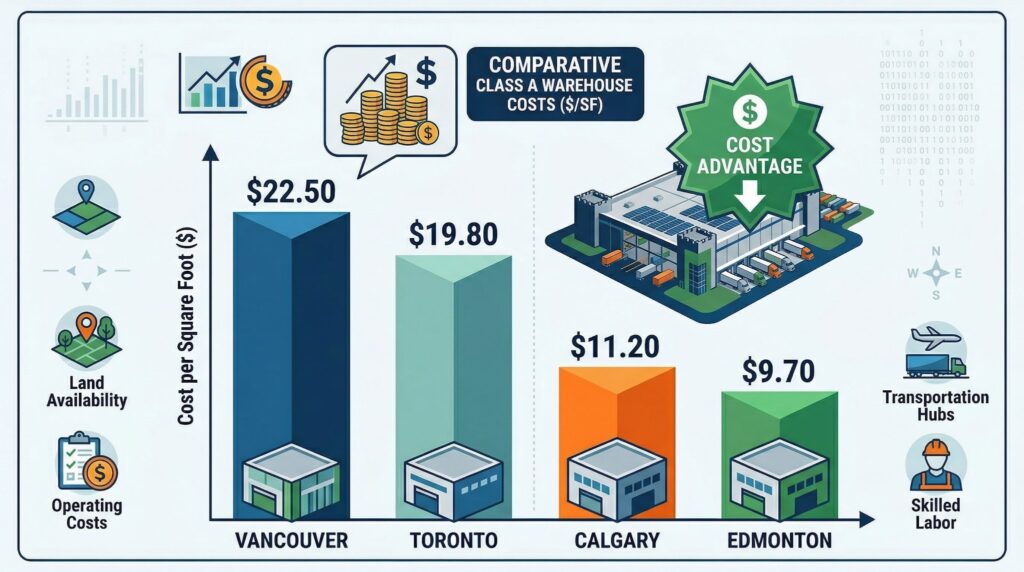
To understand the Alberta advantage, one must look at the cost of space. In the Greater Vancouver Area, industrial land is constrained by the Pacific Ocean, the Coast Mountains, the US border, and the Agricultural Land Reserve (ALR). This scarcity has driven Vancouver industrial lease rates to well over $20 per square foot, with vacancy rates historically hovering near 1%.
Conversely, the Edmonton-Calgary Corridor offers virtually limitless flat topography. This allows developers to build outward and achieve economies of scale.
- Calgary Market: Submarkets like Balzac and Rocky View County, located just north of Calgary city limits, offer developers lower property taxes and immediate access to the QEII. Lease rates here typically range between $10 to $13 per square foot.
- Edmonton Market: Areas such as Nisku, Leduc, and Acheson serve as the northern anchor. Historically dominated by oilfield services, these areas are rapidly diversifying into consumer goods logistics. Lease rates in the Greater Edmonton Area generally range from $9 to $12 per square foot.
Understanding Net Absorption
A key metric for investors is “Net Absorption,” which measures the total square footage occupied minus the total square footage vacated over a specific period. Over the past several years, the Edmonton-Calgary corridor has seen record-breaking positive net absorption, meaning that demand is consistently outstripping the delivery of new supply, even as millions of square feet are built annually. This indicates healthy, sustainable growth rather than a speculative bubble.
Engineering the Modern Mega-Warehouse
The facilities being constructed along the QEII are not the dark, dusty storage sheds of the 20th century. They are highly engineered, technologically advanced distribution centers designed to maximize throughput and accommodate cutting-edge automation. For technical engineers and architects, the specifications of these “Class A” industrial buildings are a study in modern logistics science.
Structural and Architectural Specifications
When evaluating a modern logistics facility in the corridor, several key engineering metrics dictate its value and utility:
- Clear Heights: Historically, warehouses featured 24-foot ceilings. Today, to maximize the cubic volume of the building (allowing for higher pallet racking), developers are building with 36-foot to 40-foot clear heights. This requires advanced structural steel engineering to support the increased wind and snow loads typical of Alberta winters.
- Floor Flatness and Levelness (FF/FL): As companies integrate robotics—such as Automated Storage and Retrieval Systems (AS/RS) and Autonomous Mobile Robots (AMRs)—the concrete slab becomes a critical piece of technology. Floors must be engineered to exacting FF/FL tolerances; a variance of even a few millimeters can cause a high-reaching forklift or a robotic picker to malfunction or tip over.
- Cross-Docking Configuration: To facilitate rapid movement of goods, mega-warehouses are often designed with a “cross-dock” layout. This means the building has loading docks on both sides. Goods arrive from the coast on one side, are sorted in the middle, and are immediately loaded onto outbound regional delivery trucks on the other side, minimizing storage time.
- Power and Thermal Efficiency: Alberta’s extreme climate requires robust HVAC systems. Modern facilities utilize insulated tilt-up concrete panels and sophisticated ESFR (Early Suppression, Fast Response) sprinkler systems. Furthermore, with the electrification of delivery fleets, facilities are being engineered with massive electrical service upgrades to support dozens of EV charging stations for medium-duty trucks.
Inland Ports and Foreign Trade Zones: The Legal and Logistical Mechanics
A critical component of the Edmonton-Calgary Corridor’s success is the utilization of “Inland Ports” and “Foreign Trade Zones” (FTZs). These are not just physical locations, but complex legal and regulatory frameworks designed to facilitate international trade.
What is an Inland Port?
An inland port is a specialized logistics hub located away from traditional coastal borders, designed to process international trade. It features intermodal facilities where shipping containers are seamlessly transferred from trains to trucks.
By utilizing an inland port, a container arriving at the Port of Vancouver does not need to be opened, inspected, and unpacked at the congested coastal terminal. Instead, it is placed directly onto a train “in bond” and shipped to Calgary or Edmonton. The actual customs clearance, deconsolidation, and processing happen in Alberta, saving days or even weeks of transit time.
The Power of the Foreign Trade Zone (FTZ)
Both Calgary and Edmonton have designated FTZ points. For business owners and importers, understanding how an FTZ works is a massive competitive advantage. An FTZ is a specific geographic area where goods can be imported, stored, manufactured, and re-exported without being subject to standard domestic customs duties and taxes at the time of entry.
How to Leverage an FTZ in Alberta:
1.Duty Deferral: A company imports $10 million worth of electronics from Asia to a warehouse in Leduc (an FTZ point). They do not pay duties or GST upon arrival. This frees up significant cash flow. The taxes are only paid when the goods leave the warehouse and enter the Canadian domestic market.
2.Duty Relief on Re-Exports: If that same company takes the electronics, packages them with other components, and exports them to the United States, they may never pay Canadian duties on those goods at all.
3.Value-Added Manufacturing: Businesses can import raw materials, assemble them into finished products within the FTZ, and only pay the tariff rate applied to the finished product, which is often lower than the rate for raw components.
This regulatory environment makes the QEII corridor incredibly attractive for global manufacturers and distributors looking for a North American beachhead.
Human Capital: The Evolution of the Logistics Workforce
The physical infrastructure of the Inland Empire is only as effective as the workforce operating it. As the logistics sector booms, it is fundamentally altering the employment landscape of Alberta, providing a robust diversification away from the province’s traditional reliance on the oil and gas sector.
A New Breed of Jobs
The perception of warehouse work as purely manual labor is outdated. While there is still high demand for forklift operators, order pickers, and truck drivers, the modern supply chain requires a highly skilled, technical workforce.
- Supply Chain Analysts: Professionals who utilize big data, predictive analytics, and AI to forecast demand, optimize routing, and manage inventory levels across the corridor.
- Mechatronics and Robotics Engineers: With the heavy integration of automation in facilities along the QEII, there is a surging demand for technicians who can maintain, program, and repair complex robotic sorting systems and automated conveyors.
- Fleet Managers and Dispatchers: Coordinating the movement of thousands of trucks daily requires sophisticated logistics software and highly trained personnel to ensure compliance with transportation regulations and optimize fuel efficiency.
Educational Infrastructure
Alberta’s post-secondary institutions are rapidly adapting to this shift. The University of Calgary, the University of Alberta, MacEwan University, and SAIT (Southern Alberta Institute of Technology) are expanding their supply chain management degree programs, offering specialized certifications in logistics, procurement, and industrial automation. This ensures a steady pipeline of talent to support the corridor’s long-term growth.
Strategic Guide for Investors and Business Owners
For those looking to capitalize on the transformation of the Edmonton-Calgary Corridor, strategic planning is essential. The landscape is competitive, and success requires a deep understanding of local market dynamics.
Site Selection Criteria
When evaluating where to establish a logistics hub along the QEII, business owners must look beyond the basic lease rate. Total landed cost must be calculated. Key considerations include:
1.Drayage Costs: Drayage is the cost of transporting a container from the rail yard to the warehouse. Facilities located closer to the CN or CPKC intermodal yards in Calgary (like the Dufferin Industrial Park) or Edmonton will save thousands of dollars annually on drayage fees compared to facilities located further out on the periphery.
2.Labor Availability: While land might be cheaper in rural municipalities along the highway, access to a reliable workforce is paramount. Proximity to public transit routes and major residential developments must be factored into site selection.
3.Municipal Tax Rates: Property taxes (often passed on to the tenant in a Triple Net Lease) vary significantly between municipalities. Counties bordering the major cities (such as Rocky View County or Leduc County) often offer highly competitive non-residential mill rates to attract industrial developers away from the city centers.
The Triple Net (NNN) Lease Structure
Investors and tenants must educate themselves on the standard industrial lease structure in Alberta: the Triple Net (NNN) lease. In this arrangement, the base rent (e.g., $11.00 per square foot) is only part of the cost. The tenant is also responsible for their proportionate share of the building’s operating costs, including property taxes, building insurance, and common area maintenance (CAM), which includes snow removal—a significant line item in Alberta. Understanding the historical operating costs of a facility is vital for accurate financial forecasting.
The Future Trajectory: Automation and Sustainability
As we look toward the next decade, the Edmonton-Calgary Corridor will continue to evolve. The next frontier for this logistics fortress involves the integration of sustainable technologies and advanced automation.
Green Logistics
Major corporate tenants, driven by ESG (Environmental, Social, and Governance) mandates, are demanding greener facilities. We are seeing a rise in LEED-certified industrial buildings along the QEII. Developers are reinforcing warehouse roofs to support massive solar panel arrays, utilizing smart LED lighting systems equipped with motion sensors to reduce energy consumption, and implementing sophisticated rainwater harvesting systems for landscaping and industrial use.
Autonomous Freight
The long, straight, and relatively flat nature of the QEII Highway makes it an ideal testing ground for autonomous commercial trucking. Pilot programs are already underway exploring the viability of driverless transport between Edmonton and Calgary. When combined with automated warehouses, the corridor is moving toward a future where a product can be unloaded from a train, stored, and shipped to a regional distribution center with minimal human intervention.
Conclusion
The transformation of the Edmonton-Calgary Corridor into Canada’s Inland Empire is not a temporary reaction to recent supply chain disruptions; it is a permanent structural shift in how goods are moved and stored in North America. By recognizing the vulnerabilities of coastal dependency and the limitations of “Just-in-Time” inventory, the logistics industry has found a stable, expansive, and economically viable home in Alberta.
For technical engineers designing the automated warehouses of tomorrow, for investors seeking stable yields in commercial real estate, and for business owners looking to secure their supply chains against global volatility, the QEII corridor offers unparalleled opportunities. As global trade continues to face geopolitical and environmental headwinds, the logistics fortress built upon the Alberta prairies will stand as a vital, resilient artery of the Canadian and North American economy.
Sources and References
- CBRE Canada: Quarterly Industrial Market Reports (Calgary and Edmonton submarket data, absorption rates, and lease rates).
- Colliers International: National Supply Chain and Industrial Real Estate Trends.
- Statistics Canada: Interprovincial trade flow data and supply chain disruption metrics.
- Government of Alberta: Ministry of Transportation and Economic Corridors (CANAMEX data and infrastructure investments).
- Port Alberta & Calgary Region Inland Port (CRIP): Foreign Trade Zone (FTZ) regulatory guidelines and intermodal logistics data.