


When the average person thinks of the Alberta economy, the immediate association is crude oil, natural gas, and the sprawling oil sands of the north. In recent years, the conversation has expanded to include the lithium rush in the central regions of the province. However, quietly and steadily, the sun-drenched, arid expanses of southeast Alberta are becoming the epicenter of a completely different resource boom. This new frontier is not driven by hydrocarbons, nor is it driven by battery metals. It is driven by helium, a non-flammable, lighter-than-air noble gas that is currently at the center of a global critical mineral crisis.
For potential residents, investors, business owners, and technical engineers looking at the future of the Albertan economy, understanding the helium sector is no longer optional; it is essential. This is not a story about party balloons. This is a story about the fundamental building blocks of modern technology, healthcare, and aerospace. Helium is the invisible lifeblood of the semiconductor manufacturing process, the critical cooling agent for medical imaging equipment, and the essential purging gas for space exploration. As global supplies dwindle and geopolitical tensions threaten traditional supply chains, Alberta is uniquely positioned to provide a reliable, ethical, and economically robust alternative.
The following economic facts are based on current Alberta provincial data and market trends.
The Global Helium Deficit: A Historical and Economic Primer
To understand why Alberta’s helium sector is experiencing such rapid growth, one must first understand the mechanics of the global helium market. Helium is the second most abundant element in the universe, but it is exceptionally rare on Earth. Because it is so light and unreactive, any helium released into the atmosphere simply escapes Earth’s gravity and bleeds into space.
The Collapse of Traditional Supply Chains
Historically, the global helium market was dominated by the United States, specifically through the Federal Helium Reserve located in Amarillo, Texas. Established in the 1920s to ensure a supply of helium for military blimps, this reserve eventually became the primary source of helium for the entire world. However, legislative mandates forced the privatization and sell-off of this reserve, leading to a structural deficit in the global market.
Simultaneously, other major global suppliers, primarily located in Russia and the Middle East, have proven to be volatile. Geopolitical conflicts, trade embargoes, and logistical bottlenecks have repeatedly disrupted the flow of helium to international markets. This combination of a depleting primary reserve and unstable international suppliers has created a chronic, structural shortage. Prices have experienced extreme volatility, prompting end-users in the tech and medical sectors to desperately seek stable, jurisdictionally safe jurisdictions. This is exactly where Alberta enters the equation.
The Geological Lottery: Why Southeast Alberta?
For business owners and investors evaluating the viability of the Alberta helium sector, the first question is often: why here? The answer lies deep beneath the prairie soil, in the unique geological formations of the Western Canadian Sedimentary Basin.
The Mechanics of Helium Formation
Unlike oil and natural gas, which are formed from the decomposition of ancient organic matter, helium is a byproduct of nuclear physics. Deep within the Earth’s crust, radioactive elements such as uranium and thorium undergo natural radioactive decay over billions of years. During this decay process, they emit alpha particles. An alpha particle is simply a helium nucleus. When these nuclei capture two electrons from their surroundings, they become stable helium atoms.
For this helium to be economically viable to extract, three geological conditions must be met simultaneously:
1.A Deep Source: A basement rock layer rich in uranium and thorium to generate the helium over deep geological time.
2.A Migration Pathway: Fractures and faults that allow the buoyant helium gas to migrate upward through the Earth’s crust.
3.An Impermeable Trap: A caprock, usually composed of dense shale or salt, that catches and traps the helium before it can reach the surface and escape into the atmosphere.
Southeast Alberta, particularly the regions stretching from Medicine Hat down to the Montana border, possesses the perfect combination of these three factors. The Precambrian basement rocks in this region are highly radioactive, generating steady streams of helium. The overlying sedimentary layers contain porous reservoirs where the gas accumulates, trapped perfectly by impermeable geological seals.

The Mechanics of Extraction: A Guide for Technical Engineers
For technical engineers and project managers moving to Alberta to work in this burgeoning sector, the extraction and purification of helium present unique, fascinating challenges. Extracting helium is fundamentally different from extracting traditional natural gas, primarily because of the carrier gases involved.
Nitrogen-Rich Reservoirs vs. Hydrocarbon Reservoirs
In many parts of the world, helium is extracted as a minor byproduct of massive liquefied natural gas operations. In these scenarios, the primary gas is methane. However, in southeast Alberta, many of the most promising helium reservoirs are “nitrogen-rich.” This means the gas trapped underground is predominantly nitrogen, with helium concentrations ranging from 0.5 percent to over 2.0 percent. While 1.0 percent might sound small, in the helium industry, anything above 0.3 percent is generally considered highly commercial.
Extracting helium from a nitrogen carrier gas is economically and environmentally advantageous. Because the primary byproduct is nitrogen, an inert and harmless gas that makes up 78 percent of the Earth’s atmosphere, the carbon footprint of these operations is exceptionally low. This is a crucial selling point for ESG-focused investors.
The Purification Process
The process of bringing helium to a market-ready state involves sophisticated chemical engineering and thermodynamics. The standard operating procedure for an Alberta helium facility involves several distinct stages:
- Dehydration and Sweetening: The raw gas is brought to the surface and stripped of any water vapor and trace impurities, such as carbon dioxide or hydrogen sulfide.
- Membrane Separation: The gas is forced through advanced polymer membranes at high pressure. Because helium atoms are incredibly small, they permeate the membrane much faster than the larger nitrogen molecules, allowing for an initial concentration upgrade.
- Pressure Swing Adsorption: The enriched gas is passed through beds of solid adsorbents that selectively capture impurities at high pressure, releasing them when the pressure is lowered.
- Cryogenic Distillation: To achieve the ultra-high purity required by the medical and semiconductor industries (often 99.999 percent purity, known as “Five Nines”), the gas undergoes cryogenic cooling. Because helium has the lowest boiling point of any element on Earth, the nitrogen and other remaining trace gases are liquefied and removed, leaving behind pure gaseous helium.
End-Use Markets: Fueling the Future
To understand the long-term growth mechanics of Alberta’s helium sector, one must analyze the end-use markets. The demand for helium is highly inelastic; for its primary applications, there are no known substitutes.
Medical Imaging and Healthcare
The single largest consumer of global helium is the medical industry, specifically for Magnetic Resonance Imaging machines. MRI machines utilize powerful superconducting magnets to generate highly detailed images of the human body. For these magnets to achieve superconductivity, they must be cooled to absolute zero, or approximately minus 269 degrees Celsius. Liquid helium is the only substance in the universe cold enough to achieve and maintain this temperature. As global healthcare infrastructure expands, particularly in developing nations, the demand for MRI machines, and consequently liquid helium, provides a guaranteed growth vector.
Semiconductor Manufacturing
For the modern economy, semiconductors are as critical as steel was to the industrial revolution. The manufacturing of these microchips is an incredibly delicate process that requires absolute precision and purity. Helium is used extensively in semiconductor fabrication plants for two primary reasons:
1.Inert Environment: Helium is chemically inert, meaning it will not react with the highly sensitive materials used in microchips. It is used to purge manufacturing chambers, creating a perfectly clean environment.
2.Thermal Conductivity: Helium has exceptionally high thermal conductivity. It is used to rapidly and efficiently cool silicon wafers during the intense heat of the deposition and etching processes.
As the world races to build more domestic semiconductor foundries to power artificial intelligence, quantum computing, and electric vehicles, the demand for Alberta’s ethically sourced helium is expected to skyrocket.
Aerospace and Defense
Space exploration and defense contracting represent another massive market. Helium is used to pressurize the fuel tanks of rockets. As liquid oxygen and liquid hydrogen fuel are consumed during a rocket launch, helium is pumped into the tanks to maintain structural integrity and ensure a steady flow of fuel to the engines. The booming commercial space industry relies heavily on a constant supply of high-purity helium.
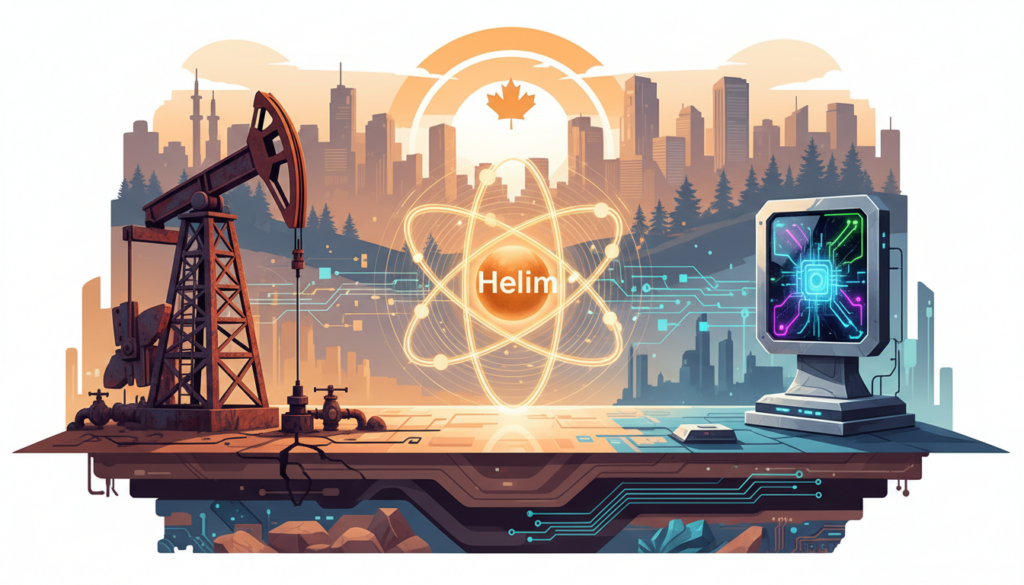
Economic Mechanics: A New Asset Class for Investors
For investors and financial analysts, the Alberta helium sector represents a unique opportunity for portfolio diversification. The economic mechanics of this industry operate on a completely different paradigm than the province’s traditional oil and gas sector.
Decoupling from Oil Volatility
The most attractive feature of the helium market for Albertan investors is its complete detachment from the price of West Texas Intermediate crude oil or natural gas. The boom-and-bust cycles that have historically defined the Alberta economy do not apply to helium. The price of helium is dictated by the demand from the technology and healthcare sectors, providing a counter-cyclical hedge against traditional energy market downturns.
The Regulatory Framework and Royalties
The Government of Alberta has recognized the strategic importance of critical minerals and has implemented a highly favorable regulatory framework to attract capital. In 2020, the province introduced a dedicated helium royalty rate set at a flat 4.25 percent. This is highly competitive on a global scale and provides operators with the fiscal certainty required to make long-term capital expenditure decisions.
Furthermore, the leasing of Crown lands for helium exploration follows a streamlined process modeled after the traditional oil and gas sector. This means that the legal and administrative infrastructure is already in place. Companies do not have to navigate a new, untested bureaucracy; they can leverage the decades of regulatory efficiency that Alberta has built for the hydrocarbon industry.
Job Creation and Skill Transferability
For potential residents and workers, the helium boom offers high-paying, stable employment. The beauty of the helium extraction process is that it utilizes the exact same skill sets that already exist in abundance within Alberta.
- Drilling Engineers: The process of drilling a helium well is virtually identical to drilling a natural gas well.
- Geologists: Seismic mapping and reservoir characterization techniques are directly transferable.
- Pipefitters and Welders: The construction of surface facilities, pipelines, and cryogenic plants requires the exact trades that have built the oil sands and the conventional gas networks.
This seamless transferability of skills means that Alberta has a massive competitive advantage over other global jurisdictions attempting to build a helium industry from scratch. The human capital is already deployed, trained, and ready to pivot to this new critical mineral.
Capital Expenditure and Return on Investment
From a capital allocation perspective, helium projects in southeast Alberta offer highly attractive economics. Unlike massive oil sands mining operations that require billions of dollars in upfront capital and decades to reach payout, helium extraction facilities are highly modular.
A standard helium purification plant can be constructed on a skid-mounted system, allowing for rapid deployment and phased expansion. Investors can fund a pilot plant to prove the reservoir’s commercial viability and then use the cash flow from initial sales to fund the expansion of the facility. This modular approach significantly reduces the initial capital risk and accelerates the timeline to a positive return on investment. Furthermore, because the wells are relatively shallow compared to deep-basin natural gas, drilling costs are kept manageable.
The Long-Term Strategic Outlook
As we look to the next two decades, Alberta’s economic pulse will be increasingly driven by diversification. While the traditional energy sector will remain a cornerstone of the provincial economy, the growth margins will be found in critical minerals.
The global push towards technological sovereignty means that North American end-users will place a massive premium on supply chains that are geographically close and politically stable. The reliance on overseas, adversarial nations for the critical components of healthcare and technology is a risk that global markets are no longer willing to tolerate.
Alberta, with its vast untapped reservoirs in the southeast, its world-class regulatory framework, its highly skilled workforce, and its proximity to the massive technology hubs of the United States, is perfectly positioned to become the dominant player in the global helium market.
For the technical engineer designing the next generation of cryogenic membranes, for the investor looking for ESG-compliant growth decoupled from oil prices, and for the business owner looking to service a rapidly expanding sector, the message is clear. The helium high is not a temporary anomaly; it is a structural shift in the Alberta economy, providing a permanent lift to the province’s future prosperity.
Sources and References
- Government of Alberta: Ministry of Energy and Minerals, Critical Mineral Strategy Reports.
- Alberta Energy Regulator: Helium Production and Royalty Directives.
- United States Geological Survey: Annual Mineral Commodity Summaries (Helium).
- The Canadian Energy Research Institute: Economic Impact of Alternative Gas Extraction.