


The invisible gas that fills party balloons is the same critical element that cools the superconducting magnets in MRI machines, purges the fuel tanks of deep-space rockets, and enables the manufacturing of microscopic semiconductor chips. Helium is the unsung hero of the modern high-tech economy, and the world is currently facing a precarious supply chain bottleneck. For decades, the global market relied on a massive strategic stockpile in the United States, but as that reserve depletes, a desperate search for reliable, geopolitically stable sources has commenced. Enter southeast Alberta. Beneath the sun-drenched prairies lies a world-class geological anomaly: vast reservoirs of high-grade helium trapped in non-hydrocarbon carrier gases. However, possessing the resource is only half the battle. Alberta is currently caught in a massive economic arbitrage, exporting raw, gaseous helium at a steep discount simply because it lacks the domestic infrastructure to liquefy it.
The following economic facts are based on current Alberta provincial data and market trends.
This comprehensive analysis will explore the geological mechanics of Alberta’s helium play, the engineering realities of cryogenic liquefaction, and the immense economic potential of securing the first-mover advantage in the liquid helium export race. For investors, technical engineers, and policymakers, understanding this arbitrage is the key to unlocking Alberta’s next great energy frontier.
Part 1: The Geological Advantage of Southeast Alberta
To understand why southeast Alberta is uniquely positioned to become a global helium powerhouse, one must first understand the origins of the element itself. Unlike natural gas or oil, which are formed from the decomposition of ancient organic matter, helium is a product of radioactive decay.
The Deep Earth Mechanics
Deep within the Earth’s crust, radioactive elements such as uranium and thorium undergo natural decay over hundreds of millions of years. This process emits alpha particles, which are essentially helium nuclei. Once these nuclei capture two electrons, they become stable helium atoms. Because helium is the second lightest element in the universe and highly volatile, it naturally migrates upward through the Earth’s crust. Most of it escapes into the atmosphere and is eventually lost to space.
However, in specific geological formations, this upward migration is halted by impermeable cap rocks—often halite (salt) or dense shale formations. In southeast Alberta, particularly near the Saskatchewan border and the Bow Island arch, the geological conditions are perfect for trapping this migrating gas.
The “Green” Helium Advantage
Historically, helium has been produced as a byproduct of natural gas (methane) extraction. In places like Qatar or the United States, natural gas streams contain small fractions of helium (often between 0.1% and 0.5%). Extracting this helium requires producing massive amounts of carbon-emitting fossil fuels.
Southeast Alberta offers a distinct, highly marketable alternative: Green Helium. The geological traps in this region capture helium alongside nitrogen, rather than methane.
- Nitrogen Carrier Gas: The primary gas in these reservoirs is inert nitrogen, making up over 90% of the volume.
- High Concentrations: Helium concentrations in southeast Alberta frequently exceed 1.0%, and in some localized strikes, have surpassed 1.5% to 2.0%. In the helium industry, anything above 0.3% is considered highly economic.
- Low Carbon Footprint: Because the carrier gas is nitrogen, extracting helium in Alberta does not result in the production of greenhouse gases. The nitrogen can be safely vented back into the atmosphere (which is already 78% nitrogen), resulting in an exceptionally low-carbon resource. This is a critical selling point for ESG-conscious tech and medical companies.

Part 2: The Mechanics of the Current Arbitrage
Despite this incredible geological wealth, Alberta is currently leaving massive amounts of capital on the table. To understand why, we must examine the economics of helium transportation and the concept of the “Helium Arbitrage.”
The Gaseous vs. Liquid State
Helium is extracted from the ground as a gas. It is purified on-site using Pressure Swing Adsorption (PSA) or membrane technologies to reach a purity of 99.999% (often referred to as “Five Nines” purity).
Once purified, the gas must be transported to end-users. This is where the physical properties of helium become an economic hurdle. Helium is incredibly light and non-dense.
- Gaseous Transport: To transport helium as a gas, it must be compressed to extremely high pressures (up to 3,000 psi) into specialized, heavy steel tube trailers. A standard heavy-duty tube trailer can only hold approximately 300,000 cubic feet (Mcf) of gaseous helium.
- Liquid Transport: If helium is cooled to its liquid state, its volume shrinks drastically. A specialized cryogenic ISO container (a large, vacuum-insulated thermos) carrying liquid helium can hold the equivalent of 1,000,000 cubic feet (1 MMcf) of gaseous helium.
The Transportation Bottleneck
Because gaseous helium is so inefficient to transport, it is economically unviable to ship it overseas or over vast continental distances. Gaseous helium must be sold to localized markets or transported to a regional liquefaction facility.
Currently, Western Canada does not possess a commercial-scale helium liquefaction facility.
Therefore, Alberta producers are forced into a compromised position:
- They extract and purify the helium to 99.999%.
- They compress it into gaseous tube trailers.
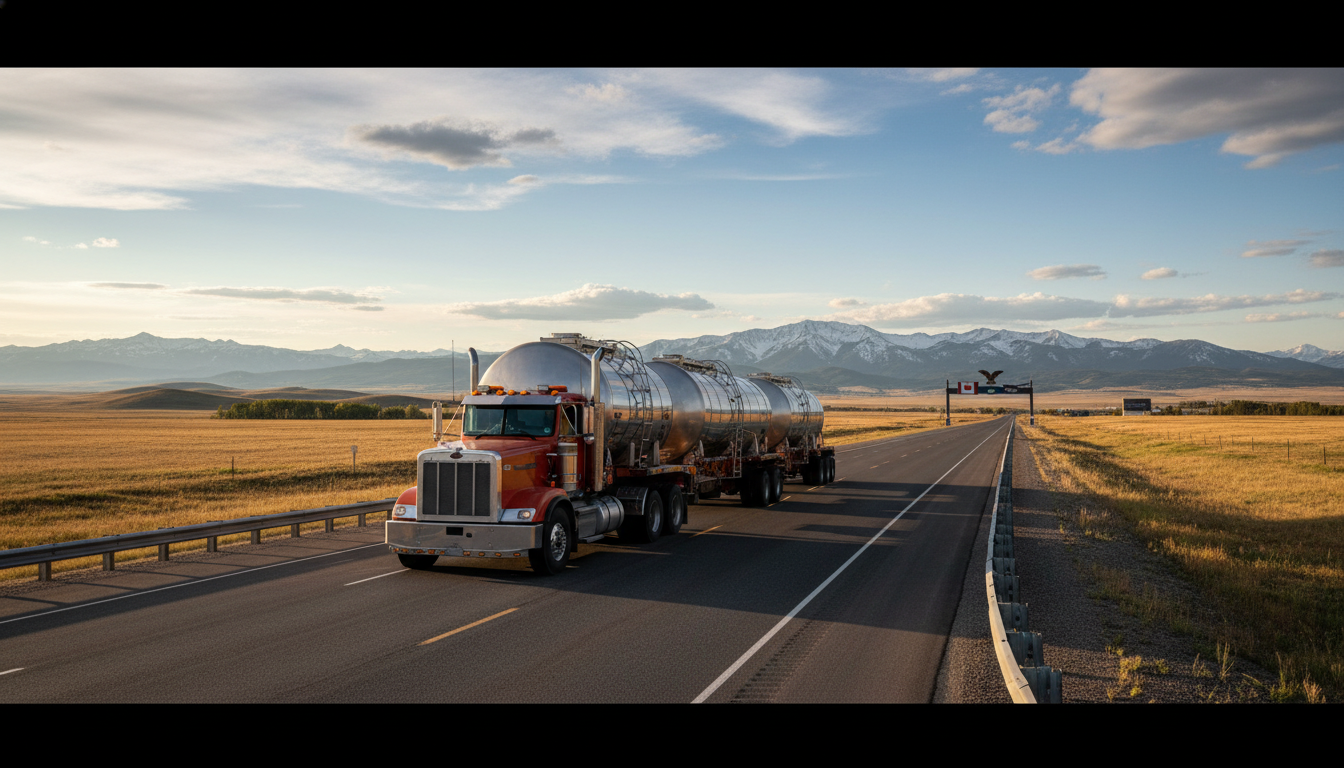
- They truck these heavy trailers hundreds or thousands of kilometers south into the United States (typically to Colorado, Wyoming, or Kansas), where American liquefaction facilities are located.
The Arbitrage Spread
This supply chain reality creates a massive arbitrage opportunity for the American midstream companies that own the liquefiers.
- Alberta producers must sell their gaseous helium at a “wholesale” or “toll” rate, heavily discounted to account for the transportation costs and the liquefaction fees.
- The American facility liquefies the Alberta helium, loads it into an ISO container, and sells it onto the global market at the premium “Liquid Helium” spot price.
The price discrepancy is staggering. While long-term contract pricing is closely guarded by the industry oligopoly, spot market prices for liquid helium have frequently spiked above $1,000 to $2,000 per Mcf during recent global shortages. Gaseous wholesale prices are significantly lower. By exporting raw gas, Alberta is effectively acting as a low-margin resource quarry, rather than a high-margin technology exporter.
Part 3: The Science and Engineering of Liquefaction
If the economic case for building a liquefaction facility is so strong, why hasn’t one been built in southeast Alberta yet? The answer lies in the extreme engineering challenges and the intense capital expenditure (CapEx) required to achieve cryogenic temperatures.
The Physics of Absolute Zero
Helium has the lowest boiling point of any element in the universe. To turn helium gas into a liquid, it must be cooled to -269 degrees Celsius (-452 degrees Fahrenheit), which is just 4.2 Kelvin—a mere fraction of a degree above absolute zero.
Achieving this temperature is not a simple matter of industrial refrigeration. It requires a highly complex, multi-stage cryogenic engineering process.
The Claude Cycle
The most common method for liquefying helium is a variation of the Claude Cycle, which involves compression, expansion, and heat exchange:
- Compression: The purified helium gas is compressed to high pressures. This process generates significant heat, which must be removed using standard water or air-cooling systems.
- Pre-Cooling: The compressed gas is pre-cooled. Historically, liquid nitrogen (-196°C) was used for this stage, but modern facilities often use specialized mechanical chillers to bring the temperature down.
- Expansion Turbines: The chilled, compressed gas is then forced through a series of expansion turbines. As the gas expands, it performs work (spinning the turbine), which rapidly removes energy from the gas, dropping its temperature drastically.
- The Joule-Thomson Valve: Finally, the ultra-cold gas is forced through a tiny orifice known as a Joule-Thomson valve. The sudden pressure drop causes a final, rapid cooling effect, pushing a portion of the gas across the threshold into a liquid state.
- Recirculation: The portion of the gas that did not liquefy is extremely cold. It is routed back through heat exchangers to help cool the incoming stream of new gas, creating a highly efficient, closed-loop thermal system.
Capital and Operational Expenditures
Building a commercial-scale helium liquefier is a massive undertaking.
- CapEx: A facility capable of processing the output of several southeast Alberta wellpads can cost anywhere from $50 million to $150 million CAD, depending on the scale and the supporting infrastructure required. The specialized compressors, turbo-expanders, and vacuum-insulated piping must be manufactured to exacting tolerances to prevent leaks, as helium atoms are small enough to slip through solid steel if it is not properly treated.
- OpEx: The operational expenditure is heavily tied to electricity. Compressing gas and running cryogenic chillers requires massive amounts of continuous, reliable baseload power. Alberta’s deregulated electricity market and robust natural gas grid provide a strong foundation for this, but the power costs must be factored into the economic models.
Part 4: The Global Macroeconomic Context
To justify the immense capital required to build a liquefaction hub in southeast Alberta, investors must look beyond local economics and understand the global macroeconomic forces driving helium demand and restricting global supply.
The Fall of the US Federal Helium Reserve
For over half a century, the global helium market was artificially stabilized by the United States Federal Helium Reserve, located in Amarillo, Texas. Established during the Cold War to ensure a supply of helium for military blimps and aerospace applications, the Reserve amassed billions of cubic feet of helium, stored underground in the Bush Dome reservoir.
In 1996, the US government passed the Helium Privatization Act, mandating the sell-off of the reserve to pay down the debt incurred to build it. For decades, this sell-off flooded the global market with cheap helium, artificially depressing prices and discouraging private exploration globally.
However, that era is now over. The Federal Reserve has been effectively depleted and transferred to private ownership. The safety net that protected the global tech and medical industries has vanished. The market has shifted from a state-subsidized surplus to a structural, structural deficit.
Geopolitical Vulnerabilities
With the US Reserve offline, the world has become dangerously reliant on a few highly volatile jurisdictions for liquid helium.
- Qatar: Qatar is currently one of the world’s largest producers of liquid helium, extracting it as a byproduct of its massive Liquefied Natural Gas (LNG) industry. However, Qatar’s supply is entirely dependent on maritime shipping routes through the Strait of Hormuz and the Red Sea. Recent geopolitical tensions and maritime blockades have proven how fragile this supply chain is. If a ship carrying liquid helium is delayed, the product literally boils off into the atmosphere.
- Russia: Prior to 2022, Russia was poised to become a dominant player in the helium market with the construction of the massive Amur gas processing plant in Siberia. However, a series of catastrophic fires at the facility, combined with severe international sanctions following the invasion of Ukraine, have effectively removed Russian helium from Western supply chains.
The Alberta Premium
In this context, southeast Alberta offers something that neither Qatar nor Russia can: Geopolitical Stability.
For a semiconductor manufacturer in Taiwan or an MRI manufacturer in Germany, a long-term off-take agreement for liquid helium from Alberta represents supply chain security. Buyers are willing to pay a premium for a reliable, democratic, and environmentally friendly (nitrogen-based) source of helium. This geopolitical reality significantly de-risks the CapEx required to build a liquefaction facility in the province.
Part 5: The Economic Impact of the First-Mover Advantage
If a consortium of producers, midstream companies, or government-backed entities successfully builds the first commercial-scale helium liquefaction facility in southeast Alberta, the economic ripple effects will fundamentally alter the provincial economy. This is the essence of the First-Mover Advantage.
1. Capturing the Full Value Chain
The most immediate impact is the elimination of the arbitrage. By liquefying the product domestically, Alberta producers can sell directly into the global spot market or secure lucrative, long-term international off-take agreements. The margin that is currently being surrendered to American midstream facilities will remain in Alberta. This will dramatically increase the profitability of existing helium wells and accelerate the payout period for exploration companies.
2. The Hub-and-Spoke Aggregation Model
A single liquefaction facility will act as a gravitational center for the entire Western Canadian helium industry.
- The Hub: The liquefaction plant acts as the central hub.
- The Spokes: Because gaseous helium can be economically trucked over short distances (e.g., 200 to 400 kilometers), exploration companies in southwestern Saskatchewan and central Alberta will truck their gaseous output to the southeast Alberta hub.
The entity that owns the liquefier will not only profit from its own helium production but will also generate immense revenue through tolling agreements—charging a fee to liquefy the gas of other regional producers. The first mover establishes a localized monopoly on liquid export.
3. High-Tech Job Creation and Brain Gain
The operation of a cryogenic liquefaction facility requires highly specialized skills. It creates a demand for:
- Cryogenic engineers and thermodynamic specialists.
- Advanced instrumentation and control technicians.
- Logistics experts specializing in the transport of hazardous and ultra-cold materials.
This represents a significant pivot from traditional oil and gas jobs, offering a pathway for Alberta’s existing energy workforce to transition their skills into a high-tech, future-proof industry.
4. Downstream Industry Attraction
Historically, energy-intensive and resource-dependent industries cluster near their primary inputs. If Alberta can guarantee a stable, abundant supply of liquid helium, it becomes an attractive jurisdiction for downstream secondary industries.
- Medical Tech: Facilities that manufacture or service MRI machines and superconducting magnets could establish regional bases in Alberta.
- Aerospace: With a growing space industry in Canada, local access to liquid helium for rocket propulsion purging is a strategic asset.
- Quantum Computing: The next frontier of computing relies heavily on ultra-low temperatures to maintain the stability of qubits. A local liquid helium supply chain positions Alberta as a viable hub for quantum research and development.
Part 6: Navigating the Regulatory and Investment Landscape
To realize this first-mover advantage, stakeholders must navigate Alberta’s regulatory framework and secure the necessary capital. Fortunately, the provincial government has recognized the strategic importance of critical minerals and rare gases.
The Regulatory Framework
Helium exploration and production in Alberta are governed by the Alberta Energy Regulator (AER) and the Department of Energy and Minerals.
- Royalty Rates: Alberta has established a highly competitive royalty framework for helium. Recognizing the high upfront costs of exploration and the strategic need to grow the industry, the provincial royalty rate for helium is set at a flat 4.25%. This is significantly lower than the sliding scale royalties applied to conventional oil and gas, providing long-term fiscal certainty for investors.
- Tenure and Leasing: The province has streamlined the process for acquiring helium and associated gas rights. Unlike the complex, fractured land rights often seen in the United States, Alberta’s Crown land system allows companies to secure large, contiguous blocks of land, which is essential for mapping and developing expansive helium reservoirs.
Capital Strategies and Government Support
Raising $100 million for a first-of-its-kind facility in a nascent industry requires creative capital strategies. Traditional debt financing from major banks can be difficult to secure without proven cash flows from an existing liquefier.
Therefore, the capital stack for the first liquefaction hub will likely require a blend of:
- Equity Financing: Risk-tolerant institutional investors, private equity firms specializing in critical minerals, and venture capital.
- Producer Consortiums: Rather than a single company bearing the risk, multiple helium exploration companies could form a joint venture, pooling their capital to build a shared midstream asset.
- Government Grants and Incentives: Both the provincial and federal governments offer programs aimed at critical mineral development and emissions reduction.
- The Alberta Petrochemicals Incentive Program (APIP) or similar future iterations could potentially be leveraged or adapted to support cryogenic infrastructure.
- Federal funding through the Strategic Innovation Fund (SIF) is a viable avenue, as securing a domestic supply of liquid helium aligns perfectly with Canada’s critical minerals strategy and national security interests.
Part 7: A Strategic Roadmap to Liquefaction
For the engineers, project managers, and executives tasked with building this industry, a clear roadmap is required. The transition from raw gas exporter to global liquid supplier involves several distinct phases.
Phase 1: Resource Delineation and Proving Reserves
Before a liquefier can be financed, the resource must be proven. Lenders and investors require absolute certainty that there is enough helium in the ground to feed the facility for a minimum of 15 to 20 years.
- Action: Extensive seismic surveying, exploratory drilling, and reservoir modeling in the Bow Island arch and surrounding geological formations.
- Metric: Securing independently verified resource estimates (e.g., NI 51-101 compliant reports) demonstrating sufficient recoverable volumes of high-concentration helium.
Phase 2: Securing Off-Take Agreements
A liquefaction facility cannot be built “on spec.” The financial models require guaranteed revenue streams.
- Action: Negotiating long-term, take-or-pay contracts with major global industrial gas distributors (Tier 1 distributors) or direct end-users (e.g., semiconductor foundries).
- Metric: Having 60% to 80% of the facility’s future liquid capacity pre-sold under binding contracts, providing the necessary collateral to secure construction debt.
Phase 3: Front-End Engineering Design (FEED)
Cryogenic engineering leaves no room for error. The design phase is critical to ensuring the facility operates efficiently and safely.
- Action: Engaging specialized cryogenic engineering firms to design the Claude Cycle process, select the appropriate compressors and turbo-expanders, and map out the power and water requirements.
- Metric: Completion of a bankable feasibility study and a finalized FEED package that provides a definitive cost estimate (Class 3 or better).
Phase 4: Logistics and Supply Chain Integration
Producing liquid helium is useless if it cannot be transported to the buyer.
- Action: Procuring a fleet of highly specialized, vacuum-insulated ISO containers. These containers are manufactured by a limited number of companies globally, and wait times can stretch into years.
- Action: Establishing rail or heavy-haul trucking logistics to transport the ISO containers from southeast Alberta to major deep-water ports (e.g., Vancouver or Prince Rupert) for export to Asian markets, or via rail to major US manufacturing hubs.
Phase 5: Construction and Commissioning
The final hurdle is the physical construction of the plant.
- Action: Managing the complex supply chain of specialized cryogenic equipment, ensuring rigorous quality control on all welding and piping to prevent microscopic helium leaks, and securing reliable baseload power connections from the Alberta grid.
- Metric: Successful start-up, achieving stable temperatures of 4.2 Kelvin, and filling the first commercial ISO container with liquid helium.
Part 8: The Cost of Inaction
While the challenges of building a domestic liquefaction hub are substantial, the cost of inaction is far greater. If southeast Alberta fails to secure the first-mover advantage, the window of opportunity may close.
Neighboring jurisdictions, particularly Saskatchewan, are also aggressively pursuing their own helium resources. If a liquefaction hub is built across the provincial border first, the economic gravity will shift. Alberta producers would simply redirect their raw gas trucking routes from the US to Saskatchewan, perpetuating the arbitrage and permanently locking Alberta into the role of a low-margin resource provider.
Furthermore, the global market will not wait. If North America cannot provide stable supplies of liquid helium, end-users will eventually engineer helium out of their processes, or look to emerging projects in Africa or Australia. The demand is immediate, and the supply deficit is real.
Conclusion: Alberta’s Next Great Export
Southeast Alberta stands at an economic crossroads. Beneath the soil lies a vast, green, and highly concentrated supply of one of the world’s most critical elements. The geological lottery has been won. The challenge now is entirely industrial and financial.
The Helium Arbitrage is a temporary inefficiency in the market—a gap between the raw resource and the global demand. By deploying capital, leveraging world-class engineering, and capitalizing on a favorable regulatory environment, Alberta has the opportunity to close that gap. Building a commercial-scale liquid helium export hub will not only eliminate the wholesale discount but will position the province as an indispensable node in the global high-tech supply chain. The race for the first-mover advantage has begun, and the prize is a permanent, lucrative foothold in the economy of the future.
Sources and References
- Alberta Energy Regulator (AER): Data regarding provincial royalty frameworks, tenure leasing, and historical well data for non-hydrocarbon gases.
- Government of Alberta – Department of Energy and Minerals: Policy documents on critical mineral strategies and the Alberta Petrochemicals Incentive Program (APIP).
- United States Geological Survey (USGS): Historical data and statistical summaries regarding the depletion and privatization of the US Federal Helium Reserve.
- Cryogenic Society of America: Engineering parameters, thermodynamic principles, and baseline capital expenditure estimates for Claude Cycle helium liquefaction facilities.
- Global Market Insights / Gasworld: Spot market pricing trends, global supply chain disruption analysis (Qatar/Russia), and demand forecasting for semiconductor and MRI manufacturing.