
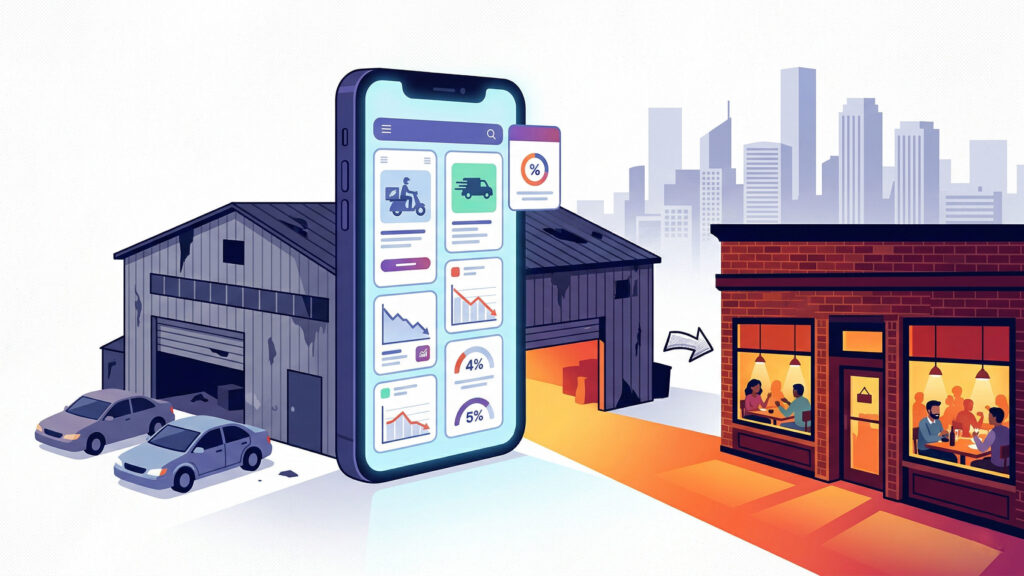

The year was 2021, and the commercial industrial parks of Calgary and Edmonton were buzzing with a new kind of energy. Unmarked warehouses, previously home to light manufacturing or logistics firms, were suddenly ringed by fleets of idling sedans and glowing smartphone screens. Inside, high-octane commercial kitchens were churning out pad thai, smash burgers, and artisanal pizzas—all under a dozen different digital brand names, yet cooked on the exact same griddle. This was the era of the “ghost kitchen,” a delivery-only restaurant model that promised to strip away the high overhead of traditional dining and usher in a hyper-efficient, tech-driven future of food service.
Fast forward to today, and the landscape looks drastically different. The neon glow of the delivery apps remains, but the underlying economics of the ghost kitchen model have violently collided with reality. Squeezed by exorbitant third-party delivery fees, relentless food inflation, and a consumer base that has enthusiastically returned to physical dining rooms, the ghost kitchen sector in Alberta is undergoing a brutal shakeout. Bankruptcies have quietly rippled through the industry, leaving behind empty stainless-steel prep stations and a profound lesson in the limits of digital disruption in the hospitality space.
This deep-dive analysis investigates the mechanics of the boom, the economic realities driving the current bust, the strategies of the resilient survivors, and how traditional brick-and-mortar restaurants in Alberta are reclaiming their territory. Whether you are a commercial real estate investor looking at industrial asset classes, a business owner navigating the food and beverage sector, or a technical engineer analyzing supply chain logistics, understanding this shakeout is crucial to grasping the modern Alberta consumer economy.
The following economic facts are based on current Alberta provincial data and market trends.
The Genesis of the Ghost Kitchen: A Pandemic Phenomenon
To understand the current contraction, we must first educate ourselves on the macroeconomic and behavioral conditions that created the ghost kitchen bubble.
The Perfect Storm of 2020
When global health mandates shuttered traditional dining rooms across Alberta, the restaurant industry faced an existential crisis. However, consumer demand for prepared food did not disappear; it simply shifted mediums. This shift catalyzed the rapid acceleration of the ghost kitchen—also known as dark kitchens, cloud kitchens, or virtual dining concepts.
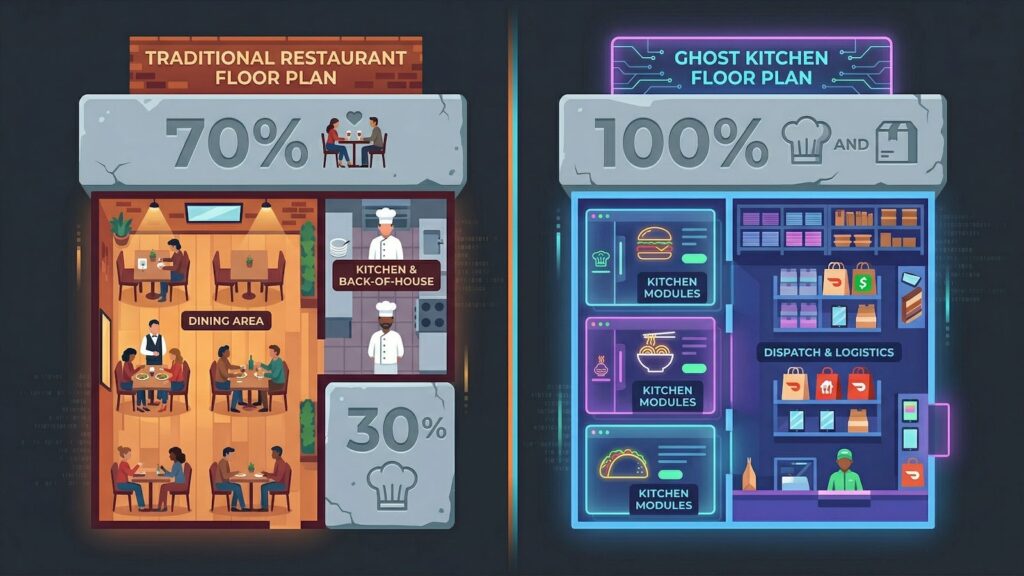
The premise was intoxicatingly simple and economically logical at the time:
1.Eliminate Front-of-House Labor: No servers, no hosts, no bussers, and no bartenders.
2.Slash Real Estate Costs: Instead of paying premium lease rates for high-foot-traffic retail spaces on Calgary’s 17th Avenue or Edmonton’s Whyte Avenue, operators could lease cheap light-industrial space in the suburbs.
3.Maximize Kitchen Utilization: A single physical kitchen space could operate five to ten different “virtual brands” on a delivery app. If tacos were trending, the kitchen spun up a digital taco brand. If demand shifted to grain bowls, the menu was updated algorithmically without changing the physical signage.
Alberta’s Unique Adoption Dynamics
Alberta provided a uniquely fertile ground for this experiment. The province boasts a highly suburbanized population with significant urban sprawl. Cities like Calgary and Edmonton have massive geographic footprints, making delivery logistics a complex but highly demanded service. Furthermore, during the early 2020s, Alberta’s commercial real estate market, particularly in light industrial sectors, offered competitive lease rates compared to markets like Vancouver or Toronto. Investors and tech aggregators poured millions into building mega-kitchens in areas like Calgary’s Foothills Industrial Park and Edmonton’s south-side industrial corridors, betting that the pandemic-induced shift to delivery was a permanent structural change in consumer behavior.
The Economics of Delivery-Only Dining
To educate investors and business owners on why the shakeout occurred, we must dissect the unit economics of a delivery-only meal. The ghost kitchen model relied on a concept known as margin arbitrage—trading the fixed costs of real estate and labor for the variable costs of delivery platform fees.
The Promise vs. The Reality of Margins
In a traditional Alberta brick-and-mortar restaurant, the prime costs (Cost of Goods Sold + Labor) typically consume 60% to 65% of revenue. Rent, utilities, and marketing consume another 20% to 25%, leaving a razor-thin net profit margin of roughly 5% to 10%.
Ghost kitchen evangelists argued that by dropping rent from 10% of revenue down to 3%, and eliminating front-of-house labor, they could achieve net margins of 15% to 20%. However, this calculation fatally underestimated the predatory pricing power of third-party delivery aggregators (e.g., SkipTheDishes, UberEats, DoorDash).
The Crushing Weight of Platform Fees
Delivery platforms operate as a duopoly or triopoly in most Canadian markets. Because ghost kitchens have no physical storefront, they are 100% reliant on these platforms for customer acquisition and order fulfillment. This extreme dependency allowed delivery apps to extract immense value from the transaction.
Let us break down the unit economics of a hypothetical $30 order from an Alberta ghost kitchen:
- Gross Order Value: $30.00
- Cost of Goods Sold (Food/Packaging): $9.00 (30%)
- Kitchen Labor: $6.00 (20%)
- Delivery App Commission (Standard 25% to 30%): $8.50
- In-App Advertising (Required for visibility): $3.00
- Overhead (Rent/Utilities/Insurance apportioned): $2.00
- Net Profit: $1.50 (A mere 5% margin)
As the data shows, the savings realized from cheaper real estate and reduced labor were entirely consumed by the digital toll booths of the delivery apps. Furthermore, as the apps became crowded with thousands of virtual brands, ghost kitchens were forced to spend heavily on in-app advertising just to appear on the first page of a user’s search results. The customer acquisition cost skyrocketed, destroying the foundational economic premise of the model.
The Shakeout: Why the Bubble Burst in Alberta
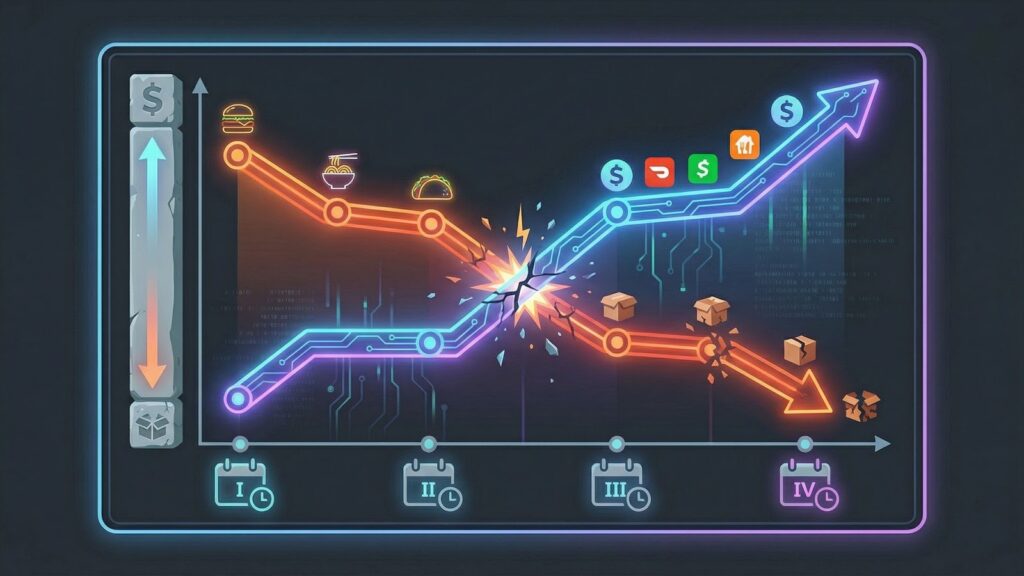
By late 2022 and accelerating through 2024, the structural flaws of the ghost kitchen model collided with harsh macroeconomic realities. The result has been a wave of quiet closures, lease defaults, and corporate restructuring within the Alberta food service sector.
Macroeconomic Headwinds: Inflation and Interest Rates
The Bank of Canada’s aggressive interest rate hiking cycle fundamentally altered the capital environment. Ghost kitchens, many of which were backed by venture capital or heavily leveraged local investment groups, suddenly faced soaring debt servicing costs.
Simultaneously, Alberta experienced significant food inflation. The cost of raw inputs—beef, poultry, cooking oil, and imported produce—surged. Traditional restaurants could mitigate some of this by raising menu prices and enhancing the “dining experience” to justify the cost. Ghost kitchens, however, compete almost entirely on price and convenience. When a delivered fast-food burger combo approaches $25 due to inflation and delivery fees, consumer elasticity snaps.
Changing Consumer Habits: The Return of the Experience Economy
The most profound miscalculation by ghost kitchen operators was psychological. They viewed food purely as a utility—calories delivered efficiently. But human beings, and Albertans in particular, view dining as a social experience.
As pandemic restrictions lifted, consumers rushed back to physical spaces. They craved the ambiance of a bustling Calgary steakhouse, the community feel of an Edmonton neighborhood pub, and the sensory experience of food served fresh from the kitchen to the table. The willingness to pay a premium for food dying in a cardboard box in the backseat of a delivery driver’s car plummeted.
The Real Estate Trap
The final nail in the coffin for many operators was the shifting dynamic of Alberta’s industrial real estate market. While retail storefronts struggled during the pandemic, industrial real estate boomed due to the rise of e-commerce warehousing and logistics. Operators who signed short-term leases for their ghost kitchens in 2020 found themselves facing massive rent escalations upon renewal. The “cheap rent” arbitrage disappeared, leaving operators with high rent, high delivery fees, and declining order volumes.
The Survivors: Who is Still Thriving and How?
Despite the carnage, the ghost kitchen concept is not entirely dead; it is evolving. The operators who are surviving—and in some cases, thriving—have abandoned the “growth at all costs” venture capital mindset and embraced rigorous operational efficiency and targeted niche strategies.
1. Niche Specialization and Dietary Silos
The surviving independent ghost kitchens in Alberta have realized they cannot compete with McDonald’s or local chain restaurants on general comfort food. Instead, they are dominating highly specific, underserved dietary niches.
- Celiac and Gluten-Free: Dedicated gluten-free facilities that guarantee zero cross-contamination.
- Strict Vegan/Plant-Based: Catering to a growing demographic that struggles to find reliable delivery options.
- Halal Verification: Serving Alberta’s growing diverse immigrant population with strictly certified halal virtual brands.
By dominating a niche, these kitchens build fierce brand loyalty, allowing them to eventually drive traffic to their own direct-ordering websites and bypass the 30% delivery app commissions.
2. The Hybrid Model: The Takeout Window Pivot
Pure delivery-only facilities are pivoting to become “hybrid” models. Operators are retrofitting their industrial spaces to include small, attractive takeout windows. By encouraging customers to pick up their food directly, the restaurant captures the full margin of the sale. This strategy is particularly effective in densely populated suburban nodes in Calgary (like the deep south or northwest corridors) where consumers are willing to drive five minutes to save $10 on delivery and service fees.
3. Tech-Enabled Efficiency and Data Engineering
For the technical engineers and data scientists analyzing this space, the surviving mega-kitchens are a masterclass in operational optimization. The survivors are utilizing advanced tech stacks to protect their margins:
- Predictive AI Prep: Using machine learning algorithms to analyze local weather patterns, local sporting events (e.g., Edmonton Oilers or Calgary Flames game nights), and historical ordering data to predict exactly how much inventory to prep. This reduces food waste from the industry standard of 5% down to under 2%.
- Kitchen Flow Optimization: Engineers have redesigned the physical layout of the cooking stations to minimize the physical steps a line cook takes, shaving seconds off each order and increasing hourly throughput.
- API Integration Consolidation: Using middleware software to funnel orders from UberEats, SkipTheDishes, DoorDash, and direct websites into a single, unified kitchen display system (KDS), reducing error rates and the need for dedicated expeditor staff.
The Empire Strikes Back: Traditional Brick-and-Mortar Retaliates
Perhaps the most fascinating economic development in this saga is how traditional Alberta restaurants have adapted. Rather than being replaced by ghost kitchens, savvy brick-and-mortar operators have reverse-engineered the ghost kitchen model to strengthen their own balance sheets.
The Rise of the “Host Kitchen”
Traditional restaurants realized they had a massive hidden asset: underutilized kitchen capacity. A breakfast and lunch diner in Red Deer, for example, has a fully equipped commercial kitchen that sits dormant from 4:00 PM to 6:00 AM.
Enter the “Host Kitchen” model. Traditional operators are now creating their own virtual brands to operate during off-peak hours or alongside their main menu. A popular Italian restaurant might launch a delivery-only “Late Night Smash Burger” brand on the apps. Because the restaurant is already paying rent, utilities, and has salaried managers on-site, the marginal cost of running this virtual brand is incredibly low. The traditional restaurant effectively uses the ghost kitchen concept to subsidize its primary operations.
Reclaiming the Customer Data
Traditional operators have also recognized the danger of letting delivery apps own the customer relationship. When a customer orders via a third-party app, the restaurant does not receive the customer’s email address or demographic data.
To combat this, Alberta restaurant groups are investing heavily in first-party ordering infrastructure. They are incentivizing customers to order directly through the restaurant’s website by offering lower menu prices, loyalty points, and free localized delivery using their own hired drivers. By reclaiming the data, restaurants can engage in targeted email marketing, driving repeat business without paying a toll to a tech aggregator.
Doubling Down on the “Experience”
Ultimately, brick-and-mortar restaurants are fighting back by emphasizing what a ghost kitchen can never provide: hospitality. Operators are investing in interior design, hiring better-trained front-of-house staff, and creating unique, Instagram-worthy dining environments. They are leaning into the fact that going out to eat is a form of entertainment. In a post-pandemic world, Albertans are demonstrating a clear willingness to pay for an experience, signaling that the future of food service remains deeply rooted in human connection.
Lessons for Investors and Business Owners
The rise and fall of the pure-play ghost kitchen in Alberta offers profound educational lessons for anyone involved in the regional economy, real estate, or venture capital.
1. Beware of Margin Arbitrage that Relies on Third Parties
The fundamental flaw of the ghost kitchen was relying on third-party tech platforms for customer acquisition and fulfillment. Whenever a business model’s profitability is entirely dependent on the fee structure of an external monopoly or duopoly, the risk profile is unacceptably high. Investors must look for businesses that control their own distribution channels or possess enough brand equity to dictate terms to aggregators.
2. Understand the Real Estate Cycle
The assumption that industrial real estate would remain perpetually cheap was a critical error. Investors must understand the macroeconomic drivers of local real estate. In Alberta, the boom in logistics and warehousing naturally drove up industrial lease rates, eroding the ghost kitchen’s primary cost advantage. Comprehensive due diligence requires forecasting real estate trends, not just current spot prices.
3. Do Not Underestimate Consumer Psychology
Economic models often assume consumers are purely rational actors optimizing for price and convenience. The ghost kitchen collapse proves otherwise. Dining is an emotional and social activity. Business owners must ensure they are selling a holistic value proposition—whether that is unparalleled dietary safety (the niche survivors), ultimate convenience (hybrid takeout models), or exceptional hospitality (traditional restaurants).
4. Technology is an Enabler, Not a Savior
For technical engineers and developers looking at the hospitality space, the lesson is clear: software cannot fix a fundamentally broken unit economic model. Technology is best utilized to optimize existing, profitable operations—such as reducing food waste via AI or streamlining order flow—rather than attempting to replace the physical realities of food preparation and delivery.
Conclusion
The ghost kitchen boom in Alberta will be remembered as a fascinating economic experiment—a rapid, pandemic-fueled attempt to turn the restaurant industry into a purely digital logistics network. While the initial promise of low overhead and high margins proved illusory, the legacy of the ghost kitchen is not total failure. It has forced the traditional restaurant industry to modernize its tech stacks, rethink kitchen utilization, and clearly define the value of the in-person dining experience.
As the shakeout settles, the Alberta food service landscape is emerging leaner, more technologically sophisticated, and deeply refocused on the fundamentals of hospitality. The delivery apps will remain, and virtual brands will persist, but they will exist as supplementary tools rather than replacements for the brick-and-mortar institutions that form the cultural and economic backbone of Alberta’s communities.
Sources and References
- Alberta Hospitality Association: Industry reports on post-pandemic dining trends and operational costs.
- CBRE Calgary and Edmonton: Commercial real estate market reports detailing industrial vacancy rates and lease escalations (2020-2024).
- Statistics Canada: Provincial data on consumer price index (CPI) specific to food purchased from restaurants and food inflation metrics.
- Bank of Canada: Historical data on interest rate adjustments impacting commercial lending and operational capital.