
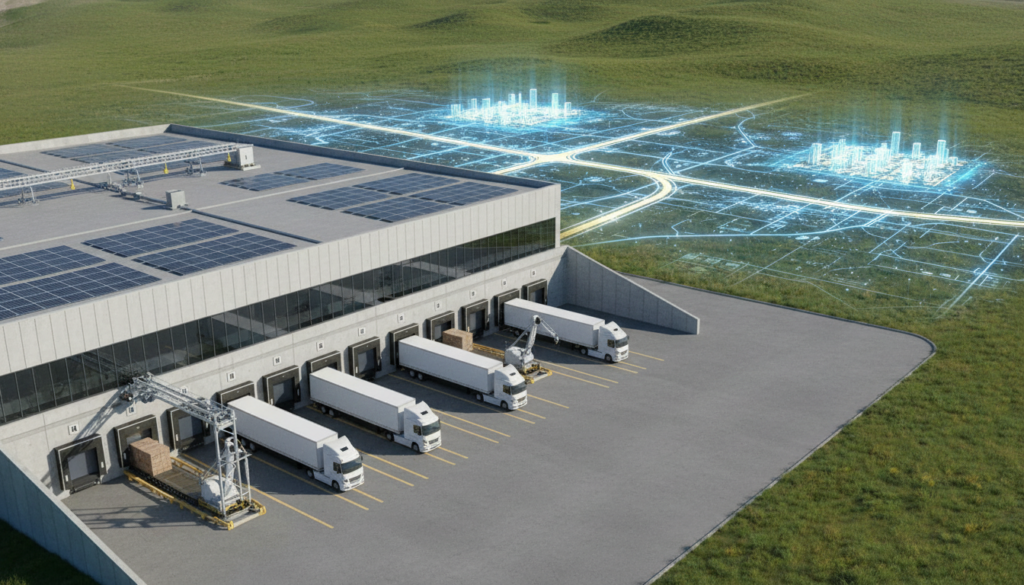

For decades, the standard playbook for commercial logistics in Western Canada was simple: secure industrial space as close to the metropolitan centers of Calgary or Edmonton as possible. The logic was rooted in proximity to the end-consumer, minimizing the final-mile delivery friction that historically eats into profit margins. However, a fascinating structural shift is currently rewriting the spatial economics of Alberta’s supply chains. Nestled exactly halfway between the province’s two major economic engines along the Queen Elizabeth II (QEII) Highway, the city of Red Deer and its surrounding county have quietly transformed into a highly lucrative logistics safe haven.
This phenomenon, known among supply chain engineers and commercial real estate analysts as the "Red Deer Paradox," challenges traditional distribution models. Mid-sized distribution businesses are discovering that retreating from the primary urban perimeters actually yields healthier operating margins. By leveraging dramatically lower industrial land acquisition costs and favorable municipal property tax brackets, these enterprises are successfully absorbing the penalties of higher inter-municipal freight fuel surcharges. For investors, business owners, and logistics engineers, understanding the mechanics of this corridor is no longer just an academic exercise; it is a critical strategy for long-term operational survival and growth in Western Canada.
The following economic facts are based on current Alberta provincial data and market trends.
The Anatomy of the Industrial Real Estate Squeeze
To understand why Red Deer is capturing the attention of site selectors, one must first examine the intense pressures currently squeezing the industrial real estate markets in Calgary and Edmonton. Over the past five years, Alberta has experienced an unprecedented boom in e-commerce fulfillment, specialized manufacturing, and agricultural processing.
The Calgary and Edmonton Bottleneck
Calgary, traditionally recognized as the inland distribution hub of the Pacific Northwest, has seen its industrial vacancy rates plummet to historic lows. Submarkets like Rocky View County and the Balzac corridor have become saturated with mega-distribution centers operated by multinational retail giants. Edmonton has experienced a parallel tightening in its Nisku and Acheson industrial parks.
This saturation has triggered a cascade of economic consequences for mid-sized operators:
- Surging Land Acquisition Costs: The price per acre for serviced industrial land in prime Calgary and Edmonton corridors has escalated rapidly, creating an insurmountable barrier to entry for mid-market warehousing firms looking to expand their footprint.
- Lease Rate Escalation: For businesses relying on triple-net (NNN) leases, base rents have climbed in tandem with land values, severely compressing the capital available for operational improvements, automation, or workforce expansion.
- Congestion and Turnaround Friction: As these mega-parks reach capacity, the localized traffic congestion increases the turnaround time for long-haul carriers, introducing hidden inefficiencies into the daily operations of a supply chain.
For a mid-sized distributor requiring anywhere from fifty thousand to two hundred thousand square feet of specialized warehousing space, the financial mathematics of operating within the immediate halo of Alberta’s two largest cities are becoming increasingly difficult to justify.
The Mechanics of the Mid-City Advantage
The Red Deer corridor offers a structural antidote to the metropolitan squeeze. The advantage is not merely geographic; it is fundamentally rooted in municipal fiscal policy and strategic infrastructure engineering. By analyzing the long-term growth mechanics of Central Alberta, we can deconstruct exactly how these regional fulfillment centers are achieving superior profitability.
Municipal Tax Brackets and Mill Rate Arbitrage
The most potent weapon in the Red Deer Paradox is the municipal property tax structure. In Alberta, municipalities have the authority to set their own mill rates for non-residential properties. Major urban centers, burdened by the immense infrastructural and social costs of supporting populations exceeding one million residents, inherently require higher commercial property tax revenues to balance their civic budgets.
Central Alberta municipalities, particularly Red Deer County, operate with a leaner civic overhead. This translates directly into highly competitive non-residential mill rates.
- The Total Cost of Occupancy (TCO): When a business calculates its TCO, property taxes often represent the largest variable expense outside of the base lease rate or mortgage.
- The Compounding Effect: The savings generated by a lower mill rate are not a one-time benefit; they compound annually. Over a standard ten-year commercial lease or financing term, the capital preserved through tax arbitrage in the Red Deer corridor can amount to millions of dollars.
- Capital Reallocation: Forward-thinking businesses are taking the capital saved on property taxes and reinvesting it directly into warehouse automation, advanced inventory management software, and high-density racking systems, further widening their competitive moat.

Strategic Positioning on the QEII Highway
Geography is the second pillar of the Red Deer advantage. The QEII Highway is the busiest and most vital economic artery in Western Canada, carrying billions of dollars in gross domestic product annually. Red Deer sits precisely at the midpoint.
From an engineering and logistics perspective, this central positioning allows for highly optimized fleet utilization. A commercial transport truck dispatched from a Red Deer fulfillment center can reach the city limits of either Edmonton or Calgary in roughly ninety minutes. This enables a "hub-and-spoke" distribution model where a single, massive, low-cost central repository can service both major metropolitan markets with same-day or next-day delivery guarantees, without the need to duplicate warehousing infrastructure in both cities.
Calculating the Trade-Offs: Margins vs. Freight
The core of the Red Deer Paradox lies in a complex mathematical trade-off. Skeptics of the centralized distribution model correctly point out that locating away from the primary consumer bases increases the distance that goods must travel on the final leg of their journey. This introduces a significant operational headwind: inter-municipal freight fuel surcharges.
Absorbing the Fuel Surcharge
When a mid-sized business relocates its primary distribution center to Red Deer, it inherently commits to paying higher freight costs to move its product north to Edmonton or south to Calgary. Fuel surcharges, which fluctuate wildly with global crude oil indices, act as a volatile multiplier on these transportation costs.
However, the educational breakdown of the financial modeling reveals why the margins remain healthier:
- The Fixed vs. Variable Dynamic: Real estate acquisition costs, property taxes, and building depreciation are fixed (or highly predictable) costs. Fuel surcharges are variable. By drastically lowering the massive fixed costs of metropolitan real estate, the business creates a deep financial buffer.
- The Offset Ratio: Detailed diagnostic modeling of Central Alberta supply chains shows that for mid-sized operators (especially those dealing in heavy, bulky, or non-perishable goods), the savings on land and taxes outpace the increased freight fuel surcharges by a ratio often exceeding three-to-one.
- Consolidated Inbound Freight: The model also benefits the inbound supply chain. Rather than splitting inbound shipments from the Port of Vancouver or the United States between an Edmonton and a Calgary facility—which often results in paying for less-than-truckload (LTL) shipping rates—the business can consolidate all inbound freight into full-truckload (FTL) shipments directed solely to the Red Deer hub, capturing significant economies of scale.
By trading localized urban convenience for centralized regional efficiency, supply chain managers are effectively utilizing real estate savings to subsidize their transportation networks.

Infrastructure and the Inter-Modal Rail Factor
While the QEII highway facilitates the rapid deployment of outbound freight, the inbound velocity of goods is heavily reliant on rail. Central Alberta possesses a distinct, historically rooted advantage in heavy rail infrastructure that technical engineers and site selectors are increasingly leveraging.
The Historic Rail Hub
Red Deer’s very existence is tied to its historical status as a major divisional point for the Canadian Pacific Railway. Today, the region is serviced by both of Canada’s Class I railways (Canadian National and Canadian Pacific Kansas City). This dual access provides a critical layer of supply chain resilience.
- Transloading Capabilities: The Red Deer corridor is equipped with extensive transloading facilities. These specialized yards allow for the seamless transfer of bulk commodities—such as agricultural products, petrochemical derivatives, and construction materials—directly from railcars to heavy-haul transport trucks.
- Bypassing Urban Bottlenecks: Routing bulk rail freight directly into Central Alberta allows shippers to bypass the heavily congested rail classification yards in Calgary and Edmonton. This reduces the dwell time of railcars, lowering demurrage fees and accelerating the overall velocity of inventory turnover.
- Heavy Haul Corridors: Red Deer County has proactively engineered specific high-load and heavy-haul road corridors connecting directly to the rail yards. These reinforced roadways are designed to handle the extreme axle weights of industrial logistics, ensuring that heavy equipment and bulk materials can be moved without the strict municipal load bans frequently enforced within major city limits.
Labor Economics and the Central Alberta Workforce
The final component of the operational margin equation is human capital. A logistics facility is only as efficient as the workforce operating it. As the mega-warehouses in Calgary and Edmonton have proliferated, they have aggressively cannibalized the local light-industrial labor pools, driving up hourly wages and increasing employee turnover rates.
Central Alberta offers a highly skilled, mechanically inclined workforce drawn from the region’s deep roots in the energy and agricultural sectors.
- Wage Stability: While wages in Red Deer are highly competitive, the localized cost of living—particularly housing affordability—is significantly lower than in the major metropolitan areas. This allows employers to offer wages that provide a high quality of life for workers while remaining economically sustainable for the business.
- Technical Proficiency: The workforce in Central Alberta possesses a high baseline of technical literacy. Operating modern warehouse environments requires familiarity with heavy machinery, automated sorting systems, and specialized safety protocols. The regional talent pool, experienced in energy sector logistics and heavy manufacturing, transitions seamlessly into advanced commercial warehousing.
Strategic Implementation for the Future
The migration of mid-sized distribution networks to the Red Deer corridor is not a temporary anomaly; it is a permanent structural realignment of Alberta’s industrial geography. As the provincial population continues to surge past the five million mark, the Calgary-Edmonton corridor will only become denser, further driving up the premium on urban industrial land.
For business owners and investors evaluating their long-term supply chain architecture, the educational takeaway is clear. Relying on legacy models of urban proximity is a strategy of diminishing returns. The modern competitive advantage lies in optimizing the Total Cost of Occupancy and Distribution.
By utilizing the Red Deer Rail Hub Paradox, enterprises can secure vast, highly engineered industrial spaces, lock in decades of favorable municipal tax rates, and streamline their inbound rail logistics. The cost of fuel will always fluctuate, and the distance between cities will remain constant. But by engineering a supply chain that fundamentally reduces fixed overhead, businesses operating in Central Alberta are proving that the most profitable path forward often lies directly in the middle.
Sources and References
- Alberta Ministry of Transportation and Economic Corridors: Annual Provincial Highway Traffic Volume Reports.
- Central Alberta Economic Partnership (CAEP): Regional Industrial Land Value and Zoning Diagnostics.
- Canadian Supply Chain Logistics Institute: Inter-provincial Freight and Fuel Surcharge Data Assesments.
- Municipal Affairs Alberta: Comparative Mill Rate and Non-Residential Property Assessment Data.
- Real Estate Investment Network (REIN) Alberta: Industrial Vacancy and Absorption Rate Analytics for the QEII Corridor.