


In the volatile landscape of global energy markets, agricultural technology companies face a daunting thermodynamic reality: indoor farming is essentially the business of converting electricity into food. For the past decade, the vertical farming industry has been plagued by a fatal flaw, wherein the unpredictable cost of powering massive arrays of light-emitting diodes and climate control systems has bankrupted otherwise innovative startups. However, tucked away in the southeastern corner of Alberta, a unique economic anomaly is rewriting the unit economics of controlled environment agriculture. Medicine Hat, affectionately known historically as “The Gas City,” is leveraging a century-old municipal utility model to attract a cutting-edge wave of advanced indoor micro-farms. By offering an oasis of stable, predictable energy pricing in a province known for its deregulated power grid, Medicine Hat is transforming from a traditional heavy-industry hub into a premier destination for ag-tech engineers, investors, and forward-thinking food producers.
This shift is not merely a happy accident of geography; it is a masterclass in long-term economic mechanics. For business owners and technical engineers looking to scale indoor agriculture, understanding how Medicine Hat’s municipally owned utilities function provides a blueprint for mitigating operational risk. This article breaks down the historical context, the thermodynamic energy calculus, and the financial architecture that makes this southern Alberta city a highly strategic launchpad for the future of food production.
The following economic facts are based on current Alberta provincial data and market trends.
The Mechanics of the “Gas City” Advantage
To understand why modern ag-tech startups are flocking to Medicine Hat, one must first examine the historical and structural foundations of the city’s utility framework. In 1904, the city made a visionary decision to establish its own municipally owned natural gas utility, capitalizing on the massive reserves located directly beneath the municipality. Shortly thereafter, it expanded into electrical generation. Today, the City of Medicine Hat remains one of the only municipalities in North America that owns and operates its entire utility value chain: gas production, electrical generation, and the distribution networks for both.
This vertical integration creates a powerful economic moat. While the rest of Alberta operates on a deregulated, market-driven electrical grid managed by the Alberta Electric System Operator, Medicine Hat operates largely independently. The city generates its own power, primarily utilizing highly efficient natural gas-fired turbines, and sells it directly to its residents and commercial enterprises.
For decades, this model was utilized to attract heavy industry. Petrochemical plants, brick manufacturers, and fertilizer producers set up operations in the region, drawn by the promise of cheap, abundant, and reliable energy. However, as the global economy transitions and heavy industry faces new carbon realities, Medicine Hat has strategically pivoted. The city now utilizes its utility advantage to attract industries where energy comprises the largest operational expenditure. Enter the modern indoor micro-farm.
The Energy Calculus of Vertical Farming
To appreciate the economic magnet that is Medicine Hat, one must dissect the operational expenditures of a commercial vertical farm. Unlike traditional open-field agriculture, where the sun provides free photonic energy and the atmosphere handles climate regulation, indoor farming requires engineers to artificially replicate the entire biosphere. This replication is highly energy-intensive.
The power demands of a commercial micro-farm can be categorized into three primary loads:
- Horticultural Lighting Systems: Plants require specific spectrums of light to drive photosynthesis. Even utilizing the most advanced, high-efficacy light-emitting diodes, lighting accounts for approximately forty to fifty percent of a vertical farm’s total energy consumption.
- Heating, Ventilation, and Air Conditioning: Plants transpire, releasing massive amounts of water vapor into the air. If this humidity is not strictly controlled, crops will succumb to mold and disease. Dehumidification and temperature control, operating twenty-four hours a day, account for another thirty to forty percent of the energy load.
- Hydrological and Automated Systems: Nutrient delivery pumps, water filtration systems, automated seeding robots, and environmental monitoring sensors consume the remaining ten to twenty percent of the facility’s power.
When an ag-tech startup builds financial projections, the cost per kilowatt-hour is the most sensitive variable in their financial model. A fluctuation of just a few cents per kilowatt-hour can mean the difference between a profitable harvest and a catastrophic quarterly loss.
Alberta’s Deregulated Grid vs. The Municipal Moat
In the broader Alberta market, electricity prices are determined by real-time supply and demand dynamics. During periods of extreme weather—such as a deep winter freeze or a scorching summer heatwave—the grid experiences peak demand. Consequently, the wholesale pool price of electricity can spike dramatically, sometimes reaching the provincial cap of nearly one thousand dollars per megawatt-hour. For a vertical farm operating in Calgary or Edmonton, these price spikes are financially lethal. The plants cannot simply be turned off during peak pricing hours; they require consistent light and climate control to survive.
Medicine Hat fundamentally alters this risk profile. Because the city generates its own power and is not entirely beholden to the provincial wholesale market, it can offer commercial energy contracts with remarkable stability. The municipality utilizes a blended pricing strategy, often benchmarking against the rest of the province but smoothing out the extreme peaks and valleys. Furthermore, for high-load commercial clients like advanced micro-farms, the city can negotiate fixed-rate agreements or offer predictable, cost-plus pricing models that provide absolute certainty for financial forecasting.
This predictability is the core thesis of Medicine Hat’s appeal. It allows ag-tech CFOs to lock in their largest operational expense, transforming a volatile commodity into a fixed, manageable line item.
Engineering the Modern Micro-Farm
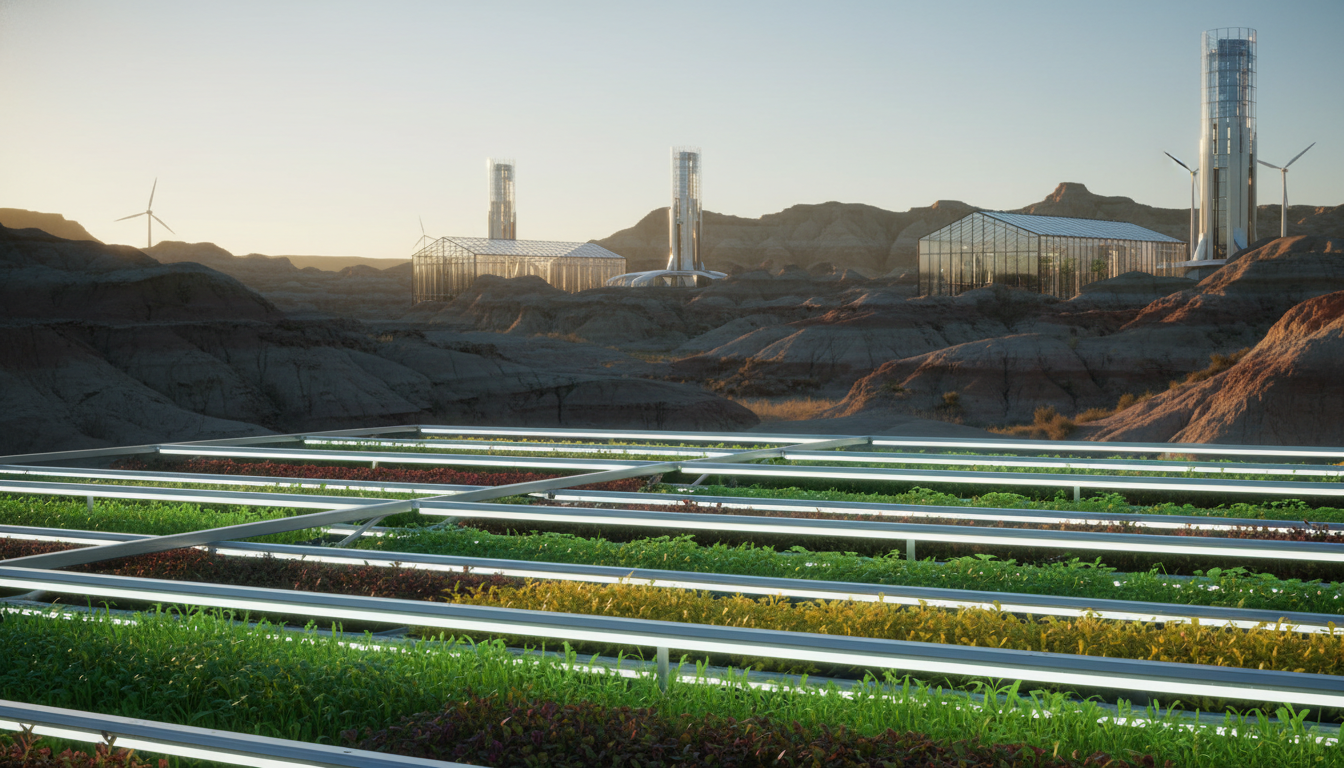
The influx of ag-tech into southeastern Alberta is not limited to basic greenhouse operations; it is characterized by the deployment of highly advanced, automated micro-farms. These facilities are marvels of modern engineering, designed to maximize yield per square foot while minimizing resource input. Medicine Hat’s reliable utility grid provides the necessary foundation for these complex systems to operate without interruption.
Thermodynamic Balancing and Climate Control
Engineering a micro-farm requires precise thermodynamic balancing. The massive arrays of LED lights generate sensible heat, while the plants themselves generate latent heat through transpiration. Engineers must design HVAC systems capable of handling these dynamic loads. In Medicine Hat, the availability of affordable natural gas provides an additional engineering advantage. Many advanced micro-farms utilize natural gas not just for winter heating, but for combined heat and power systems, or even for carbon dioxide enrichment.
By burning natural gas cleanly on-site, a facility can capture the resulting carbon dioxide and pump it directly into the growing chambers. Plants thrive in carbon-enriched environments, often growing up to thirty percent faster. This symbiotic use of municipal utilities—leveraging both electricity for lighting and gas for atmospheric enrichment—creates a highly optimized growth environment.
Hydroponic and Aeroponic Architectures
The agricultural methods deployed in these facilities are equally sophisticated. Soil is entirely eliminated from the equation. Instead, engineers utilize:
- Deep Water Culture: Plant roots are suspended directly in a highly oxygenated, nutrient-rich water solution. This method requires constant electrical power to run air pumps; a power failure of even a few hours can drown the roots and destroy the crop.
- Aeroponics: Roots are suspended in the air and periodically misted with a nutrient solution. This utilizes up to ninety-five percent less water than traditional farming but relies heavily on high-pressure pumps and precise digital timers.
- Nutrient Film Technique: A shallow stream of water containing dissolved nutrients constantly recirculates past the bare roots of plants in a watertight channel.
These systems are inherently fragile if disconnected from reliable power. Medicine Hat’s localized generation and distribution grid historically boasts exceptional reliability metrics, further reducing the operational risk for engineers deploying these sensitive hydroponic and aeroponic architectures.
Unit Economics and Investor Appeal
For investors evaluating the ag-tech sector, the financial viability of vertical farming has been fiercely debated. The high capital expenditures required to build a facility are often compounded by the crippling operational expenditures required to run it. By situating operations in Medicine Hat, business owners drastically improve their unit economics, making their ventures significantly more appealing to private equity and venture capital.
De-Risking the Operational Expenditure
When an ag-tech company pitches to investors, the focus is heavily heavily scrutinized on the path to profitability. The traditional model in volatile energy markets requires companies to build massive cash reserves to weather unpredictable utility bills. In Medicine Hat, the predictable utility rates allow companies to operate with leaner capital reserves, directing more funds toward research, development, and market expansion.
Furthermore, the predictable cost of goods sold allows micro-farms to negotiate long-term, fixed-price supply contracts with grocery chains and local restaurants. If a vertical farm knows exactly what a head of lettuce will cost to produce in December, they can confidently lock in a wholesale price in June. This level of supply chain stability is highly attractive to major food distributors who are increasingly frustrated by the weather-dependent volatility of traditional agriculture imported from California or Mexico.
Long-Term Growth: Ag-Tech as the New Heavy Industry
The economic evolution of Medicine Hat represents a broader transition within the Alberta economy. While the province will remain a global powerhouse in traditional energy extraction for the foreseeable future, municipalities are actively diversifying their industrial bases. Medicine Hat is proving that the infrastructure built for the heavy industries of the twentieth century can be seamlessly adapted to power the sustainable technologies of the twenty-first century.
This transition brings significant secondary economic benefits to the region. Advanced micro-farms require a highly skilled workforce, including software developers, mechanical engineers, agronomists, and supply chain logisticians. By attracting these companies, Medicine Hat is fostering a new talent pool, diversifying its demographic base, and insulating its local economy from the boom-and-bust cycles traditionally associated with global commodity prices.
For business owners and investors, the lesson is clear: innovation in agriculture is not solely about biological advancements; it is equally dependent on strategic economic positioning. By leveraging the municipal utility framework of Medicine Hat, ag-tech startups are finding the stability required to scale their operations, proving that sometimes, the most advanced technological disruptions rely on the foundational reliability of century-old civic planning. As the demand for localized, climate-resilient food production continues to escalate globally, the “Gas City” is uniquely positioned to become a premier capital of controlled environment agriculture.
Sources and References
- Alberta Electric System Operator. Annual Market Statistics and Wholesale Pool Price Historical Data.
- City of Medicine Hat. Municipal Utility Rate Schedules and Historical Charter Documentation.
- Ministry of Agriculture and Irrigation, Government of Alberta. Reports on Controlled Environment Agriculture and Sector Diversification.
- International Journal of Agricultural and Biological Engineering. Studies on Thermodynamic Loads and Energy Consumption in Vertical Farming Systems.