
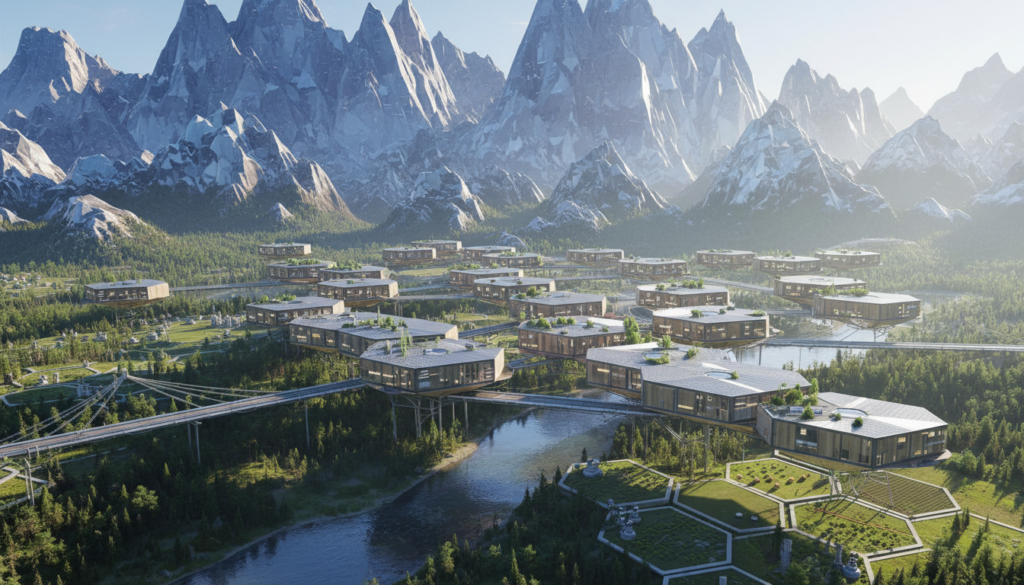

For decades, the economic geography of southern Alberta operated on a strictly monocentric model. Calgary was the undisputed gravitational center—a massive economic sun—while surrounding municipalities functioned as mere satellites. Cities like Airdrie and Cochrane were historically classified as “bedroom communities,” places where the workforce slept, raised families, and paid residential taxes, only to commute down Highway 2 or Highway 1A every morning to fuel the economic engine of the Calgary core.
However, over the past decade, a profound structural shift has occurred. Driven by shifting industrial logistics, aggressive municipal zoning strategies, and a fundamental change in how the modern workforce operates, these satellite cities have achieved economic escape velocity. They are no longer just places to live; they are independent engines of commerce, manufacturing, and technology. This article explores the mechanics of this transformation, offering a deep dive into the “Inland Empire Logic” that allowed Airdrie and Cochrane to decouple from Calgary and establish their own sovereign industrial bases.
The following economic facts are based on current Alberta provincial data and market trends.
Understanding Urban Gravity and the Bedroom Community Paradigm
To appreciate the magnitude of this decoupling, we must first examine the historical mechanics of the bedroom community. In urban economics, a bedroom community is characterized by a heavily skewed property tax base—often relying on residential property taxes for up to 80 percent or 90 percent of municipal revenues.
This creates a structural vulnerability. Without a robust commercial and industrial tax base, municipalities struggle to fund the infrastructure, recreation, and civic services required by a growing population. Furthermore, the local economy remains entirely dependent on the health of the adjacent metropolitan core. If the core experiences an economic downturn—such as the cyclical oil price shocks historically seen in downtown Calgary—the bedroom community suffers disproportionately through job losses and plummeting housing demand, despite having no direct control over the industries affected.
Breaking this cycle requires a deliberate and often difficult transition. It requires a municipality to attract primary industries that export goods or services outside the local region, thereby importing new capital. For Airdrie and Cochrane, this meant leveraging their unique geographic advantages to capture commercial growth that Calgary could no longer easily accommodate.
The “Inland Empire Logic” Explained
The economic phenomenon driving Airdrie and Cochrane can be best understood through the lens of the “Inland Empire Logic.” In the United States, the Inland Empire refers to the vast region east of Los Angeles (primarily Riverside and San Bernardino counties). Originally agricultural and residential, the Inland Empire transformed into a global logistics and manufacturing powerhouse because the coastal core of Los Angeles ran out of affordable, developable industrial land.
This exact dynamic is playing out in the Calgary metropolitan region. As Calgary expanded, large-scale industrial parcels within city limits became increasingly scarce and expensive. The cost per acre for prime industrial land in Calgary’s established southeast and northeast quadrants reached premiums that compressed profit margins for logistics, warehousing, and manufacturing firms.
Mechanics of the Regional Shift
The Inland Empire Logic in Alberta is driven by three primary economic mechanics:
- Land Valuation Arbitrage: Industrial developers seek the lowest possible land cost that still offers access to major transportation nodes. Airdrie and Cochrane offered expansive, greenfield development opportunities at a fraction of the cost per acre compared to Calgary.
- The Rise of E-Commerce Logistics: The modern supply chain requires massive footprint distribution centers. These facilities require hundreds of acres, a scale of land assembly that is exponentially easier to achieve on the municipal periphery.
- Tax Differentials: By strategically setting non-residential property tax rates lower than those in the metropolitan core, peripheral cities can financially incentivize businesses to relocate just across the municipal border.

Airdrie: The Logistics and Manufacturing Powerhouse
Airdrie’s decoupling strategy has been heavily rooted in logistics, transportation, and advanced manufacturing. Situated directly on the Queen Elizabeth II Highway (QEII)—the busiest transportation corridor in Alberta—and located just minutes north of the Calgary International Airport (YYC), Airdrie possesses a geographic advantage that is impossible to replicate.
The CANAMEX Corridor Advantage
Airdrie is a critical node on the CANAMEX trade corridor, a continuous transportation route linking Canada, the United States, and Mexico. For supply chain managers and industrial engineers, this location is highly strategic. Goods manufactured or stored in Airdrie can be deployed north to Edmonton, south to the United States border, or loaded onto global air freight out of YYC with near-zero urban traffic friction.
Building the Industrial Base
To capitalize on this, Airdrie’s municipal planners aggressively zoned for large-scale industrial parks. The city recognized that transitioning from a bedroom community required a deliberate shift in the residential-to-commercial tax assessment ratio. By streamlining the permitting process for industrial developers, Airdrie attracted massive investments in warehousing, agri-business, and energy services manufacturing.
Key developments in Airdrie’s industrial sector demonstrate a shift toward complex, high-value operations. It is no longer just storage; it is advanced fabrication, food processing, and technical engineering. Businesses are choosing Airdrie not because they have to, but because the infrastructure, land availability, and municipal support make it the optimal environment for scaling operations.
Cochrane: The Lifestyle-Driven Tech and Engineering Hub
While Airdrie capitalized on logistics and manufacturing, Cochrane utilized a distinctly different economic mechanism to break Calgary’s orbit: lifestyle-driven technological innovation.
Located to the west of Calgary, nestled in the Bow River valley with immediate access to the Rocky Mountains, Cochrane historically relied on tourism, ranching, and its status as a scenic commuter town. However, Cochrane’s decoupling is a masterclass in the Anchor Tenant Theory of economic development.
The Anchor Tenant Theory in Practice
In commercial real estate and urban planning, an “anchor tenant” is a major, high-profile business that draws other businesses, talent, and infrastructure to a specific location. For Cochrane, the presence of Garmin Canada (formerly Dynastream Innovations) served as this critical anchor.
Garmin’s decision to maintain and expand its research and development headquarters in Cochrane proved that a globally recognized technology firm could thrive outside a major metropolitan downtown. This established a precedent and created a localized ecosystem of technical engineers, software developers, and product designers.
Remote Work Mechanics and the Innovation Economy
The global shift toward remote and hybrid work models accelerated Cochrane’s industrial independence. High-income technical workers and business owners were no longer tethered to downtown office towers. Instead, they sought locations that offered a high quality of life, access to outdoor recreation, and a supportive community for innovation.
Cochrane responded by investing in innovation incubators and supporting the development of local tech hubs. The city is actively transitioning its economy to focus on intellectual property, software development, and specialized engineering. Because these industries do not require massive industrial land footprints, they integrate seamlessly into Cochrane’s scenic, environmentally conscious urban footprint.
The Price Divergence: Real Estate Economics at Play
The physical decoupling of these cities is mirrored by a significant price divergence in real estate markets. Historically, housing and commercial lease rates in Airdrie and Cochrane moved in lockstep with Calgary, usually maintaining a predictable discount. Today, these markets exhibit independent economic gravity.
Commercial Real Estate Dynamics
The commercial real estate sector clearly illustrates this independence. As businesses actively choose Airdrie and Cochrane over Calgary, the demand for Class A office space, retail storefronts, and industrial bays in these municipalities has surged.
Key commercial mechanics include:
- Independent Yield Compression: Investors are purchasing commercial properties in Airdrie and Cochrane at capitalization rates (cap rates) that reflect a mature, stable market, rather than a risky peripheral market.
- Localized Supply Constraints: Because these cities are attracting primary employers, local commercial vacancy rates have tightened independently of Calgary’s downtown office vacancy challenges.
- Retail Maturation: The influx of high-paying local jobs means residents are spending their disposable income locally rather than in Calgary. This has led to a boom in local retail, dining, and entertainment developments, further solidifying the local tax base.
Residential Real Estate and Affordability
On the residential side, the price divergence is equally complex. While Airdrie and Cochrane initially offered a steep discount compared to Calgary, the massive influx of interprovincial migrants and the growth of the local job market have driven up property values.
However, the value proposition has changed. Buyers are no longer purchasing in these cities simply to “drive until they qualify” for a mortgage. They are buying in Airdrie and Cochrane because they intend to work, live, and invest in those specific communities. The housing market is now supported by local economic fundamentals rather than just the overflow of Calgary’s housing demand.
Migration Ripples: The Demographic Shift
The economic independence of Airdrie and Cochrane is fundamentally reshaping the demographic profile of the region. We are witnessing significant migration ripples, categorized by distinct demographic shifts:
1. Interprovincial Talent Acquisition: Engineers, tech workers, and supply chain professionals moving to Alberta from Ontario and British Columbia are increasingly bypassing Calgary entirely. Drawn by the availability of new housing, proximity to the mountains (in Cochrane’s case), or proximity to major logistics hubs (in Airdrie’s case), these new arrivals are injecting fresh capital and highly specialized skills directly into the peripheral economies.
2. The Entrepreneurial Exodus: Small and medium-sized business owners are migrating their operations out of the metropolitan core. Faced with rising operational costs and complex urban regulations in larger cities, entrepreneurs are finding that municipalities like Airdrie and Cochrane offer a more agile, business-friendly regulatory environment.
3. The Retention of Youth: Historically, young adults raised in bedroom communities had to leave for the metropolitan core to find meaningful career opportunities. Because Airdrie and Cochrane now host advanced manufacturing, tech firms, and robust commercial sectors, these cities are retaining their young talent, creating a sustainable, multi-generational workforce.
The Role of Municipal Policy in Fostering Independence
It is crucial to understand that this decoupling was not accidental; it was engineered through deliberate municipal policy. The transition from a satellite to an independent economic hub requires a city council willing to make long-term, sometimes politically difficult decisions regarding infrastructure investment and zoning.
Strategic Infrastructure Investments: Both Airdrie and Cochrane have had to invest heavily in independent water, wastewater, and transportation infrastructure. By securing their own utility capacities, they removed the physical limitations that would have otherwise capped their growth and kept them reliant on regional utility agreements dominated by Calgary.
Zoning for the Future: By protecting prime land for commercial and industrial use—resisting the urge to rezone it for quick, lucrative residential subdivisions—these municipalities ensured they had the physical space required to attract major corporate investments. This disciplined approach to land-use planning is the bedrock of their current economic independence.
Long-Term Growth Mechanics and Future Outlook
The decoupling of Airdrie and Cochrane from the Calgary orbit represents a fundamental maturation of the southern Alberta economy. We are witnessing the transition from a monocentric region to a polycentric mega-region.
For potential residents, this means a higher quality of life with reduced commute times and localized career opportunities. For technical engineers and business owners, it represents a diversified landscape of innovation hubs and logistics corridors that offer competitive advantages over traditional metropolitan centers. For investors, the independent economic gravity of Airdrie and Cochrane presents lucrative opportunities in commercial development, industrial logistics, and localized retail.
As Alberta’s economy continues to diversify beyond traditional energy extraction into technology, advanced manufacturing, and global logistics, the self-sustaining industrial bases of Airdrie and Cochrane will be critical drivers of provincial GDP. They have successfully broken the orbit, transforming from dependent satellites into twin stars of the Alberta economy.
Sources and References
- Alberta Ministry of Jobs, Economy and Trade: Regional Economic Indicators and Interprovincial Migration Reports.
- Municipal Development Plans and Economic Strategy Reports for the City of Airdrie and the Town of Cochrane.
- Statistics Canada: Census Metropolitan Area (CMA) Commuting Flow and Demographic Data.
- Commercial Real Estate Market Reports (CBRE, Colliers) on Southern Alberta Industrial and Office Vacancy Rates.