


For decades, the narrative of the “Alberta Advantage” was built on a simple, powerful promise: high wages and low costs of living. While the boom-bust cycles of the oil patch occasionally rattled the windows of Calgary and Edmonton high-rises, the province’s secondary markets—the quiet towns of the foothills, the lakeside retreats, and the agricultural hubs—remained bastions of affordability. A service worker in Cochrane or a tradesperson in Sylvan Lake could reasonably expect to own a home, raise a family, and participate in the local economy without the crushing debt loads seen in Vancouver or Toronto.
However, the “Exodus Reversed” phenomenon—the massive influx of interprovincial migrants seeking refuge from the astronomical prices of British Columbia and Ontario—has triggered a secondary seismic shift. The spillover effect is no longer a trickle; it is a flood. As remote work decouples income from geography, Alberta’s small towns are experiencing a “Rural Gentrification Crisis.” This isn’t just about rising home prices; it is about the fundamental restructuring of the rural economy, the displacement of the local labor force, and a growing spatial mismatch that threatens the very viability of small-town commerce.
The following economic facts are based on current Alberta provincial data and market trends.
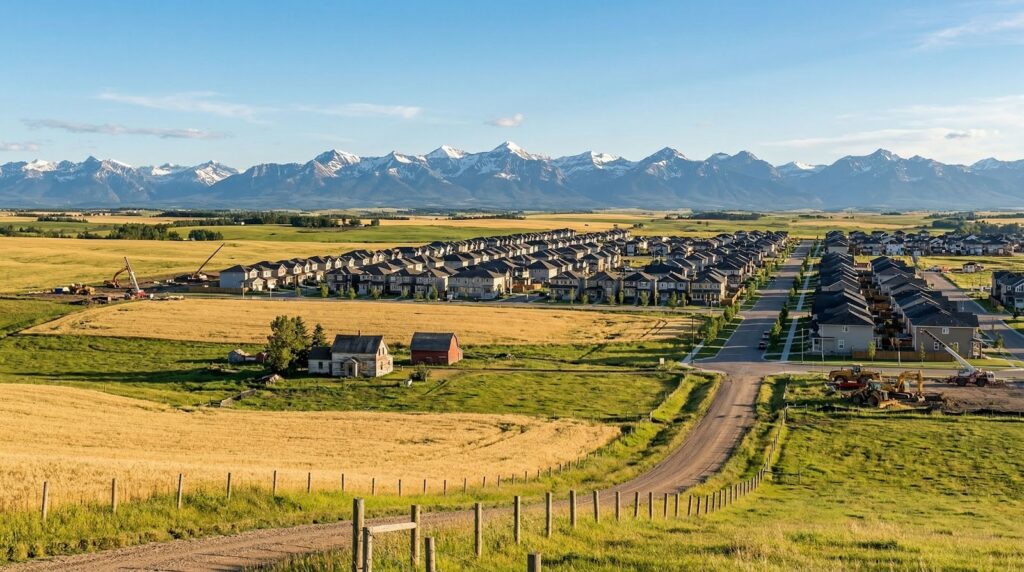
1. The Mechanics of the “Equity Migration”
To understand why a bungalow in Okotoks is suddenly seeing bidding wars, we must look at the “Equity Migration” coming from the East and West.
The Wealth Gap Transfer
The primary driver is the disparity in real estate equity. An average residential property in the Greater Toronto Area (GTA) or Greater Vancouver Area (GVA) frequently exceeds $1.1 million. When a mid-career professional sells a modest semi-detached home in Mississauga and moves to a secondary market in Alberta, they arrive with hundreds of thousands of dollars in liquid capital.
- Purchasing Power: This migrant isn’t looking for a “starter home” in the traditional sense. They are looking for an upgrade.
- Market Distortion: By entering a market where the average price was historically $450,000 with a budget of $750,000, they effectively reset the “floor” for local valuations.
- The Remote Work Catalyst: The COVID-19 pandemic permanently shifted the labor model for tech, finance, and administrative sectors. If a worker can earn a Toronto salary while living in High River, the local wage-to-housing ratio becomes irrelevant to them, but devastating for their neighbors.
Statistical Context: Interprovincial Migration Records
In 2023 and early 2024, Alberta saw record-breaking net interprovincial migration. While Calgary and Edmonton absorbed the bulk, a significant percentage—estimated at 15-22%—bypassed the major metros entirely for “lifestyle” towns within a 45-minute commute of an international airport.
2. The Geographic Hotspots: From Commuter Belts to Resort Towns
The crisis is most acute in three specific types of “secondary” markets. Each faces a unique version of the gentrification squeeze.
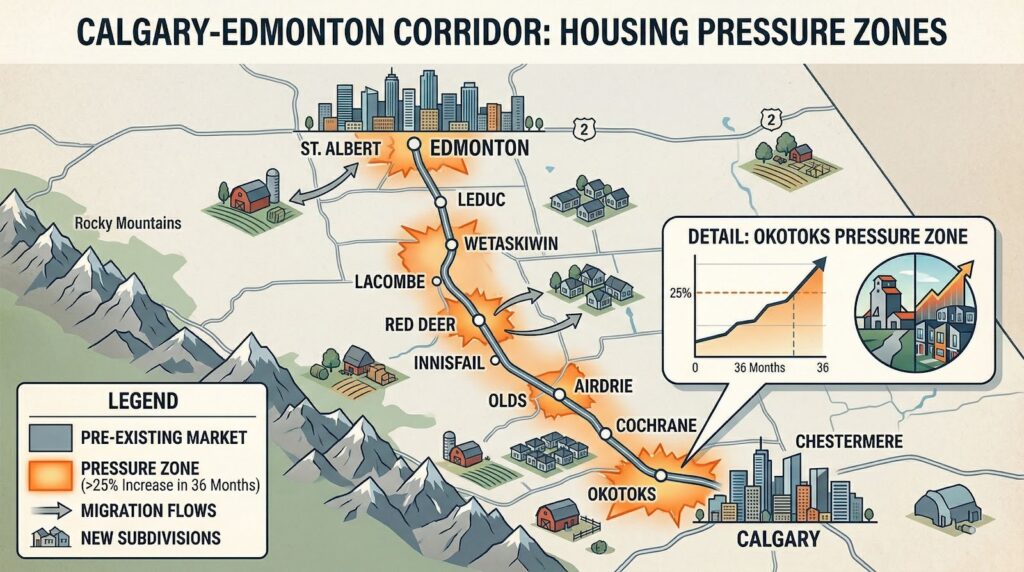
The “Bedroom Community” Expansion (Cochrane and Okotoks)
Cochrane and Okotoks have transitioned from quiet towns to essential extensions of the Calgary Metropolitan Region.
- The Squeeze: As Calgary’s median home price climbed, people moved to Cochrane for “value.” Now, Cochrane’s prices have converged with Calgary’s, pushing the next wave of buyers even further out to places like Crossfield or Black Diamond.
- Infrastructure Lag: These towns are struggling to scale water treatment, schools, and road networks to match a population growth rate that often exceeds 5% annually.
The “Amenity-Driven” Markets (Canmore and Sylvan Lake)
Canmore represents the “canary in the coal mine” for rural gentrification. It has moved beyond gentrification into a state of “elite enclave” status.
- The Canmore Model: When the median price of a detached home crosses the $1.5 million mark, the local service economy collapses because no one who works in a restaurant or hotel can live within 50 kilometers of the town.
- Sylvan Lake: Once a seasonal tourist destination, it is becoming a year-round hub for remote workers. This has cannibalized the rental stock previously used by seasonal tourism workers.
3. The Labor Paradox: The “Missing Middle” of the Workforce
The most dangerous economic byproduct of rural gentrification is the displacement of the “Essential Class.” This includes teachers, nurses, police officers, baristas, mechanics, and municipal workers.
The Wage-Housing Decoupling
In a healthy economy, local home prices are tethered to local wages. In a gentrifying rural market, this link is severed.
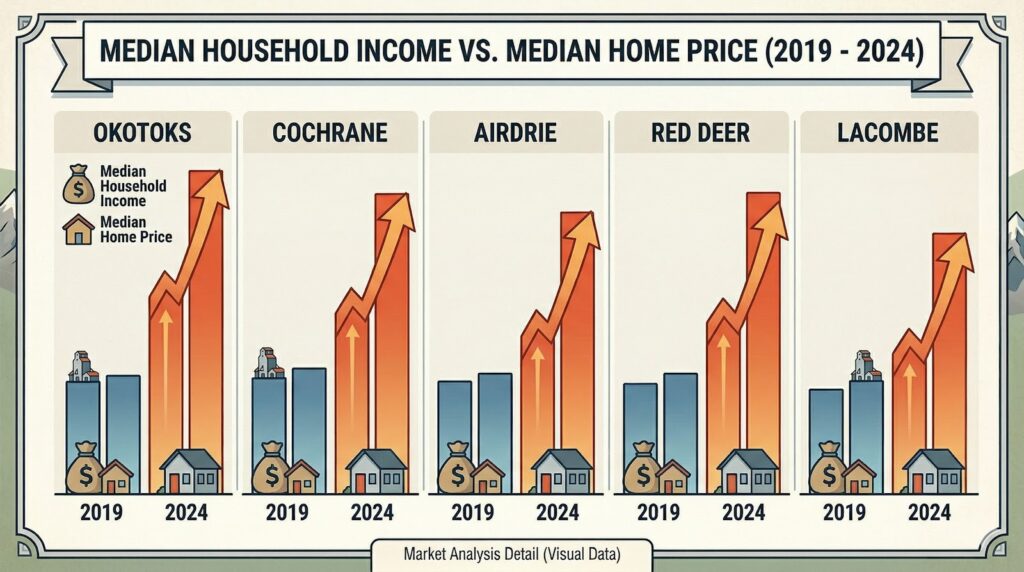
- Local Income: A senior retail manager in a small town might earn $65,000 per year.
- Housing Requirement: To afford a $600,000 mortgage (the new norm in many “hot” towns), a household needs an income closer to $130,000.
- The Result: Local workers are forced to “drive ’til they qualify,” moving to even smaller, more remote locations. This creates a labor shortage in the very towns that are growing.
Retention Struggles for Small Businesses
Small business owners in towns like Olds or Innisfail are reporting a “hiring ceiling.” They cannot offer a high enough wage to cover the rising rents of the area without making their own business uncompetitive or insolvent.
1.Reduced Hours: Restaurants closing two days a week due to lack of staff.
2.Service Degradation: Longer wait times for trades (plumbing, electrical) as workers move to more affordable regions.
3.The “Ghost Town” Effect: High-end homes owned by remote workers who don’t frequent local services as much as long-term residents, leading to a decline in community cohesion.
4. The Housing Inventory Crunch: Why We Can’t Build Our Way Out (Quickly)
Educational analysis of the housing market often points to “supply” as the silver bullet. However, in rural Alberta, supply faces unique bottlenecks.
Zoning and NIMBYism
Small towns often have rigid zoning bylaws designed to preserve “character.”
- Resistance to Density: Proposals for townhomes or low-rise apartments in historically single-family neighborhoods often face fierce opposition from existing residents who fear for their property values or “small-town feel.”
- Secondary Suite Restrictions: Many towns are only now beginning to allow legal secondary suites, which are crucial for housing service workers.
Construction Labor Shortages
Ironically, the people needed to build the houses can’t afford to live where the houses are being built.
- The Cost of Mobilization: Bringing crews from Calgary or Edmonton to a site in a secondary market adds significant costs to the build, which are then passed on to the buyer.
- Material Costs: While lumber prices have stabilized since the 2021 peak, the cost of specialized trades remains high due to the province-wide demand.
5. The Impact on Social Infrastructure
Gentrification isn’t just about the cost of a roof; it’s about the strain on the “social fabric.”
Schools and Healthcare
When a town grows by 20% in three years, the provincial funding models for schools and hospitals—which often lag by 18 to 24 months—fail to keep up.
- Classroom Crowding: Portable classrooms become permanent fixtures.
- Doctor Shortages: Rural Alberta already faces a primary care crisis. Gentrification exacerbates this because, like the barista, the new family physician also looks at the housing market and may choose a different jurisdiction with a better cost-of-living-to-amenity ratio.
The “Shadow Population”
Remote workers often maintain their professional networks and spending habits in their previous jurisdictions (online shopping, professional services from their “home” city), which means the local tax base grows, but the local “economic multiplier” is smaller than that of a traditional resident.
6. Policy Solutions: Reclaiming the Alberta Small Town
To mitigate the crisis, a multi-pronged approach involving municipal and provincial cooperation is required.
Inclusionary Zoning and Incentives
Municipalities must incentivize developers to build “attainable” housing.
- Density Bonusing: Allowing developers to build more units if a percentage is set aside for “below-market” rental or sale.
- Fee Waivers: Reducing municipal permit fees for purpose-built rentals.
The “Land Trust” Model
Communities like Canmore have experimented with Perpetual Affordable Housing (PAH) programs.
- How it works: The town or a non-profit owns the land, and the resident owns the structure. When the resident sells, the appreciation is capped to ensure the home remains affordable for the next “local” buyer.
Regional Transit Solutions
To solve the spatial mismatch, Alberta needs better regional transit. If a worker can live in a truly affordable rural area and reliably commute to a high-growth “gentrified” town via rail or express bus, the economic pressure is vented.
7. Conclusion: The Future of the Rural Economy
The gentrification of rural Alberta is a double-edged sword. On one hand, it brings fresh capital, new talent, and increased property tax revenue to towns that were once stagnant. On the other, it threatens to turn these vibrant communities into “dormitory towns” for the wealthy, devoid of the working class that makes them function.
The “Alberta Advantage” is at a crossroads. If the province cannot ensure that its teachers, nurses, and service workers can afford to live in the communities they serve, the very growth that is currently being celebrated will become unsustainable. The goal for investors and policymakers alike should not be to stop growth, but to ensure that growth is inclusive enough to maintain the “pulse” of rural Alberta.
Sources and References
1.Statistics Canada: Population Estimates and Interprovincial Migration Trends, Q1 2024.
2.Alberta Real Estate Association (AREA): Monthly Market Reports for Secondary Markets (Cochrane, Okotoks, Sylvan Lake).
3.Canada Mortgage and Housing Corporation (CMHC): Housing Market Outlook – Alberta Region 2024.
4.Town of Canmore: Economic Development and Housing Affordability Strategy Report.
5.University of Calgary School of Public Policy: The Impact of Remote Work on Municipal Infrastructure and Housing.
6.Government of Alberta: Alberta is Calling Campaign Impact Assessment.