Tag: Labour Market

  • The Alberta Job Market Outlook for Late 2025: Opportunities, Salaries, and Strategic Considerations

    1. Executive Summary

    The Alberta job market in late 2025 presents a compelling and complex picture of rapid growth paired with structural labour imbalances. The province continues to lead Canada in year-over-year job creation, fueled by record-setting population increases and massive capital investments in energy transition, construction, and technology diversification. This sustained momentum makes Alberta a highly attractive destination for skilled workers, investors, and new residents

    .

    Key Highlights of Alberta’s Current Job Market

    • Employment Growth: Alberta leads the nation in job creation, with a year-over-year employment growth rate of +3.8% (as of September 2025). Key sectors driving this growth are Construction, Manufacturing, and Professional, Scientific, and Technical Services.
    • Elevated Unemployment: Despite this job growth, the provincial unemployment rate stands at 7.8% (September 2025), significantly higher than the national average (7.1%). This paradox is a direct result of the labour force growing faster than job vacancies, driven by record interprovincial and international migration.
    • Economic Strength: Real GDP growth is forecast at 2.0% for 2025, positioning Alberta to lead Canadian provincial economic performance. This resilience is supported by high commodity prices, improved market access (Trans Mountain Expansion), and the absence of a Provincial Sales Tax (PST).
    • Snapshot of Opportunities: High-value, long-term opportunities are moving beyond traditional oil and gas and are concentrating in the Skilled Trades, Energy Transition (Hydrogen, Carbon Capture), Healthcare, and Technology (AI, Cybersecurity) sectors.

    Why Alberta Remains Attractive for Job Seekers in 2025

    Alberta’s continued appeal rests on its competitive economic advantages: high wages, lower overall taxation (due to no PST), and a comparatively affordable cost of living, particularly regarding housing compared to Toronto and Vancouver. Multi-billion dollar industrial projects like the Dow Path2Zero Ethylene Cracker and the Air Products Net Zero Hydrogen Energy Complex establish a robust foundation for long-term, high-value employment.

    2. Current Employment Landscape

    The current labour market is defined by historic population inflows and an accelerated pace of industrial diversification, which together are reshaping regional employment dynamics.

    2.1 Overall Employment Statistics

    IndicatorValue (September 2025)Y-o-Y ChangeNational Comparison
    Total Employment (Working Population)2,605,600+3.8%Largest Y-o-Y job growth in Canada.
    Current Unemployment Rate (UR)7.8% (Provincial)+0.2 pptsAbove national average (7.1%).
    Labour Force Participation Rate69.3%+0.6 pptsHigher than national average (65.2%).
    Average Hourly Wage Growth$36.78 per hour+3.3%Strong growth, helping to offset inflation.

    The high Labour Force Participation Rate underscores Alberta’s status as a highly desirable destination for working individuals. However, the 7.8% unemployment rate indicates that the labour supply, driven by historic interprovincial and international migration, is expanding faster than the rate at which job vacancies can be filled, creating absorption challenges primarily in the major cities.

    2.2 Economic Context

    Alberta’s GDP Performance: The province’s economy is expected to lead Canada in Real GDP growth for 2025, forecasted at 2.0%. This strength is attributed to stable energy production (bolstered by the Trans Mountain Expansion project) and robust activity in capital-intensive sectors.

    Population Growth and Migration Trends: Alberta has led the country for 12 consecutive quarters in interprovincial migration, reinforcing its position as a net migration leader. While population growth (forecasted at 2.4% for 2025) is expected to moderate slightly in 2026, this demographic influx fuels residential construction and consumer spending.

    Impact of Oil Price Volatility: Despite strong underlying economic activity, Alberta’s fiscal health remains susceptible to global commodity price swings. Recent moderation in oil prices (WTI prices hovering around $63.75/barrel in Q1 2025/26, down from budget expectations) has resulted in billions of dollars in lost royalty revenues and an increased budget deficit projection. For the average Albertan, while this volatility primarily impacts government revenue, strong oil performance underpins investment confidence, which translates into job security and high wages. Conversely, the lack of a PST acts as a consistent buffer, enhancing household purchasing power against inflation compared to other provinces.

    Investment Climate Overview: The climate remains highly optimistic, anchored by multi-billion dollar, long-term projects. Key drivers include provincial policy changes incentivizing industrial carbon policy compliance through direct corporate reinvestment into emissions reduction (CCS and Hydrogen), signaling long-term business confidence beyond the current economic cycle.

    2.3 Geographic Distribution

    Job growth is heavily concentrated in the two major CMAs, though these areas also face the highest unemployment rates due to their high appeal to newcomers.

    Geographic AreaUnemployment Rate (Sep 2025)Primary Economic Drivers
    Edmonton CMA8.7% (Highest UR)Public Administration, Petrochemicals, Hydrogen Investment, Infrastructure.
    Calgary CMA8.1%Corporate Headquarters, Financial Services, Tech Hub Development, Aviation/Aerospace.
    Camrose–Drumheller5.6% (Lowest UR)Agriculture, Regional Services, Local Trades.

    Rural vs. Urban Job Opportunities: The Calgary and Edmonton regions account for 75% of Alberta’s employment. However, lower unemployment rates in rural areas like Camrose–Drumheller (5.6%) reflect tighter, specialized labour markets in agriculture and resource extraction. Regional programs like the Rural Renewal Stream are designed to direct talent to these high-need, lower-competition regions.

    3. Top Growing Industries & Sectors

    The engine of Alberta’s future employment is built upon five highly active sectors:

    3.1 Energy & Natural Resources

    Job growth is pivoting toward the energy transition.

    • Oil and Gas Sector Evolution: Production remains robust (record crude oil output in 2025), yet traditional roles are facing headwinds due to efficiency gains and corporate restructuring (e.g., announced workforce cuts by major companies by 2027).
    • Renewable Energy Expansion: Alberta is Canada’s hydrogen leader. Projects like the $1.6 billion Air Products Net Zero Hydrogen Energy Complex are creating immediate demand for specialized process engineers, construction trades, and environmental regulators.
    • Carbon Capture and Storage (CCS): Government incentives are driving significant investment, with mega-projects like the proposed $16.5 billion Pathways Alliance CCS project promising long-term, high-value engineering and operational roles.

    3.2 Technology & Innovation

    Both Calgary and Edmonton are rapidly developing their tech ecosystems, backed by low 3.3% unemployment in the Canadian tech sector.

    • In-Demand Roles: Demand is concentrated in highly specialized areas such as AI Engineers, Machine Learning Specialists, and Full-Stack Developers to support the digital transformation of energy and financial firms.
    • Cybersecurity and Data Analytics: This is a crucial growth area as industrial and corporate assets require advanced protection.
    • Startup Ecosystem: Specialized investment in sectors like aviation technology (Calgary Training Centre of Excellence) and agritech continues to boost software and technical job creation.

    3.3 Healthcare & Life Sciences

    Structural labour shortages, driven by an aging and rapidly growing population, keep healthcare a critical priority.

    • Healthcare Worker Demand: There is a persistent, critical need for Registered Nurses (RNs), Nurse Practitioners (NPs), Physicians, and Personal Support Workers (PSWs) across acute, community, and long-term care settings.
    • Medical Technology and Research: Provincial investment in preventative care and research is driving demand for professionals in medical technology, data management, and specialized technicians.

    3.4 Construction & Infrastructure

    The construction sector is a major job-growth engine, driven by both residential and industrial demand.

    • Residential Construction Boom: Historic population growth has led to a near-record pace of housing starts in Calgary and Edmonton, sustaining high demand for framers, finishers, and residential construction managers.
    • Skilled Trades Demand: The sector faces a persistent shortage exacerbated by a high retirement rate (estimated 21% of the current labour force retiring over the next decade). In-demand roles include Electricians, Welders, Pipefitters, and Heavy Equipment Operators.

    3.5 Agriculture & Agri-Food

    This sector is undergoing a technology-driven transformation.

    • Agricultural Technology Adoption: The focus is shifting to Agritechnology Specialists, Data Analysts, and Farm Operations Managers skilled in implementing AI, IoT, and precision agriculture technologies.
    • Food Processing Industry: Alberta is prioritizing value-added processing and export capacity, requiring specialists in quality control, food science, and supply chain management.

    3.6 Professional Services

    Growth in this sector directly reflects the strength and complexity of the broader provincial economy.

    • Financial Services Growth: Demand is high for Financial Analysts, Senior Accountants, and Managers of Financial Planning & Analysis to support the province’s capital investment and strategic planning efforts.
    • Legal and Consulting Sectors: Expansion is fueled by increased regulatory compliance requirements related to energy transition and the need for legal technology integration.

    4. In-Demand Occupations

    Specific occupations are experiencing critical labour shortages and are highly prioritized by provincial immigration and recruitment efforts.

    4.1 High-Demand Skilled Trades

    The demand is focused on certified tradespeople capable of industrial and energy-transition work.

    OccupationSector FocusKey Skills/Certification
    ElectriciansIndustrial, Commercial, Energy TransitionAutomation/Control systems, specialized licenses.
    Welders (Pressure/Industrial)Oil & Gas, Petrochemicals, HydrogenPressure ticket certification, specialized alloy welding.
    Pipefitters & SteamfittersHydrogen, CCS, UtilitiesIndustrial maintenance, high-pressure system installation.
    Construction ManagersResidential and Commercial DevelopmentProject Management Professional (PMP) certification preferred, safety leadership.

    4.2 Healthcare Professionals

    The critical shortage continues across the care continuum.

    • Registered Nurses (RNs) and Nurse Practitioners (NPs): Critical need across all care settings.
    • Physicians: Ongoing recruitment challenges, particularly for family doctors and specialists in regional areas.
    • Medical Laboratory Technologists: Essential support for provincial testing and diagnostic demands.
    • Personal Support Workers (PSWs)/Health Care Aides: High demand, especially in continuing care facilities due to the aging population.

    4.3 Technology Professionals

    Tech roles require specialized skills to support the province’s diversification efforts.

    • Software Developers and Engineers: Demand for full-stack developers skilled in React, Python, DevOps, and Cloud platforms (AWS, Azure).
    • Data Scientists and Analysts: Expertise in Python, R, SQL, Machine Learning (ML), and predictive analytics for energy and agritech.
    • Cybersecurity Engineers: Needed to protect industrial and corporate data assets, with skills in network security and governance.
    • UX/UI Designers: Crucial for enhancing digital products and customer experience in both the startup and corporate environments.

    4.4 Business & Management Roles

    These roles require adaptability and specialized knowledge across complex sectors.

    • Project Managers: Required across construction, energy transition (CCS/Hydrogen), and IT for complex multi-year projects.
    • Financial Analysts: Needed to support capital investment, M&A activity, and strategic planning in energy and technology firms.
    • Human Resources Specialists: Focus on talent acquisition and retention strategies to address migration-driven turnover and the ongoing skills shortage.
    • Supply Chain Managers: Essential for optimizing logistics, particularly in the growing Transportation and Warehousing sector.

    5. Salary & Compensation Insights

    Alberta remains a high-wage jurisdiction, offering a significant financial advantage over many other Canadian markets.

    5.1 Average Salaries by Sector

    Alberta consistently records higher average earnings, especially in specialized trades and technical roles. The average hourly wage for a full-time worker in Alberta ($36.78/hour) remains significantly above the federal median.

    Occupation CategoryAverage Annual Salary Range (CAD)Median Hourly Wage
    Plumber/Pipefitter/Steamfitter (Experienced)$87,000 – $101,400+~ $49.00 – $55.00
    Industrial Electrician$81,400 – $106,861+~ $45.00 – $50.00
    Construction Manager$82,000 – $101,480+~ $45.00 – $55.00
    Software Developer (Mid-Senior)$90,000 – $135,000+N/A (Highly variable)
    Utility Technician (Instrumentation/Power)~ $107,000 (Annual Median)$51.28 (Utilities Sector Median)

    5.2 Cost of Living Considerations

    Alberta’s competitive edge is strongly tied to housing affordability and the absence of PST, which significantly boosts purchasing power.

    • Housing Costs: Alberta housing remains substantially more affordable than markets in British Columbia (BC) and Ontario (ON). Average 1-bedroom rent in Calgary is approximately $1,850/month, while Edmonton is around $1,450/month (as of May 2025). This affordability is a key driver of interprovincial migration.
    • Utilities and Daily Expenses: While housing is cheaper, many newcomers note that monthly utility costs (due to long, cold winters) and auto/home insurance premiums are often noticeably higher in Alberta than in central and coastal provinces.
    • Purchasing Power Analysis: The lack of Provincial Sales Tax (PST), combined with higher average wages, generally results in greater disposable income for middle-income households in Alberta.

    5.3 Benefits & Perks

    In late 2025, benefits packages are increasingly focused on retention through flexibility and well-being.

    • Work-life Balance Initiatives: Flexible hours and hybrid work arrangements are standard in competitive sectors like tech and professional services, serving as a key retention tool.
    • Wellness and Financial Perks: There is a growing trend toward investing in mental health support (therapy coverage) and financial wellness perks (savings tools, loan repayment assistance) to help employees manage the rising cost of living stress.

    6. Job Search Resources & Strategies

    Navigating Alberta’s competitive market requires targeted strategies, including leveraging professional networks and official government channels.

    6.1 Online Job Platforms

    A combination of national and provincial platforms is recommended.

    • Provincial Government: Alberta Job Postings (ALIS) provides direct access to jobs verified by the government and essential career planning tools.
    • Federal Government: Job Bank (Canada) offers a national database, useful for filtering by Labour Market Impact Assessment (LMIA) status.
    • Strategy Tip: Experts recommend applying directly through the employer’s website or portal rather than third-party job board quick-apply functions to ensure visibility and priority processing.

    6.2 Networking Opportunities

    Professional associations are crucial for finding unposted jobs and accessing industry-specific training.

    • Construction: Groups like the Calgary Construction Association (CCA) and Edmonton Construction Association (ECA) offer networking and training (e.g., Site Supervisor workshops) for the booming building sector.
    • Energy & Renewables: Young Professionals in Energy (YPE) Calgary is a key network for career development in O&G, renewables, and energy transition.
    • LinkedIn Strategies: Follow major industrial investors (Dow Chemical, Air Products), key regional economic development organizations (Calgary Economic Development), and engage directly with specialized local recruiters.

    6.3 Recruitment Agencies

    Agencies offer specialized knowledge in segmented markets.

    • Top Firms: Global firms like Randstad and Robert Half specialize in placing contract and permanent talent in Finance & Accounting, Technology, and Skilled Trades.
    • Temporary vs. Permanent Placements: Many organizations are using contract professionals (temporary placement) to address immediate skills gaps, providing a flexible entry point into key organizations.

    6.4 Government Employment Services

    The provincial government provides comprehensive, free resources.

    • Alberta Supports Centres: Provide in-person and phone advice and referrals for career, education, and employment options.
    • WorkFirst Alberta: A strategic program, including the upcoming Thrive web service, designed to connect job-ready Albertans with employment resources.
    • Job Training and Upgrading Programs (ALIS): Provides access to the CAREERinsite tool and information on apprenticeships and trades training.

    7. Immigration & Work Permits

    Alberta’s strategy is highly targeted toward filling sector-specific labour shortages via accelerated pathways.

    7.1 Provincial Nominee Programs

    The Alberta Advantage Immigration Program (AAIP) is the primary PR pathway, with a focus on candidates who meet sector needs, often resulting in lower minimum Comprehensive Ranking System (CRS) scores compared to federal draws. The AAIP was granted an increased total allocation of 6,403 nominations for 2025. Recent draws in September and October 2025 have confirmed the prioritization of key streams:

    • Accelerated Tech Pathway: Offers expedited processing for high-demand tech roles (e.g., Data Scientists) with minimum scores as low as 55-60.
    • Dedicated Health Care Pathway: Targets nurses, physicians, and allied health professionals.
    • Priority Sector Streams: Frequent draws target Construction, Agriculture, and Aviation roles.
    • Rural Renewal Stream: Targets workers with a job offer in a designated rural community, providing a non-Express Entry option to drive talent outside the major CMAs.

    7.2 Work Permit Requirements

    Work authorization typically falls under the Temporary Foreign Worker Program (TFWP) or the LMIA-exempt International Mobility Program (IMP).

    • LMIA Refusal in High-Unemployment CMAs: Due to elevated unemployment rates (Edmonton 8.7%, Calgary 8.1%), the federal government will refuse to process LMIA applications for low-wage positions in those metropolitan areas. This reinforces the need for employers in major cities to focus on high-wage or highly skilled recruitment.
    • LMIA-Exempt Options (IMP): Over half of temporary work permits are LMIA-exempt, including the Post-Graduation Work Permit (PGWP) for Canadian graduates and work permits issued under trade agreements like CUSMA.

    7.3 Credential Recognition

    Foreign Credential Recognition (FCR) is mandatory for regulated occupations (e.g., Doctors, Engineers).

    • Credential Assessment Process: This process, which verifies that foreign education and skills meet Alberta’s provincial standards for licensure, should ideally be initiated before arriving in Canada. Key bodies include APEGA (Engineers) and CPA Alberta (Accountants).
    • Bridging Programs for Immigrants: Alberta offers the Immigrant Bridging Program at no cost to help eligible immigrants align foreign skills with local market demands, including occupation-related skills training and work experience. FCR Loans of up to $30,000 are also available to cover exam and licensing fees.

    8. Future Outlook & Projections

    Alberta’s long-term outlook remains strong, but stakeholders must prepare for technological and demographic shifts.

    8.1 Short-Term Forecast (6–12 months: Q4 2025 to Q3 2026)

    • Employment Growth: Forecasted to remain positive and sustained, driven by population growth and resilient energy sector performance. Alberta’s Real GDP is forecast to grow at 2.1% in 2026.
    • Unemployment Rate: Expected to persist above 7.0% through 2026 as strong job creation struggles to absorb the high volume of new job seekers entering the labour market.
    • Emerging Opportunities: Short-term shortages will persist in skilled trades and nursing. The Accelerated Tech Pathway will continue to be a high-priority channel for recruitment.

    8.2 Long-Term Trends (2–5 years: 2027–2030)

    • Automation and AI Impact: AI will create a bifurcated market. Roles involving routine cognitive tasks (data entry, basic analysis) are expected to see decline. Conversely, roles that leverage AI for higher-value activities—requiring human judgment, creativity, and complex problem-solving—will see the fastest growth, particularly for Data Scientists, AI Engineers, and specialized Engineers.
    • Energy Transition Implications: This will result in a net shift in job type. The construction and operation of CCS infrastructure and hydrogen production facilities are expected to generate up to 67,200 new jobs over the next decade. Existing skilled trades and engineers will be able to transition with specialized upskilling in areas like materials handling and power grid optimization.
    • Demographic Shifts: The aging workforce means retirements will necessitate the recruitment of an estimated 59,000 workers in construction alone over the next decade, placing sustained pressure on the talent pipeline.

    9. Challenges & Considerations

    9.1 Market Challenges

    • Skills Gaps and Training Needs: A significant mismatch exists between the skills of incoming migrants and the high-demand needs of employers. A specific shortage persists for digitally skilled workers who can integrate AI/automation, and certified Skilled Trades required for major infrastructure projects.
    • Economic Volatility: While the economy is diversified, Alberta remains vulnerable to global commodity price swings and geopolitical trade uncertainties, which can impact capital investment decisions in the energy sector.

    9.2 Competitive Landscape

    • Competition for Top Positions: Competition remains fierce for the best-paying, high-skill roles, particularly in corporate headquarters and technology fields in Calgary and Edmonton.
    • International Talent Attraction: Alberta must aggressively compete with other global centres for highly specialized talent (e.g., Hydrogen Engineers, Senior Data Scientists) by leveraging its high wages and comparatively lower cost of living against global hubs.

    10. Actionable Recommendations

    10.1 For Job Seekers

    • Skills to Develop: Prioritize skills that are AI-augmented. Focus on specialized trades certification, complex project management, and digital literacy (e.g., cloud platforms, data visualization).
    • Networking Strategies: Engage directly with industry associations (e.g., ECA, YPE Calgary) for unposted opportunities, as 75% of job growth is concentrated in the CMAs.
    • Application Best Practices: For regulated occupations, start the Foreign Credential Recognition (FCR) process before arrival and utilize the Immigrant Bridging Program to rapidly align skills with Alberta standards.

    10.2 For Employers

    • Talent Attraction Strategies: Embrace targeted immigration streams like the AAIP’s Accelerated Tech and Dedicated Health Care Pathways to fast-track permanent residency for key talent.
    • Retention Initiatives: Move beyond salary by offering flexible/hybrid work models and investing in high-quality wellness and financial benefits, which are key differentiators in the 2025 market.
    • Training Investments: Invest in upskilling existing staff in digital competencies and fund apprenticeships in the skilled trades to mitigate long-term, retirement-driven shortages.

    10.3 For Investors

    • Growth Sectors to Watch: Focus capital deployment on Energy Transition Infrastructure (CCS, Hydrogen, Renewables) and Construction/Housing which are supported by major provincial policies and demographic expansion.
    • Business Opportunities: Consider opportunities in the Rural Renewal Stream communities, which offer lower labour market competition and government support for businesses filling localized labour gaps. As a business owner incorporated in Alberta, these strategic areas represent the highest potential for subsidized labour attraction and long-term provincial support.

    11. Conclusion

    The Alberta job market in late 2025 is defined by a paradoxical mix of record job creation and structural labour imbalances. The strength of its economy, driven by diversified capital investment and demographic momentum, provides a highly resilient base. However, successfully navigating the future requires strategic action: job seekers must focus on acquiring specialized, in-demand skills, and employers must actively leverage immigration programs and retention strategies to bridge the persistent skills gap. Alberta remains a beacon of opportunity in Canada, but future prosperity depends on the ability of all stakeholders to adapt to the profound technological and energy shifts already underway.

    Sources and Links of the Article

    1. Statistics Canada (StatCan) / Job Bank: Primary source for Labour Force Survey (LFS) data, including total employment, unemployment rates, and hourly wage statistics.
    2. Alberta.ca Economic Highlights and Job Market Forecasts: Official source for provincial economic dashboard metrics, GDP performance, and government-verified job opportunities (ALIS).
    3. ATB Financial Economic Outlook: Source for real GDP forecasts and comprehensive economic analysis on energy and provincial investment climate.
    4. Alberta Advantage Immigration Program (AAIP): Official government information regarding the Provincial Nominee Program, specific draw scores, and priority sector pathways (Tech and Healthcare).
    5. Robert Half / Industry Recruitment Reports: Used for salary insights, median hourly wages in specialized fields (like finance and technology), and retention/benefit trends.
      • Link: General search for “Robert Half Canada Salary Guide”
    6. Alberta Foreign Credential Recognition (FCR): Information regarding the assessment process for regulated occupations and access to the Immigrant Bridging Program.
    7. Canada.ca – Foreign Credential Recognition (FCR) Loans: Details on the financial assistance available to immigrants for licensing and credential costs.
    8. Business Council of Alberta (BCA) / Construction Labour Relations Alberta (CLRA): Sources providing sector-specific analysis on skills gaps, especially in the skilled trades and construction/infrastructure projects.
    9. The Canadian Press (via YouTube): Specific citation used to illustrate the impact of oil price volatility on the provincial budget and deficit projections.
    10. Agriculture and Agri-Food Canada: Used for details on the Agri-Food sector’s focus on technology adoption and export growth opportunities.
  • Alberta Economic Overview 2025: A Crossroads of Energy and Diversification

    Alberta Economic Overview 2025: A Crossroads of Energy and Diversification

    1. Introduction

    Alberta’s economy stands at a crossroads in late 2025. With an estimated Nominal Gross Domestic Product (GDP) of around $365 billion and historically maintaining the highest GDP per capita in Canada, the province continues to punch above its weight on the national stage. While this strength is fundamentally linked to its vast energy resources, a key surprising fact in 2025 is the disconnect between strong economic activity and rising employment pressure.

    Beneath the headline numbers, a fundamental transformation is underway. Driven by volatile global oil markets, increasing climate action mandates, and a massive influx of interprovincial migrants, the story of Alberta in 2025 is a narrative of transition: from an economy historically defined by oil dependency to one actively seeking diversification through technology, value-added agriculture, and a burgeoning hydrogen sector.

    This article provides a detailed look at the current state of Alberta’s economy, analyzing its key sectors, major urban centers, labour market dynamics, and government fiscal policy. Whether you are an investor looking for new growth opportunities, a business owner seeking a low-tax environment, or a potential new resident planning a move, this overview will equip you with the essential information to navigate Alberta’s rapidly evolving economic landscape.

    2. Current State of Alberta’s Economy

    The economic performance of Alberta in 2025 is marked by robust momentum, primarily driven by record energy production and population-fueled residential construction, even as employment growth struggles to absorb the rapid influx of new workers.

    Key Metrics and Quick Comparison

    Alberta is forecasted by economists (TD, ATB, CBoC) to be among the top-performing provincial economies in Canada for Real GDP growth in 2025.

    MetricAlberta (2025 Est.)Canada Average (2025 Est.)
    Real GDP Growth Rate~1.9% to 2.0% (Expected to lead provinces)~1.0% to 1.6%
    GDP per capita~$71,600 (Highest among major provinces)~$55,000
    Unemployment Rate (Average)~7.4% (Q3/Q4 average forecast)~7.1%
    Average Weekly Earnings (July 2025)$1,376.53 (Highest in Canada)~$1,220
    PopulationNearing 5.0 Million~42 Million

    Where Alberta Ranks Nationally: Alberta leads in per-capita economic output, average weekly earnings (with year-over-year wage growth of +3.2%), and in the crucial metric of net interprovincial migration (leading the country for the 12th consecutive quarter). The primary challenge is the elevated unemployment rate, which, as noted by RBC, is a temporary “labour market absorption pressure” rather than a sign of economic weakness.

    Current Challenges

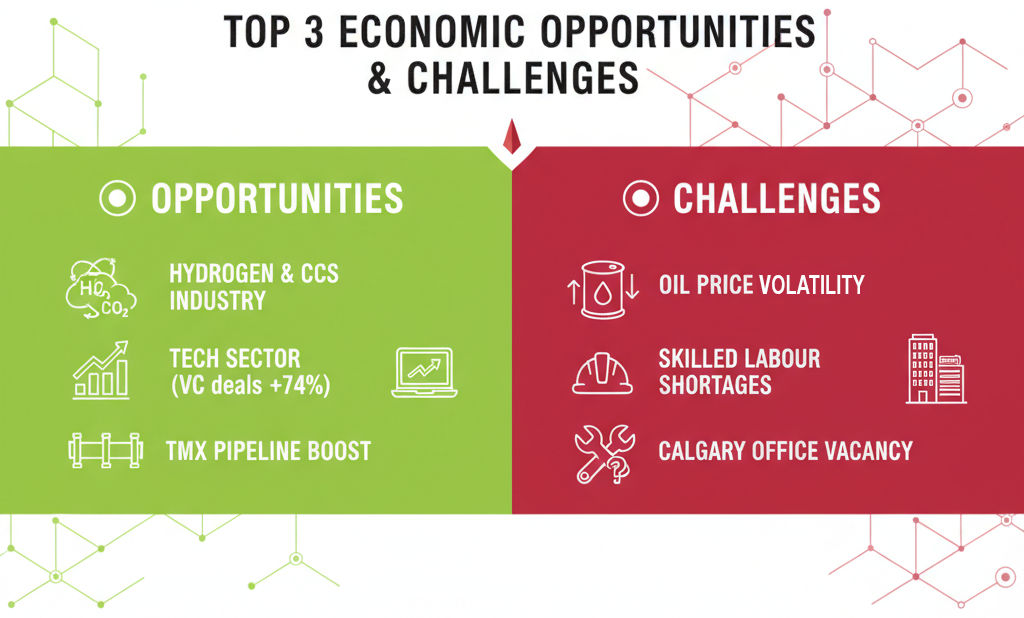
    1. Oil Price Volatility: Government revenue remains highly exposed to global energy prices. While production is high, price fluctuations and maintaining the cautious WTI forecast (Budget 2025 benchmark of US$63.75) create fiscal planning uncertainty.
    2. Skilled Labour Shortages: The residential construction and healthcare sectors face acute shortages. The high volume of $26.1 billion in planned infrastructure and public capital spending over three years puts intense pressure on the availability of skilled tradespeople.
    3. Trade Protectionism: Global trade risks and geopolitical uncertainty dampen business confidence and can slow private-sector investment. Although energy exports benefit from lower exposure to U.S. tariffs (Conference Board of Canada), non-energy exports to the U.S. have underperformed the national average.
    4. Office Vacancy: Calgary’s downtown core continues to face structural challenges. The downtown office vacancy rate is still high, with Q3 2025 data showing a rise in sublet space, signaling ongoing corporate right-sizing despite significant inventory removal via office-to-residential conversions (CBRE).

    Current Opportunities

    1. Hydrogen and Decarbonization Economy: The province is leveraging its existing infrastructure and natural gas resources to become a leader in the blue hydrogen economy, supported by major Carbon Capture and Storage (CCS) projects.
    2. Tech Sector Growth: Calgary captures 74% of Alberta’s venture capital deals, and the city’s innovation ecosystem is actively focused on technology, finance, and aerospace/defence. This, combined with low corporate tax rates, drives private investment in high-growth knowledge industries.
    3. Market Access (Trans Mountain Pipeline): The full operation of the TMX pipeline is the critical factor for the energy sector in 2025. Record production levels (YTD growth of +3.6% in oil production through August 2025, per the AER) are now supported by increased export capacity, which has led to a significant boost in non-U.S. exports (Document 9).
    4. Interprovincial Migration: The massive, sustained net inflow of new residents—driven by affordability—is the primary factor buttressing consumer spending and the residential housing market in 2025 (RBC, TD).

    3. Key Economic Sectors

    Alberta’s economic strength is shifting from reliance on a single commodity to a more distributed portfolio of resilient and growth-oriented industries.

    Estimate sector shares of Alberta GDP (illustrative)

    A. Energy Sector

    The Energy Sector remains the foundational engine of Alberta’s economy.

    • Current State: Total oil production for January–August 2025 reached 157.5 million cubic meters (Mm$^3$), a YTD increase of +3.6% over 2024 (AER). Non-conventional oil (oil sands) accounted for 84.7% of this output. Natural gas producers are also set to benefit from the start of Liquefied Natural Gas (LNG) exports from the B.C. coast, a key diversification boost for the sector (ATB).
    • Recent Developments: The key story is the transition in investment focus: the primary capital allocation is now on sustaining existing production and maximizing pipeline capacity rather than major new greenfield expansions (ATB). This limits the sector’s immediate torque on job creation but maximizes export revenues.
    • Future Outlook: The focus on decarbonization is driving massive capital investment in CCUS and hydrogen. Projects like the Dow Path2Zero petrochemical facility are crucial examples of leveraging energy resources for value-added, lower-carbon industrial production.

    B. Technology Sector

    Alberta’s tech sector continues its rapid expansion, leveraging local talent and a low-cost base. The Professional, Scientific, and Technical Services sector is a significant employer in urban centers, especially for small businesses (ATB).

    • Growth Story: The sector continues to be centered in Calgary (leading in venture capital) and Edmonton (known for AI and innovation). The availability of skilled technical talent transitioning from the energy sector provides a strong foundation for future growth.
    • Why It’s Growing: Competitive tax rates and operational costs compared to major coastal Canadian tech hubs remain key attractors for investment and talent migration.

    C. Agriculture & Food Processing

    • Scope: Alberta is the Canadian leader in cattle ranching and a major producer of grain crops. The focus continues to shift toward value-added processing—turning raw commodities into finished food and consumer products—which provides higher economic stability and rural employment.
    • Challenges and Opportunities: The sector has historically shown strong long-term labour productivity growth, significantly outpacing the overall provincial average since 2000 (ATB). The challenge lies in managing climate impacts while leveraging export markets.

    D. Construction & Real Estate

    This sector is a major pillar of non-energy economic activity in 2025.

    • Current State: Construction activity is booming. Residential housing starts are on pace to hit record levels (TD forecasts 56,500 units for 2025), driven entirely by the need to house the rapidly growing population. Non-residential construction is buttressed by the government’s robust $26.1 billion three-year Capital Plan (Alberta Government).

    E. Other Key Sectors

    • Healthcare and Social Assistance: Driven by the growing population, this public sector area is a major focus of government expenditure and employment.
    • Financial Services: Primarily based in Calgary, the sector is leveraging the city’s corporate concentration to grow beyond its traditional energy financing roots.

    4. Major Cities Economic Profiles

    Calgary (The Corporate and Diversification Hub)

    Calgary, with a metro population of 1,562,600 as of April 2025, remains a powerful economic engine.

    • Economic Profile: Calgary maintains the highest concentration of corporate headquarters per capita in Canada (Calgary Economic Development). Its economic momentum in 2025 is defined by sustained population-led demand and competitive corporate advantages.
    • Housing Market: The housing market is experiencing continual strong momentum, with high benchmark price growth (projected at 3-5% increase for the average home price in 2025). The biggest challenge is persistently low inventory combined with high demand (Calgary Economic Development).
    • Challenges: The downtown office core still faces immense structural headwind. While the Office-to-Residential Conversion program is actively removing inventory, sublet space continues to rise in Q3 2025, indicating ongoing corporate rationalization and a sustained “flight-to-quality” (CBRE).

    Edmonton (The Stable Capital and Innovation Engine)

    Edmonton’s metro economy, while experiencing the same population influx, is characterized by stability and affordability.

    • Economic Profile: Edmonton’s economy is anchored by its robust public sector (government, healthcare, education), offering more predictable employment growth than Calgary’s corporate sector (Edmonton Global). Construction is surging, with the total value of building permits issued in the first half of 2025 reaching $2.8 billion, a 39% increase over the previous year.
    • Real Estate Market: The Edmonton market remains significantly more affordable than Calgary (Edmonton Global). The market is described as balanced, offering stronger cash flow potential for investors.
    • Labour Market: Edmonton’s Q2 2025 unemployment rate was 7.5%. Its real average weekly wage was at its lowest Q2 level in 15 years (adjusted for inflation), suggesting that while nominal wages grew, inflation eroded real purchasing power in the first half of the year (Edmonton Global).

    Side-by-Side City Comparison Cards

    FeatureCalgaryEdmonton
    2025 Metro Pop.1.56M1.51M
    Economic TypeCorporate HubPublic Sector Anchor
    Housing Price Growth+3–5%+1–2%
    Key SectorTech & FinanceGovernment & Healthcare
    Office VacancyHigh (Downtown)Stable
    AffordabilityModerateHigh

    5. Labour Market Analysis

    Alberta’s labour market paradox—strong job creation, high unemployment—is the defining feature of 2025.

    Employment Trends

    • Unemployment: The provincial unemployment rate was 7.8% in September 2025 (Statistics Canada). This is due to the labour force growing faster than job creation. Strong employment growth of +1.7% in September (Statistics Canada) confirms that hiring is active, but the sheer volume of new job seekers puts upward pressure on the jobless rate.
    • Wages and Income: Average Weekly Earnings were $1,376.53 in July 2025 (Statistics Canada), maintaining Alberta’s lead in Canadian income levels.

    Migration Patterns

    Alberta leads the country in both interprovincial and international migration. The influx provides a critical supply of young workers, but this rapid growth poses immediate challenges. The labour market is absorbing newcomers, but the process is creating the highest urban unemployment rates in years (RBC). New federal policies have started to moderate the influx of non-permanent residents, which RBC projects will give the labour market “more room to adjust” toward normalization in 2026.

    6. Government Finances & Policy

    Provincial Budget Overview

    The Budget 2025 is forecasted to swing into a deficit for the 2025-26 fiscal year after several surpluses.

    • Fiscal Status: The government projects a deficit due to economic uncertainty, fluctuating oil prices, and the rising permanent costs associated with rapid population growth (Alberta Government).
    • Key Policy: The 2025 Capital Plan allocates over $26.1 billion over three years to address growth pressures in health, education, and transportation networks (Alberta Government).

    Key Policies Affecting the Economy

    1. Tax Advantage: Alberta remains the only province without a Provincial Sales Tax (PST) and committed to lowering the personal income tax rate to 8% on the first $60,000 of income (Budget 2025), a massive draw for both businesses and households.
    2. Investment Incentives: Strategic capital spending and incentives are focused on mega-projects in the petrochemical, hydrogen, and technology sectors to de-risk the long-term economy.

    7. Economic Outlook & Future Trends

    The consensus among economists (TD, ATB) is cautious optimism: Alberta’s growth will continue, but the journey will be uneven, and the provincial economy is well-positioned to weather global turmoil better than most other provinces (ATB).

    Short-term (2025-2026)

    • Key Factors to Watch: Continued stable oil prices above the budget benchmark, sustained housing activity (forecasted to remain high), and the successful integration of TMX.
    • Prediction: Real GDP growth is expected to slow slightly to around 1.6% in 2026 (TD), but the unemployment rate is forecasted to gradually normalize toward 7.1% as the labour market absorbs the recent influx of migrants (RBC).

    Long-term Structural Changes

    1. Diversification Success: The shift to value-added industries like blue hydrogen and petrochemicals (e.g., Dow’s Path2Zero) is the primary long-term hedge against oil volatility.
    2. Demographics: The massive influx of young, working-age people is the single most critical long-term asset, providing the labour supply and consumption base needed for growth through 2030 and beyond.

    8. What This Means for You

    If you’re a business owner or investing (like your friend and you):

    The business environment is optimized for low operating costs and high profit retention, reinforced by the lowest corporate tax rate and no PST.

    • Real Estate: Residential real estate remains a strong investment, with benchmark prices continuing to rise (3-5% increase projected in Calgary). Commercial real estate investment should focus on Suburban Class A/Trophy assets (CBRE) and industrial logistics, while carefully considering the risk of high downtown vacancy rates.
    • Best Opportunities: Focus on the Migration Boom (construction materials, home services, consumer retail) and the Energy Transition (engineering, project management, and specialized service contracts for hydrogen/CCS infrastructure).

    If you’re considering moving to Alberta:

    The job market is active, but competition is fierce due to the influx of new workers.

    • Best Prospects: Target the Construction, Healthcare (nursing, specialized medical roles), Logistics (trucking), and Skilled Trades sectors.
    • Affordability Edge: The low-tax environment (no PST, new lower personal income tax bracket) and relatively lower housing costs (Edmonton is still significantly more affordable than Calgary) offer a massive financial advantage over Canada’s coastal cities.

    9. Conclusion

    Alberta’s economy in 2025 is a study in resilient strength undergoing accelerated change. It maintains its status as Canada’s economic powerhouse in terms of output and income, built on the steady foundation of its massive energy reserves and enhanced export access. Yet, its future trajectory is increasingly defined by its commitment to bold diversification projects. While managing fiscal volatility and a high but transitional unemployment rate remain key challenges, the unprecedented influx of people and strategic infrastructure investment paint a picture of forward-looking optimism. Alberta isn’t just weathering the global economic transition; it’s actively seeking to lead it.

    10. External Source Links and Data Portals

    This article leverages data and forecasts from the following authoritative public and private sector organizations:

    Government & Official Statistics

    Economic Forecasts & Financial Institutions

    Urban & Commercial Market Data