Tag: Alberta Business Grants 2025

  • The 2025-2026 Guide to Launching Your Business in Alberta

    The 2025-2026 Guide to Launching Your Business in Alberta

    The 2025-2026 Guide to Launching Your Business in Alberta

    A Comprehensive Playbook for Incorporation, Funding, Hiring, and Growth

    Table of Contents

    1. Executive Summary & Introduction
    2. Understanding Alberta’s Business Environment
    3. Business Structure Options & Registration
    4. Licensing, Permits & Compliance
    5. Government Grants, Incentives & Support Programs
    6. Location Strategy: Calgary vs Edmonton vs Rural
    7. Hiring & Human Resources Strategy
    8. Financial Planning & Banking
    9. Navigating TIER Regulations (for industrial businesses)
    10. Industry-Specific Guides (Construction, Tech, Food)
    11. Common Pitfalls & How to Avoid Them
    12. 6-Month Action Plan for New Business Owners
    13. Resources, Tools & Key Contacts
    14. Conclusion & Your Next Steps
    15. Comprehensive Sources List

    Section 1: Executive Summary & Introduction

    In 2025, Alberta is forecast to lead Canada with a real GDP growth of approximately 2.8%. For entrepreneurs and investors, this headline figure is underpinned by a tangible, aggressive, and structural advantage: a pro-business environment designed to compete.

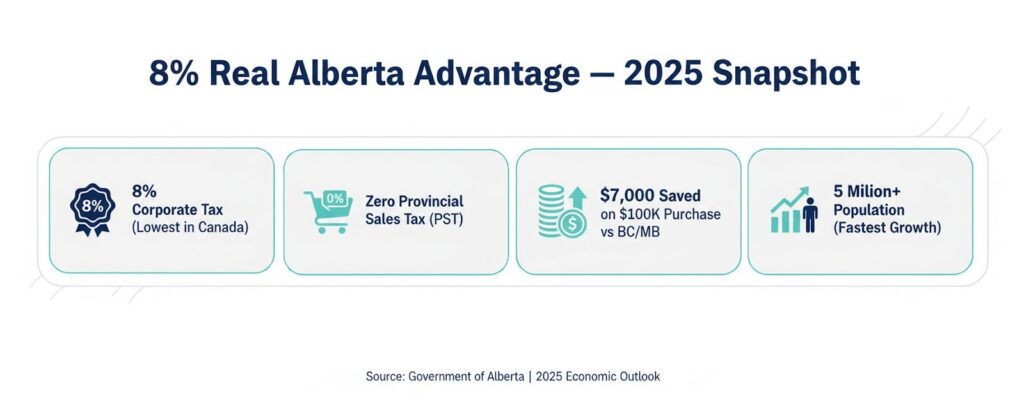
    At the heart of this strategy is Canada’s lowest general corporate tax rate at 8%. This, combined with the absence of a Provincial Sales Tax (PST), creates a powerful financial incentive that directly impacts your bottom line.

    This guide is a comprehensive playbook for launching a business in Alberta, designed for three key audiences:

    1. Local Entrepreneurs: Ready to turn a “side hustle” into a full-time, registered corporation.
    2. Interprovincial Relocators: Business owners in BC, Ontario, or Quebec looking to move their operations to a lower-cost, high-growth jurisdiction.
    3. International Investors: Founders from abroad who can leverage Alberta’s unique removal of director residency rules to establish a North American headquarters.

    Over the next 14 sections, we will provide a clear roadmap covering everything from the legal structure and licensing to hiring strategies, funding sources, and a 6-month launch plan.

    The Real-World “Alberta Advantage”

    • The Tax Hook (8% Corporate Rate): Alberta’s 8% general corporate tax rate is the lowest in Canada, compared to 12% in British Columbia and 11.5% in Ontario.
    • The “No PST” Savings: Alberta is one of five provinces with no PST, operating only with the 5% federal Goods and Services Tax (GST).
    • Real-Dollar Example: On a $100,000 purchase of new business equipment (computers, machinery, vehicles), you would pay $7,000 less in tax in Alberta than you would in British Columbia (which has a 7% PST) or Manitoba (7% PST).
    • The 5 Million+ Consumer Market: Alberta’s population officially surpassed 5 million in 2025 and continues to grow, fueled by the highest interprovincial migration in the country. This creates a powerful, expanding base of consumer demand for services and housing.
    • Access to World-Class Talent: While known for energy, the province is home to a massive pool of highly skilled professionals—engineers, project managers, and logisticians—who are increasingly transitioning their expertise into new sectors like technology, cleantech, and advanced manufacturing.

    Section 2: Understanding Alberta’s Business Environment

    Alberta’s economy is defined by more than just its traditional energy sector. In 2025, the province is a story of diversification, population-driven demand, and strategic infrastructure investment.

    Key Economic Drivers

    While oil and gas remain a cornerstone, the “key growth sectors” have expanded significantly. The economy is now increasingly powered by:

    • Technology & Innovation: With a focus on AI, cleantech, and fintech, Calgary and Edmonton are becoming globally recognized tech hubs.
    • Agri-Food & Value-Added Processing: Leveraging its agricultural roots to become a leader in food manufacturing and export.
    • Construction: Driven by a population boom, housing starts are at record highs, fueling massive demand for construction and trades.
    • Energy Transition: Billions are being invested in decarbonization, hydrogen, and carbon capture (CCUS) projects, creating a new industrial wave.

    The Tax & Cost Advantage: A Provincial Comparison

    The most immediate and compelling advantage is Alberta’s cost structure. The 8% corporate tax rate is just the beginning. When you compare the primary cost centres for a business, Alberta’s lead becomes clear.

    MetricAlbertaBritish ColumbiaOntario
    General Corporate Tax8.0%12.0%11.5%
    Small Business Tax2.0%2.0%3.2%
    Provincial Sales Tax (PST)0%7.0%8.0% (RST)
    Average Weekly Wage$1,359$1,282$1,334

    Note: Data from 2025 reports. Average wages reflect provincial-level data and vary by sector.

    While Alberta’s average wage is the highest in Canada—a benefit for attracting top talent—the total tax burden for the corporation remains the lowest.

    Market Access & Infrastructure

    A business in Alberta is not just serving the local market; it is a gateway to the rest of Canada and the world.

    • Trade Corridors: Alberta has a robust road (Trans-Canada), rail (CP & CN), and air (Calgary & Edmonton) logistics network.
    • Port Access: The province has direct rail access to the Port of Vancouver and Port of Prince Rupert for shipping to Asian markets.
    • Energy Exports: The Trans Mountain Pipeline (TMX) expansion, completed in 2024, has significantly increased Alberta’s capacity to export energy to global markets, solidifying its role as a key energy supplier.

    Current Challenges (2025-2026)

    To build a resilient business, you must also understand the risks.

    • Skilled Labour Shortages: The flip side of a booming economy. In sectors like construction, healthcare, and tech, finding and retaining qualified workers is the number one challenge.
    • Oil Price Volatility: While diversification is working, provincial sentiment and government royalty revenues are still heavily tied to global oil prices, which can create economic uncertainty.
    • High Interest Rate Environment: Like the rest of the world, high borrowing costs in 2025 can make it difficult for businesses to secure capital for major expansions or equipment purchases.

    Section 3: Business Structure Options & Registration

    Choosing your legal structure is the most important decision you’ll make, as it dictates your liability, tax obligations, and ability to raise capital.

    Comparing Business Structures

    StructureLiabilityTaxBest For…
    Sole ProprietorshipUnlimited. You are the business. Your personal assets (house, car) are at risk.Business income is taxed as your personal income.Freelancers, small consultants, or side businesses with low risk.
    PartnershipUnlimited. You are personally liable for your and your partner’s actions.Each partner reports their share of the profit/loss on their personal tax return.Collaborations built on high trust, such as a spousal team.
    CorporationLimited. The corporation is a separate legal entity. Your personal assets are protected.The corporation pays its own taxes (at the low 8% rate). You pay personal tax only on the salary or dividends you take.Almost all growing businesses. Required for accessing grants, hiring employees, and raising capital.

    The Critical Decision: Provincial vs. Federal Incorporation

    For most new businesses, incorporating is the right choice. The next question is where.

    • Federal Incorporation: Creates a corporation at the national level.
    • Provincial Incorporation: Creates an Alberta corporation.

    For international founders, the choice is clear: incorporate in Alberta.

    As of 2021, Alberta eliminated the requirement for its corporations to have Canadian-resident directors. This is a game-changing advantage, allowing international entrepreneurs (like you in Australia) to own and operate 100% of an Alberta corporation without needing a Canadian partner or nominee director.

    Director Residency Rules: The Alberta Advantage

    JurisdictionResidency Requirement
    Alberta (Provincial)No Canadian residency required.
    Federal (Canada)At least 25% of directors must be resident Canadians.
    British Columbia (Provincial)No Canadian residency required.
    Ontario (Provincial)At least 25% of directors must be resident Canadians.

    Registration Costs & Timelines

    ItemProvincial (Alberta)Federal (Canada)
    Government Filing Fee~$275~$200 (online)
    NUANS Name Search~$45~$45
    Extra-Provincial RegistrationNot RequiredMandatory. You must also register in Alberta (~$275)
    Total Govt. Cost (to operate in AB)~$320~$520+
    Timeline1-3 business days1-3 business days (online)

    Key Considerations for Non-Residents

    1. Director: Incorporate provincially in Alberta to act as the sole director from Australia.
    2. Registered Office: You must have a physical address in Alberta (not a P.O. Box). Use a local law firm, accountant, or a “virtual office” service for this.
    3. Bank Account: You will almost certainly need to visit Alberta in person to open your corporate bank account. Canadian banks require in-person verification to comply with anti-money-laundering (KYC) laws.

    Section 4: Licensing, Permits & Compliance

    Incorporating is just the first step. To operate legally, you must navigate a three-tiered system of licensing and compliance.

    The 3 Levels of Business Compliance

    1. Municipal (City Level): This is your “licence to operate” in a specific town.
    2. Provincial (Alberta): This involves workplace safety (WCB) and corporate registry filings.
    3. Federal (Canada): This involves your tax numbers from the CRA.

    1. Municipal Licensing

    Every business in Alberta, including home-based and online businesses, must have a business licence from the municipality where its registered office is located.

    • City of Calgary: A standard business licence fee is typically based on the number of employees. For a small professional service, expect a base fee of around $172.
    • City of Edmonton: Fees are tiered by business category. A standard “Professional Service” licence is in Tier 3. Non-resident businesses (those based outside Edmonton but working in it) face a higher fee.

    2. Provincial Registration

    • Workers’ Compensation Board (WCB):
    • This is mandatory. You must register with WCB-Alberta before you hire your first employee (including part-time staff and most subcontractors).
    • WCB provides no-fault disability insurance for your workers.
    • Cost: You pay premiums as a percentage of your payroll, based on your industry’s risk rating. For example, low-risk office work has a lower rate than high-risk roofing.
    • Corporate Registry:
    • You must file a Corporate Annual Return every year.
    • This is NOT a tax return. It’s a simple filing to tell the government your corporation is still active.
    • Deadline: The last day of the month after your incorporation anniversary month. (e.g., Incorporated in April? Due by May 31st).

    3. Federal Registration

    • Business Number (BN): A 9-digit number from the Canada Revenue Agency (CRA). This is your single ID for all federal accounts.
    • GST/HST Account: You must register for GST/HST once your business earns over $30,000 in revenue in a 12-month period.
    • Payroll Account: You must have a payroll account before you pay your first employee.

    An Annual Compliance Calendar

    DeadlineCompliance ActionWho Is It For?
    January 31Renew Municipal Business Licence (Varies by city, often your anniversary)All Businesses
    February 28File WCB Annual ReturnEmployers
    March 31Corporate Income Tax (T2) Return Due (if Dec 31 year-end)Corporations
    April 30Personal Income Tax DueSole Props & Partners
    Anniversary Month + 1File AB Corporate Annual ReturnCorporations
    QuarterlyRemit GST/HST (if applicable)GST Registrants
    MonthlyRemit Payroll Deductions (CPP, EI, Tax)Employers

    Section 5: Government Grants, Incentives & Support Programs

    Alberta’s government, along with federal partners, offers a wide range of grants, tax credits, and support programs. This funding is rarely for “starting” a business but is instead targeted at specific activities: hiring, innovation, and decarbonization.

    Major Grant & Incentive Programs

    ProgramSectorFunding TypeWhat It’s For
    Alberta Innovates (Varies)Tech, Health, ResearchGrantFunding for product development, commercialization, and scaling tech startups.
    Emissions Reduction Alberta (ERA)Industrial, CleantechGrant / Co-PayFunding for projects that reduce GHG emissions, often tied to TIER (See Section 9).
    Canadian Agricultural Partnership (CAP)Agri-FoodGrant / Co-PaySupports projects in value-added processing, food safety, and market expansion.
    Canada Small Business Financing Program (CSBFP)All SectorsLoan GuaranteeMakes it easier to get a loan from your bank for equipment, leaseholds, or real estate.
    Rural Renewal Stream (AAIP)All Sectors (Rural)Incentive (Hiring)A non-financial incentive that provides a fast-track immigration path to attract foreign workers to designated rural communities.

    Case Studies & Examples

    • Cleantech & Decarbonization: Funding from Emissions Reduction Alberta (ERA) has been critical for large-scale projects like Dow’s Path2Zero complex in Fort Saskatchewan, which aims to be the world’s first net-zero ethylene cracker.
    • Technology: Alberta Innovates is the primary engine for tech startups, providing everything from micro-vouchers for initial R&D to larger-scale funding to help companies commercialize their products.
    • Agriculture: The Canadian Agricultural Partnership (CAP) helps businesses, for example, a local meat processor, get funding to purchase new equipment needed to meet federal food safety certification, allowing them to expand into new markets.

    Common Application Pitfalls

    1. Applying Too Late: You cannot get a grant for an expense you have already paid. The application must be approved before you start the project or make the purchase.
    2. Not “Grant Ready”: Most grant applications require a detailed business plan, 2-3 years of financial projections, and clear proof of your corporate registration and insurance.
    3. Misunderstanding the Goal: You are not being given “free money.” You are being co-funded to achieve a specific government objective (e.g., “create 5 tech jobs,” “reduce 1,000 tonnes of CO2,” “develop a new export product”). Your application must clearly state how you will achieve their goal.

    Section 6: Location Strategy: Calgary vs Edmonton vs Rural

    Where you register your business dictates your costs, your access to talent, and your strategic advantages.

    1. Calgary: The Corporate & Tech Hub

    • The Vibe: A dense, corporate downtown with the highest concentration of head offices in Canada. It has a “work hard, play hard” culture and a booming tech and venture capital scene.
    • Talent Pool: Deep expertise in finance, engineering, project management, and software development.
    • Commercial Real Estate (Q3 2025):
    • Office (Downtown): Vacancy rates are high (approaching 24%) but are tightening in top-tier “Class A” buildings. This creates a “tenant’s market” where you can find high-quality office space for a relative bargain.
    • Industrial: Extremely low vacancy (~3.9%) and rising lease rates, driven by logistics and e-commerce.
    • Best For: Tech startups, financial services, engineering firms, and corporate head offices.

    2. Edmonton: The Industrial & Government Capital

    • The Vibe: A resilient, practical, and diverse economy. As the provincial capital, it has a large public sector, and its “Industrial Heartland” is a massive hub for manufacturing, processing, and logistics.
    • Talent Pool: Strengths in public administration, manufacturing, AI research (U of A), and skilled trades.
    • Commercial Real Estate (Q3 2025):
    • Office (Downtown): High vacancy (~23.6%) as new-builds come online, providing many options for tenants.
    • Industrial: The market is strong and stable (~5.9% vacancy), with average net rental rates around $11.55 per sq. ft. It is the primary logistics and distribution hub for northern Alberta.
    • Best For: Manufacturing, logistics & distribution, AI research, and businesses servicing the public sector.

    3. Rural Alberta: The Resourceful & Resilient Option

    • The Vibe: A diverse network of communities built on agriculture, resources, and entrepreneurship.
    • The Advantage: Lower real estate and living costs, a strong community-oriented workforce, and powerful government incentives.
    • The Incentive: The Alberta Advantage Immigration Program (AAIP) – Rural Renewal Stream is a game-changer. Designated communities (like Brooks, Grande Prairie, or Fort McMurray) can partner with employers to provide foreign workers with an accelerated path to permanent residency, helping to fill critical labour shortages.
    • Best For: Agri-food processing, trades, transportation, and businesses that can leverage the Rural Renewal Stream for hiring.

    Location Comparison: At-a-Glance

    MetricCalgaryEdmontonRural
    StrengthsCorporate, Finance, Tech, VCIndustrial, Logistics, AI, GovtAgri-Food, Trades, Lower Costs
    Talent PoolEngineers, Developers, FinanceSkilled Trades, AI, Public SectorTrades, Agriculture, General
    Office VacancyHigh (~24%)High (~23.6%)Low
    Industrial VacancyVery Low (~3.9%)Stable (~5.9%)Varies
    Key IncentiveTech AcceleratorsIndustrial HeartlandRural Renewal Stream (Hiring)

    Section 7: Hiring & Human Resources Strategy

    Your business is only as good as your team. In Alberta’s tight labour market, a successful hiring strategy requires understanding the data, the legal framework, and the immigration pathways.

    The Labour Market: A Tale of High Wages & High Demand

    • High Wages: As of July 2025, Alberta has the highest average weekly earnings in Canada at $1,359. This is a key advantage for attracting talent from other provinces but must be factored into your financial planning.
    • Skills Shortages: The unemployment rate (around 7.8% in late 2025) masks deep shortages in specific sectors. Construction, skilled trades, healthcare, and tech are all facing intense competition for qualified workers.

    Wage Benchmarking: Calgary vs. Edmonton

    Industry (Average Hourly Wage)CanadaAlberta (Province-wide)
    All Industries$31.60$33.76
    Construction$31.41$33.76
    Manufacturing$29.13$31.04
    Professional/Sci/Tech$37.91$41.62

    Source: Statistics Canada, 2025

    Hiring Locally: The HR Compliance Checklist

    When you hire your first employee, you must comply with Alberta’s Employment Standards Code and Workers’ Compensation Act.

    • [ ] 1. Get a CRA Payroll Account: You must have this before your first payday to remit CPP, EI, and income tax.
    • [ ] 2. Register with WCB: You must have WCB coverage in place before their first day of work.
    • [ ] 3. Sign a Written Employment Agreement: Do not hire on a handshake. Your contract must outline:
    • Job title and duties.
    • Wage/salary, pay schedule, and hours of work.
    • Vacation (minimum 4% of wages).
    • Probation period (maximum 90 days).
    • Clear termination clauses (to avoid costly common-law payouts).
    • [ ] 4. Add to Payroll: You must provide a pay stub each payday showing gross pay, deductions, and net pay.

    Hiring Internationally: Key Immigration Pathways

    When you can’t find the talent locally, these programs are your next step.

    1. Alberta Advantage Immigration Program (AAIP): A provincial program to nominate workers for permanent residency.
    • Rural Renewal Stream: The best option for businesses in designated rural communities. Employers partner with the community to recruit and endorse candidates.
    • Other Streams: Multiple streams exist for tech workers, healthcare professionals, and other in-demand occupations.
    1. Temporary Foreign Worker Program (TFWP): This is the “go-to” for most other jobs.
    • The Process: You must first prove you tried to hire a Canadian by posting the job for a minimum period.
    • LMIA: If you are unsuccessful, you apply for a Labour Market Impact Assessment (LMIA). A positive LMIA proves you need a foreign worker, which they then use to apply for a work permit.
    • Cost & Time: This process can cost over $1,000 in government fees and take several months.

    Section 8: Financial Planning & Banking

    A solid financial plan is the difference between a high-growth business and a stressed-out owner. Your plan needs to cover startup costs, funding sources, and tax strategy.

    Startup Cost Breakdown (Typical Estimates)

    Business TypeEst. Startup CostKey Expenses
    Service/Consulting$5,000 – $20,000Incorporation, laptop, software, insurance, website.
    Tech Startup$30,000 – $100,000+All of the above, plus developer salaries, data/server costs, IP legal fees.
    Retail (Leased Space)$50,000 – $150,000Lease deposit, store build-out (leasehold), initial inventory, POS system.
    Manufacturing$200,000 – $500,000+Industrial lease, specialized equipment, materials, safety certifications.

    Funding Sources: Your 3 Main Options

    1. Bootstrapping (Self-Funding):
    • What it is: Using your own savings.
    • Pros: You retain 100% ownership and control.
    • Cons: High personal risk; growth is limited by your personal cash flow.
    1. Traditional Debt (Bank Loans):
    • What it is: Loans from banks (BMO, Scotiabank, etc.) or credit unions. ATB Financial is an Alberta-based crown corporation that is often more focused on local businesses.
    • The Reality: Banks rarely lend to new businesses without a track record, significant assets, or a personal guarantee from the owner.
    • The Solution: The Canada Small Business Financing Program (CSBFP). This federal program guarantees a large portion of your loan, reducing the bank’s risk and making them much more likely to approve you for equipment, leasehold, or property financing.
    1. Venture Capital / Angel Investors:
    • What it is: Selling equity (a piece of your company) to investors in exchange for capital.
    • The Hub: This ecosystem is almost entirely concentrated in Calgary’s tech scene.
    • Pros: Access to large amounts of capital and valuable investor networks.
    • Cons: You give up ownership and are now accountable to a board. This is only for high-growth tech-style businesses.

    Banking for Non-Residents

    Opening a bank account as a non-resident is a challenge, but not impossible.

    • The Hurdle: Canadian banks must follow strict “Know Your Customer” (KYC) rules.
    • The Solution: You (or your designated director) will almost certainly be required to visit an Alberta bank branch in person with your new incorporation documents and two pieces of government-issued ID (like your passport).
    • Tip: Call the bank’s “New Business” line before you fly to book an appointment and confirm exactly which documents they require.

    Essential Tax Planning

    Your accountant is your most valuable partner. Discuss these two items immediately.

    1. The Small Business Deduction (SBD):
    • In Alberta, the first $500,000 of active business income is taxed at a combined federal/provincial rate of just 11% (9% federal + 2% Alberta).
    • Income above $500,000 is taxed at the 23% general rate.
    • Action: Your accountant will help you structure your finances to ensure you qualify for this.
    1. Capital Cost Allowance (CCA):
    • You cannot “expense” a large purchase (like a $50,000 truck) all in one year.
    • Instead, you “depreciate” it over several years using CCA. This means you get to deduct a portion of its cost from your income each year.
    • Action: Your accountant manages this. Keep every receipt for capital purchases.

    Section 9: Navigating TIER Regulations (for industrial businesses)

    If you are a small business, this section likely won’t apply. But if you are in manufacturing, energy, or industrial processing, it is one of the most critical regulations in the province.

    What is TIER?

    The Technology Innovation and Emissions Reduction (TIER) regulation is Alberta’s industrial carbon pricing system. It is not a broad carbon tax on consumers; it is a system that applies only to large industrial emitters.

    • Who it Applies To: TIER is mandatory for any facility emitting 100,000 tonnes or more of CO₂e (carbon dioxide equivalent) per year.
    • The “Opt-In” Option: Facilities that emit less (e.g., a new mid-sized manufacturing plant) can “opt-in” to TIER. Businesses do this to be exempt from the federal fuel charge and gain access to the TIER compliance options.

    Your TIER Compliance Options

    If your facility is regulated by TIER, you are given an emissions benchmark. If you emit more than your benchmark, you have a compliance obligation. You can meet this obligation in several ways:

    1. Reduce On-Site Emissions: Invest in new technology (e.g., carbon capture) to lower your facility’s emissions.
    2. Use Emissions Performance Credits (EPCs): Buy credits from another Alberta facility that beat its emissions target.
    3. Buy Emission Offset Credits: Purchase credits from an approved project at a non-TIER facility (e.g., a farmer who implemented a conservation program).
    4. Pay the TIER Fund: As a last resort, you can pay a set price per-tonne of excess emissions into the TIER compliance fund. This money is then used by Emissions Reduction Alberta (ERA) to fund new green technologies.

    TIER and the New Business Owner

    As a new industrial business owner, TIER has two major implications:

    1. It is a Planning Tool: When designing your facility, TIER (and the grants from ERA) provides a powerful financial incentive to invest in energy-efficient, low-emission technology from day one.
    2. It Creates Uncertainty (and Opportunity): The TIER system is currently under review (as of late 2025). The government is balancing the need to remain competitive (by freezing the carbon price) with the need to drive real emissions reductions. This creates a complex and evolving market for credits and offsets, and engaging a specialized environmental consultant is highly recommended.

    Section 10: Industry-Specific Guides

    While the core rules are the same, some of Alberta’s key sectors have unique requirements.

    1. The Construction Business

    • The Market: Booming. Housing starts in Alberta for the first half of 2025 were up 30% over last year’s record pace, driven by the population surge. This has created a massive demand for new builds and renovations.
    • Licensing & Permits:
    • Provincial: If you build new homes, you must have a Residential Builder Licence from the province.
    • Municipal: You need a municipal contractor licence (e.g., from Calgary or Edmonton).
    • Prepaid Contracting: If you accept any deposit from a homeowner before work is complete, you must have a separate Prepaid Contractor’s Licence from the Government of Alberta and be bonded.
    • Safety (Mandatory):
    • WCB-Alberta: Non-negotiable.
    • Safety Tickets: You and your staff will need various safety certifications, such as CSTS (Construction Safety Training System) and First Aid, to be allowed on most worksites.

    2. The Tech Startup

    • The Ecosystem: Centered in Calgary and Edmonton, supported by hubs like Edmonton Unlimited and Platform Calgary. These organizations run accelerator programs (like Alberta Catalyzer) that provide mentorship, connections, and pre-seed funding.
    • Funding: Your primary funding sources will be Alberta Innovates (for non-dilutive grants) and the local Angel/VC network.
    • Intellectual Property (IP):
    • Protecting your IP is your #1 priority.
    • Action: Use a specialized IP lawyer to file for patents or trademarks before you publicly disclose your innovation.
    • Support: Programs like ElevateIP Alberta (run by the University of Calgary) provide funding to help startups pay for the high costs of IP strategy and filing.

    3. Food Processing & Agriculture

    • The Opportunity: To move “beyond the farm gate.” Alberta is pushing to add more value to its raw commodities, creating huge opportunities in food processing, packaging, and export.
    • Incentives: The Canadian Agricultural Partnership (CAP) and other provincial programs offer grants for:
    • Purchasing processing and packaging equipment.
    • Implementing food safety systems.
    • Developing value-added products (e.g., turning bulk pulse crops into high-protein snack food).
    • Certifications:
    • Food Safety: Your facility will need a Food Handling Permit from Alberta Health Services (AHS).
    • HACCP: To sell to larger retailers (like Loblaws or Sobeys) or to export, you will need a HACCP (Hazard Analysis and Critical Control Point) plan. This is an internationally recognized food safety system that is complex and costly to implement but essential for growth.

    Section 11: Common Pitfalls & How to Avoid Them

    The “Alberta Advantage” is real, but it doesn’t guarantee success. New business owners often make the same handful of costly, unforced errors. Understanding these pitfalls is the first step to avoiding them.

    Pitfall 1: Underestimating Total Labour Costs

    • The Pitfall: You budget for an employee’s wage but forget the “fully-loaded” cost. Alberta has the highest average weekly earnings in Canada (at $1,359 in July 2025). On top of that, you must pay for CPP (employer portion), EI (employer portion), and WCB premiums. You also owe vacation pay (4% minimum).
    • The Avoidance Strategy:
      Budget for an employee’s “fully-loaded” cost, which is typically 15% to 25% above their gross wage. For a $33/hour tradesperson, this means you should budget for ~$40/hour.

    Pitfall 2: Mismanaging Compliance Deadlines

    • The Pitfall: Failing to meet key deadlines. The two most common failures are:
    1. Forgetting the WCB Annual Return: Due every year at the end of February, this is where you report your actual payroll from the previous year. Missing it incurs penalties.
    2. Ignoring the Corporate Annual Return: Many new owners confuse this with their tax return. It’s not. It’s a simple filing with the Alberta Corporate Registry to confirm your business is still active. If you fail to file, the government can strike your corporation from the registry, leaving you personally liable.
    • The Avoidance Strategy:
      Hire a bookkeeper or CPA from day one. At a minimum, set digital calendar reminders for these key dates:
    • February 28: WCB Annual Return deadline.
    • Your Incorporation “Anniversary Month”: Your Corporate Annual Return is due by the end of the following month.

    Pitfall 3: Botching GST/HST Registration

    • The Pitfall: You are a small business and your sales are growing. You pass the $30,000 in revenue (over four consecutive quarters) mandatory registration threshold. You don’t notice, and you fail to register for, collect, or remit GST. Six months later, the CRA sends you a bill for all the GST you should have collected, which now comes directly out of your pocket.
    • The Avoidance Strategy:
      Speak to an accountant before you launch. Understand your revenue and when you will likely hit this threshold. It is often better to register from Day 1, as this allows you to claim “Input Tax Credits” (ITCs) on the GST you pay for your startup costs (e.g., on laptops, equipment, and rent).

    Pitfall 4: Misunderstanding Economic Seasonality

    • The Pitfall: Assuming revenue will be consistent every month. Alberta has a highly seasonal economy. Construction and landscaping grind to a halt in the winter. Retail and hospitality boom before Christmas and in the summer. A business that is wildly profitable in July can be bankrupt by January.
    • The Avoidance Strategy:
      Build a 12-month cash flow forecast, not a 1-month one. Be realistic about your high and low seasons. Secure a business line of credit during your busy season (when the bank sees you’re successful) so you have the cash reserves to cover your fixed costs (rent, salaries) during the slow season.

    Preventive Actions Checklist

    • [ ] Did I budget a “fully-loaded” (Wage + 20%) cost for my first hire?
    • [ ] Am I registered with WCB before my first employee’s first day?
    • [ ] Have I set a calendar reminder for my Corporate Annual Return (anniversary month + 1)?
    • [ ] Have I spoken to a CPA about my GST/HST registration threshold?
    • [ ] Do I have 6-12 months of operating cash (runway) set aside?

    Section 12: 6-Month Action Plan for New Business Owners

    This is a sample roadmap to take you from idea to launch.

    Phase 1: Foundation (Months 1-2)

    • Theme: Strategy, Legal & Banking
    • [ ] Finalize Business Plan: Refine your model, target audience, and financial projections.
    • [ ] Decide on Structure: (Section 3) Make the critical choice: Sole Proprietorship vs. Corporation.
    • [ ] Incorporate: (Section 3) For 99% of growing businesses, this is the right move.
    • File for Provincial (Alberta) Incorporation. This is especially critical for non-residents, as it does not require a Canadian-resident director.
    • File for Federal Incorporation only if national name protection is more important than the cost and hassle of extra-provincial registration and Canadian-director requirements.
    • [ ] Open Bank Account: (Section 8) Book an in-person meeting with a bank (e.g., ATB, BMO, RBC). Bring your new incorporation documents, personal ID, and be prepared to make an initial deposit.
    • [ ] Register Domain & Email: Secure your digital identity.

    Phase 2: Build-Out & Compliance (Months 3-4)

    • Theme: Location & Licensing
    • [ ] Secure Location: (Section 6) Finalize your choice (Calgary, Edmonton, or Rural) and sign a lease if you need a physical space.
    • [ ] Get Municipal Licence: (Section 4) Apply for your business licence from the city your registered office is in. This is mandatory before you can legally operate.
    • [ ] Register for Taxes:
    • Call the CRA to register for a GST/HST account.
    • Register for a CRA Payroll Account (you will need this before your first hire).
    • [ ] Register with WCB: (Section 4) Register your new corporation with WCB-Alberta. This is a mandatory step before hiring.
    • [ ] Apply for Grants: (Section 5) If your business is in tech, green energy, or agri-food, start the grant application process. It is slow and best started early.

    Phase 3: Pre-Launch & Operations (Months 5-6)

    • Theme: Hiring & Marketing
    • [ ] Set Up Accounting: Choose your software (e.g., QuickBooks, Xero) and hire a bookkeeper.
    • [ ] Launch Website: A simple, professional website is a minimum requirement.
    • [ ] Hire First Employee: (Section 7)
    • Finalize a job description.
    • Post the job on relevant boards.
    • Draft a formal Employment Agreement compliant with Alberta’s Employment Standards Code.
    • [ ] Finalize Suppliers: Get quotes and lock in your supply chain for any physical products.
    • [ ] OPEN FOR BUSINESS: Make your first sale and officially start operations.

    What You Should Have Achieved by End of Month 6:

    • A legally incorporated and compliant business.
    • All essential municipal, provincial, and federal licences and registrations.
    • A separate business bank account and accounting system.
    • A live website and marketing presence.
    • Your first employee hired and onboarded correctly.
    • Your first sale or client.

    Section 13: Resources, Tools & Key Contacts

    Navigating your new business launch is easier when you know where to turn for help. Here is a curated list of essential resources.

    Tier 1: Must-Use Government & Professional Resources

    These are the non-negotiable portals and organizations every new business owner will interact with.

    • Government of Alberta – Start a Business: Your official provincial guide.
    • Link: https://www.alberta.ca/start-a-business
    • Canada Business Network: The federal equivalent, excellent for understanding national obligations.
    • Link: https://canadabusiness.ca/
    • City of Calgary Business Licences
    • Link: https://www.calgary.ca/for-business/licences.html
    • City of Edmonton Business Licences
    • Link: https://www.edmonton.ca/business-economy/business-licences
    • WCB-Alberta
    • Link: https://www.wcb.ab.ca/
    • CPA Alberta (Chartered Professional Accountants)
    • Link: https://www.cpaalberta.ca/
    • Law Society of Alberta
    • Link: https://www.lawsociety.ab.ca/

    Tier 2: Sector-Specific & Networking Resources

    These organizations provide sector-specific support, advocacy, and invaluable networking opportunities.

    • Calgary Chamber of Commerce: https://www.calgarychamber.com/
    • Edmonton Chamber of Commerce: https://www.edmontonchamber.com/
    • Alberta Innovates: https://albertainnovates.ca/
    • Edmonton Unlimited & Platform Calgary: https://edmontonunlimited.com/ & https://www.platformcalgary.com/
    • Alberta Construction Association (ACA): https://www.albertaconstruction.net/
    • Food Processors of Alberta: https://www.afpa.com/

    Section 14: Conclusion & Your Next Steps

    This guide has outlined the significant, tangible advantages of launching a business in Alberta.

    From a $1,350+ average weekly wage that attracts top talent to a forecast 2.8% GDP growth that leads the nation, the economic fundamentals are strong. When combined with a 5-million-strong consumer market, you have a recipe for opportunity.

    But the single greatest advantage is the one you can take to the bank: Alberta has the lowest general corporate tax rate in Canada at 8% and no Provincial Sales Tax (PST). This isn’t just a slogan; it is a direct, calculated financial advantage that puts thousands of dollars back into your business every year—money you can use to hire, invest, and grow.

    Your First Action Items

    Your journey starts now. Use this list as your immediate call to action.

    • [ ] Book a Consultation: Your first call should be to an Alberta-based Accountant (CPA). Ask them:
    • “Should I register for GST from Day 1?”
    • “What is the best fiscal year-end for my business?”
    • “Can you set up my CRA payroll accounts?”
    • [ ] Engage a Lawyer: Your second call is to a business lawyer. Ask them:
    • “Can you complete my provincial incorporation?”
    • “Can you review the commercial lease for my new location?”
    • “Can you draft a standard employment agreement for my first hire?”
    • [ ] Finalize Your Location: Based on Section 6, decide if your business is best suited for Calgary’s corporate/tech hub, Edmonton’s industrial heartland, or a designated rural community.
    • [ ] Start Your 6-Month Plan: Open Section 12 (“Pitfalls & Action Plan”) and set a “Month 1” start date.

    Alberta is a province built by entrepreneurs. The framework is in place, the incentives are clear, and the economy is ready. It’s time to get started.

    Section 15: Comprehensive Sources List