
Alberta, with its vast geological capacity and deep expertise in energy development, is globally recognized as a pioneer in the practical, commercial-scale deployment of Carbon Capture, Utilization, and Storage (CCUS). This technology is not merely a theoretical concept for the province; it is a live, operational strategy—an essential bridge for its energy-intensive industries to meet ambitious emissions targets. The foundation of this real-world application is a robust infrastructure backbone, led by the colossal Alberta Carbon Trunk Line (ACTL), and a new generation of supportive policy, spearheaded by the Alberta Carbon Capture Incentive Program (ACCIP).
The Infrastructure Backbone: ACTL and the Hub Strategy
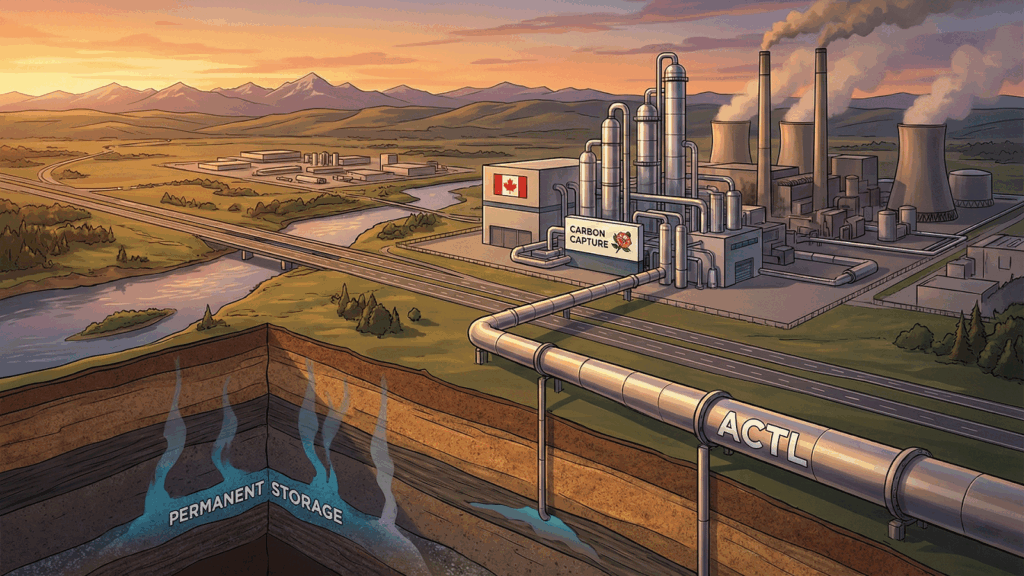
CCUS requires a complex, integrated system: capturing carbon dioxide (CO2) at the source, transporting it safely, and then either utilizing or permanently storing it. Alberta’s leadership is most evident in the successful implementation of the transportation and storage components, which are crucial for scaling up the entire CCUS value chain.
The Alberta Carbon Trunk Line (ACTL)
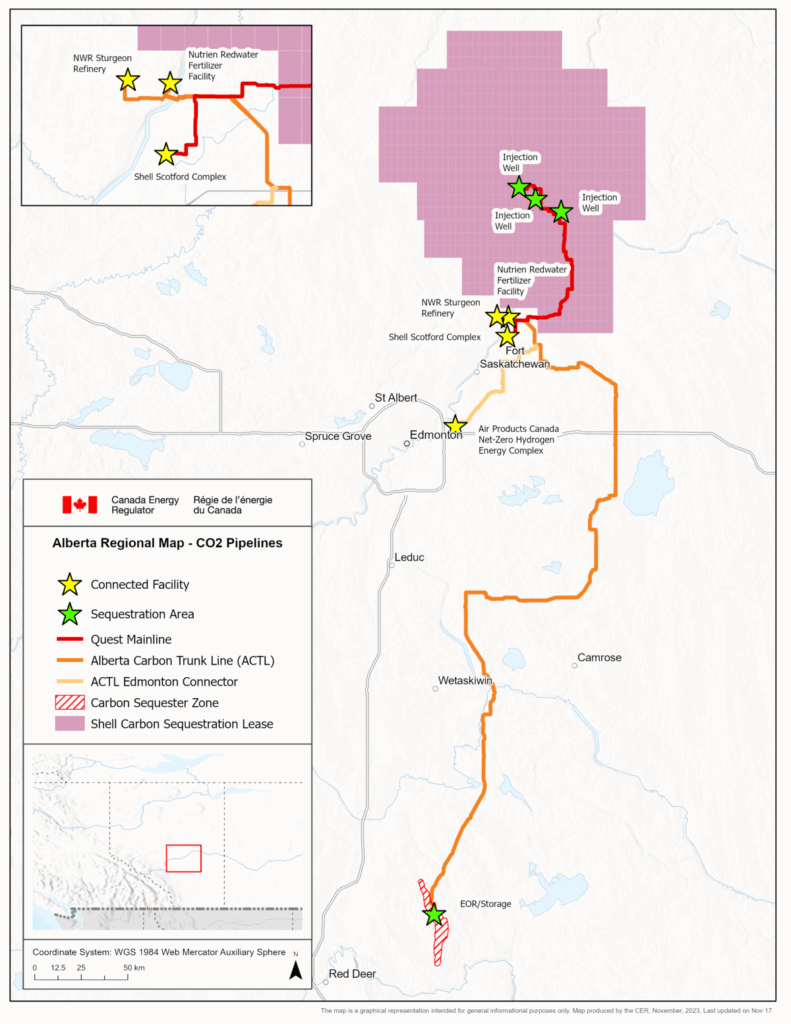
Image Source: Market Snapshot: Canada is expanding its CO2 pipeline network
The ACTL system is the largest operational CO2 pipeline in Alberta and one of the largest in the world. Its design and function exemplify Alberta’s commitment to creating shared, open-access infrastructure:
- Design and Scope: The ACTL is a 240-kilometre, 16-inch diameter pipeline that forms the central artery of a carbon capture network in the Alberta Industrial Heartland, northeast of Edmonton.
- Massive Capacity: While initially licensed for $5.5$ million tonnes of CO2 per year (Mt/yr), the pipeline’s full design capacity is an astounding 14.6 Mt/yr. This massive, unutilized capacity future-proofs the system, allowing dozens of new industrial emitters to connect as the CCUS industry grows.
- Current Anchor Emitters: The system currently gathers CO2 from two major industrial sources: the North West Sturgeon Refinery (a bitumen upgrader) and the Nutrien Redwater Fertilizer Facility.
- Open-Access Model: Crucially, the ACTL operates as an open-access system owned and operated by Wolf Midstream and Enhance Energy. This model allows multiple companies to share the infrastructure, significantly lowering the barrier to entry for individual emitters who would otherwise have to build their own dedicated pipelines.
The Rise of Carbon Hubs
The ACTL is the pioneer, but the future of CCUS in Alberta is the Carbon Storage Hubs. These are geological areas that the Government of Alberta has designated for dedicated, long-term CO2 sequestration.
- Geological Advantage: Alberta sits atop the Western Canadian Sedimentary Basin, which has immense storage potential—estimated at over 100 billion tonnes of CO2. This includes deep saline aquifers and depleted oil and gas reservoirs that have securely held hydrocarbons for millennia, making them ideal for CO2 storage.
- Hub Concept: Following a competitive process, the government has selected and awarded tenure for multiple carbon sequestration hubs across the province. These hubs will serve as the collective, permanent storage sites for captured CO2 from various industrial emitters, consolidating the captured carbon into large, regulated, and monitored subterranean formations.
- Scaling Up: Projects like the proposed Alberta Carbon Grid (led by Pembina and TC Energy) and the Wabamun Carbon Hub (led by Enbridge and Capital Power) promise to dramatically increase the provincial storage capacity to over 50 Mt/yr by 2030, a vital step toward achieving net-zero goals.
💰 Incentives and Adoption: Driving Commercialization
The large capital cost associated with building capture facilities has historically been the primary hurdle for CCUS adoption. To overcome this, the Alberta government has introduced aggressive fiscal policies to accelerate project development, particularly in the hardest-to-abate sectors.
The Alberta Carbon Capture Incentive Program (ACCIP)
The ACCIP is a cornerstone provincial policy designed to make CCUS projects financially viable for heavy industry, aligning with the federal government’s investment tax credit.
- Core Incentive: ACCIP provides a grant of 12% on new eligible CCUS capital costs. This grant is paid out in three instalments over three years, beginning one year after the project becomes operational. The total program support is anticipated to be between $3.2 and $5.3 billion from 2024 to 2035.
- Targeted Sectors: The program is specifically designed to drive adoption in sectors with few other viable decarbonization options, including:
- Oil Sands and Oil and Gas Production
- Petrochemicals and Hydrogen Production
- Cement and Manufacturing (e.g., the Heidelberg Materials project in Edmonton, the world’s first planned full-scale CCUS project on a cement plant)
- Funding and Alignment: The ACCIP is partially funded through the industry-paid Technology Innovation and Emissions Reduction (TIER) fund and is designed to complement the Federal Government’s CCUS Investment Tax Credit (CCUS ITC), providing a powerful double-incentive for companies choosing to invest in Alberta. This combination of provincial and federal financial support significantly de-risks multi-billion dollar CCUS investments, turning long-term climate action into a near-term economic decision.
🎯 Utilization vs. Sequestration: The End Game for CO2
Once CO2 is captured and transported via systems like the ACTL, its ultimate destination is determined by whether it will be used for Utilization (Enhanced Oil Recovery) or Permanent Geological Storage (Sequestration). Both pathways are essential components of Alberta’s CCUS landscape.
Utilization: Enhanced Oil Recovery (EOR)
- Process: In CO2-EOR, the captured and compressed CO2 is injected into mature, depleted oil reservoirs. The high-pressure CO2 acts like a solvent, reducing the viscosity of the residual oil, pushing it toward production wells, and significantly increasing the overall yield of the field.
- Economic Driver: For projects like the ACTL, EOR provides the crucial commercial revenue stream that helps justify the initial high investment costs of the capture and pipeline infrastructure. Enhance Energy’s operations at the Clive Field (the current endpoint of the ACTL) are a prime example, where CO2 is used for EOR, simultaneously unlocking additional oil reserves and storing the carbon.
- Dual Benefit: EOR is classified as a form of CCUS because a significant portion of the injected CO2 remains permanently trapped within the reservoir rock and pore space, effectively achieving permanent storage alongside resource recovery. This dual-purpose mechanism has been regulated in Alberta since the 1980s, demonstrating decades of operational expertise.
Permanent Geological Sequestration (Dedicated Storage)
- Process: Dedicated Sequestration is the injection of CO2 into deep, massive geological formations—typically saline aquifers or unrecoverable depleted hydrocarbon reservoirs—solely for the purpose of permanent containment. The CO2 is stored thousands of metres underground, capped by impermeable rock layers that prevent its migration back to the surface.
- The Quest Project: Shell’s Quest project, operational since 2015, is a key example of dedicated storage in Alberta. It captures CO2 from the Scotford Upgrader and injects it into the deep Basal Cambrian Sandstone unit for permanent sequestration. Quest has safely stored millions of tonnes of CO2 to date, demonstrating the security and effectiveness of this method.
- Future Focus: While EOR provides an immediate economic incentive, the provincial government’s long-term strategy is focused on building the large, dedicated storage hubs (mentioned above) to manage the massive volumes of CO2 required to reach net-zero by 2050. These hubs will rely on permanent geological storage, which is the most effective method for retiring large volumes of CO2 emissions indefinitely.
The Path Forward: A Global Energy Transition Leader
The operational success of the ACTL and Quest, coupled with the strategic launch of the ACCIP and the development of new carbon hubs, solidifies Alberta’s role as a global leader in energy transition.
For Technical Engineers, Alberta offers an unparalleled opportunity to work on cutting-edge, commercial-scale CCUS infrastructure—from advanced capture technologies in hard-to-abate sectors to the complex geomechanics of permanent storage. For Alberta Residents, CCUS provides a path to sustain the province’s economic foundation in the energy sector while delivering substantial environmental benefits and creating thousands of high-value jobs. And for Energy Investors, the combination of world-class geology, established regulatory frameworks (including pore space tenure), and robust, multi-billion-dollar government incentives makes Alberta a premier jurisdiction for deploying CCUS capital with confidence and a clear line of sight to commercial returns.
CCUS in Alberta is past the blueprint phase; it is an active, expanding industrial ecosystem proving that climate action and economic vitality can be mutually reinforcing. The province is not just talking about net-zero—it is building the physical infrastructure necessary to achieve it.
CCUS in Action: Article Sources
1. Infrastructure: Alberta Carbon Trunk Line (ACTL) and Hubs
1.1 Carbon Capture Utilization and Storage Opportunities in Alberta https://investalberta.ca/carbon-capture-storage-alberta/
1.2 Market Snapshot: New projects in Alberta could add significant carbon storage capacity by 2030 – Canada Energy Regulator https://www.cer-rec.gc.ca/en/data-analysis/energy-markets/market-snapshots/2022/market-snapshot-new-projects-alberta-could-add-significant-carbon-storage-capacity-2030.html
1.3 Inside Clive, a model for reducing emissions while adding value in Alberta https://www.canadianenergycentre.ca/inside-clive-a-model-for-reducing-emissions-while-adding-value-in-alberta/
1.4 Alberta Has “Tonnes” of Room to Grow Carbon Storage – BOE Report https://boereport.com/2021/03/31/alberta-has-tonnes-of-room-to-grow-carbon-storage/
1.5 Carbon Capture, Utilization, and Storage (CCUS)
2. Incentives and Adoption: Alberta Carbon Capture Incentive Program (ACCIP)
2.1 Alberta Carbon Capture Incentive Program https://www.alberta.ca/alberta-carbon-capture-incentive-program
2.2 The Alberta Carbon Capture Incentive Program – Dentons https://www.dentons.com/en/insights/alerts/2024/april/23/the-alberta-carbon-capture-incentive-program
2.3 Government of Alberta Unveils Further Details Regarding the Alberta Carbon Capture Incentive Program
3. Utilization vs. Sequestration (EOR and Permanent Storage)
3.1 Market Snapshot: New projects in Alberta could add significant carbon storage capacity by 2030 – Canada Energy Regulator https://www.cer-rec.gc.ca/en/data-analysis/energy-markets/market-snapshots/2022/market-snapshot-new-projects-alberta-could-add-significant-carbon-storage-capacity-2030.html
3.2 Inside Clive, a model for reducing emissions while adding value in Alberta https://www.canadianenergycentre.ca/inside-clive-a-model-for-reducing-emissions-while-adding-value-in-alberta/
3.3 Final preparations for Alberta’s biggest CO2 Enhanced Oil Recovery in the Leduc Formation at Clive – GeoConvention https://geoconvention.com/wp-content/uploads/abstracts/2019/GC2019_301_Final_preparations_for_Albertas_biggest_CO2_Enhanced_Oil_Recovery_Leduc_Fm.pdf