
Introduction: The Baseload Power of the Earth
Alberta is currently experiencing a new kind of gold rush—but this time, the resource is heat, not oil. A critical shift is occurring in the province’s economic diversification strategy as stakeholders realize that Alberta’s vast underground resources aren’t just hydrocarbons; they are also reliable, non-emitting heat sources.
Unlike intermittent renewable sources like wind and solar, geothermal energy is a “baseload” power source. It offers firm, dispatchable power that can run 24/7 regardless of weather conditions or the time of day, providing crucial stability to Alberta’s deregulated electricity grid.
The thesis for this energy transition is clear: Alberta’s unique geological assets and, crucially, its legacy oil and gas infrastructure and expertise, position it to become a North American leader in geothermal power. This approach promises to turn former liabilities, such as defunct wells, into valuable energy assets.
The Technical Synergy: Why Geothermal is a Perfect Fit for the Oil Patch
The “Co-production” Breakthrough
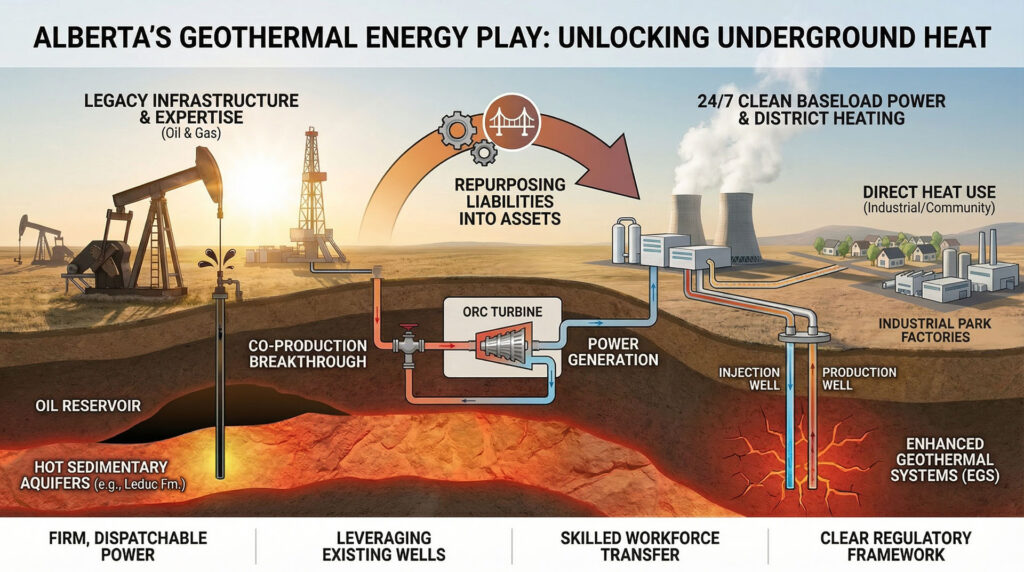
The “lowest-hanging fruit” for the sector is a model known as co-produced geothermal. This involves extracting thermal energy from hot fluid that is already being brought to the surface as part of routine oil and gas operations.
In existing Enhanced Oil Recovery (EOR) and waterflood operations, large volumes of naturally heated water (brine) are brought to the surface. This produced water can reach temperatures up to 108∘C at the wellhead, and sometimes higher in deep formations, but is currently treated as waste heat. Geothermal technology intercepts this heat before the fluid is reinjected, making the process non-consumptive and non-interruptive to hydrocarbon production.
The Technology: Organic Rankine Cycle (ORC)
The core technology for capturing this moderate-temperature energy is the Organic Rankine Cycle (ORC) turbine. Unlike traditional steam turbines, the ORC uses a hydrocarbon working fluid with a much lower boiling point. The hot brine heats this fluid, creating pressurized vapor to spin the turbine and generate electricity. These systems are often integrated with a Natural Gas Turbine (NGT) in hybrid configurations for maximum output and system resilience.
Leveraging Legacy Assets and Skills
Geothermal development in Alberta radically reduces capital costs by utilizing existing deep wells, pipelines, and surface facilities. This strategy provides a pathway to mitigate the province’s financial and environmental issues regarding managing thousands of orphan or inactive oil and gas wells, essentially transforming a liability into an asset.
Furthermore, the transition relies on direct human capital transfer. As the developers of the Alberta No. 1 project state, the project is “a natural fit for Alberta’s evolving energy sector… creat[ing] over 300 indirect and direct jobs” by utilizing legacy expertise to drill for clean heat and power.
- Geologists/Geophysicists: Their expertise in Western Canadian Sedimentary Basin (WCSB) reservoir characterization, fluid dynamics, and subsurface modeling is essential for finding heat reservoirs.
- Drillers/Engineers: The specialized deep-drilling expertise, including directional drilling and high-pressure well control required for Enhanced Geothermal Systems (EGS), is a direct carry-over from the oil and gas industry.
Geological Advantage: Inside Alberta’s Heat Map
The Western Canadian Sedimentary Basin (WCSB)
The WCSB is a vast, layered basin of porous and non-porous rock stretching across Western Canada. The key factor in its viability for energy is the geothermal gradient—how quickly temperature increases with depth. While not as high as volcanic regions, Alberta’s gradient is sufficient in several areas to reach power-producing temperatures at economically viable depths of 3–5 km.
Specific geological formations hold immense potential. The Leduc Formation alone is estimated to contain about 8.97 GW of gross electrical power capacity, representing a significant, untapped energy source comparable to a large portion of the current grid’s capacity.
The Two Paths to Development
- Sedimentary Basins (Co-production/Deep Direct Use): This utilizes moderate heat from naturally porous, water-filled rock. It is ideal for heat-intensive applications like district heating and industrial process heat.
- Enhanced Geothermal Systems (EGS): This targets deep, hot, dry rock beneath the basement. EGS requires creating artificial permeability through injection and production wells to circulate fluid, holding the potential for large-scale, baseload power generation in a manner conceptually similar to deep fracking techniques.
Project Profiles: Leading the Canadian Geothermal Frontier
Swan Hills Geothermal Project (FutEra Power)
Commissioned in 2023, the Swan Hills project stands as Canada’s first operational co-produced geothermal power plant. It serves as a primary example of using hot fluids from an active, mature oil field—specifically Razor Energy’s operation—to generate electricity for the grid.
This hybrid approach optimizes efficiency and reduces the emissions intensity of the existing operation. The project boasts a combined capacity of 21 MW, with up to 7.5 MW derived from the ORC system. Notably, it was privately financed by Razor and Arena Investors, demonstrating that innovative partnerships and leveraging legacy assets can secure private capital for energy transition projects.
Alberta No. 1 (Terrapin Geothermics)
Located near Grande Prairie, Alberta No. 1 is the province’s first conventional, standalone deep geothermal project. This project signifies a move beyond co-production toward dedicated geothermal development. The name is a “nod to Leduc No. 1, the site of Alberta’s major oil discovery in 1947… cho[sen] to signify how Alberta’s legacy in oil and gas can be used for a renewable energy frontier”.
The project emphasizes dual value, planning for both 10 MW of electricity and 985 TJ/year of direct heat for a district heating system. This direct-use component supports local industrial facilities, such as wood manufacturing, offering a stable, low-cost heat source that significantly reduces industrial emissions and operating expenses.
Regulatory & Financial Landscape: De-Risking the Investment
A Clear Regulatory Framework (The Alberta Advantage)
Alberta has moved to de-risk investment through the creation of the Geothermal Resource Development Act (GRDA) and accompanying regulations like Directive 089, finalized in 2022. With these regulations, the Alberta Energy Regulator (AER) has addressed long-standing uncertainties by creating a single, lifecycle regulatory framework for deep geothermal. This move is “noteworthy” for facilitating investment, as it applies the AER’s extensive expertise from oil and gas to the new resource.
Crucially, Directive 089 outlines a specific regulatory path for converting an existing oil and gas well to a geothermal well. This process is vital for companies looking to minimize liabilities and quickly deploy low-cost geothermal projects.
Funding and Investment Catalysts
While the regulatory framework is clear, experts note that the “cost of drilling is really key” and that geothermal energy costs remain significantly higher upfront than oil and gas projects. This high initial capital expenditure underscores the necessity of government funding programs and low-interest loan guarantees to de-risk projects and drive the sector toward maturity.
Current support includes funding from the federal Emerging Renewable Power Program and provincial innovation bodies like Alberta Innovates and Emissions Reduction Alberta (ERA). Additionally, organizations like the Alberta Indigenous Opportunities Corporation (AIOC) play a key role in providing financial support and loan guarantees for Indigenous-led renewable projects, ensuring inclusive economic growth.
Conclusion: The Road Ahead
Geothermal energy offers non-intermittent, clean, and locally sourced power and heat that is perfectly positioned to leverage Alberta’s existing industrial ecosystem. It provides foundational stability for a diversifying energy grid.
Looking forward, the ability of geothermal to provide continuous, high-volume heat makes it an ideal energy source for hard-to-abate industrial sectors and large, predictable power consumers, such as the growing data center industrial parks in the region.
For engineers, investors, and residents, the call to action is clear: support the transition toward a diversified, resilient energy future that redefines Alberta’s vast subsurface potential.
Sources
- Aslani, M. S. et al. (2025). Co-producing Geothermal Power from Oil and Gas Operations: A Case Study from Alberta, Canada. Stanford University.
- Mueller, L. (2020). Construction imminent on Swan Hills geothermal plant. Lakeside Leader.
- Geothermal Canada. (2023). Canada’s First Co-Produced Geothermal Power Project is Operational.
- Government of Alberta. (2025). Geothermal Resource Development.
- Terrapin Geothermics. (2025). About the Project – Alberta No. 1.
- Alberta Energy Regulator (AER). (2025). Emerging Resources – Geothermal. (Alberta Energy Outlook ST98).
- Mechanical Business. (2025). Geothermal project receives ERA funding.
- Osler, Hoskin & Harcourt LLP. (2022). Alberta finalizes new geothermal regulatory regime with Directive 089.
- Richter, A. (2022). Alberta, Canada releases Geothermal Resource Development Rules. ThinkGeoEnergy.
Trescher, B. (2025). Geothermal Energy Cost Still a Hurdle as Canadian Projects Expand. Geothermal Canada.