

1. Executive Summary
The Alberta job market in late 2025 presents a compelling and complex picture of rapid growth paired with structural labour imbalances. The province continues to lead Canada in year-over-year job creation, fueled by record-setting population increases and massive capital investments in energy transition, construction, and technology diversification. This sustained momentum makes Alberta a highly attractive destination for skilled workers, investors, and new residents
.
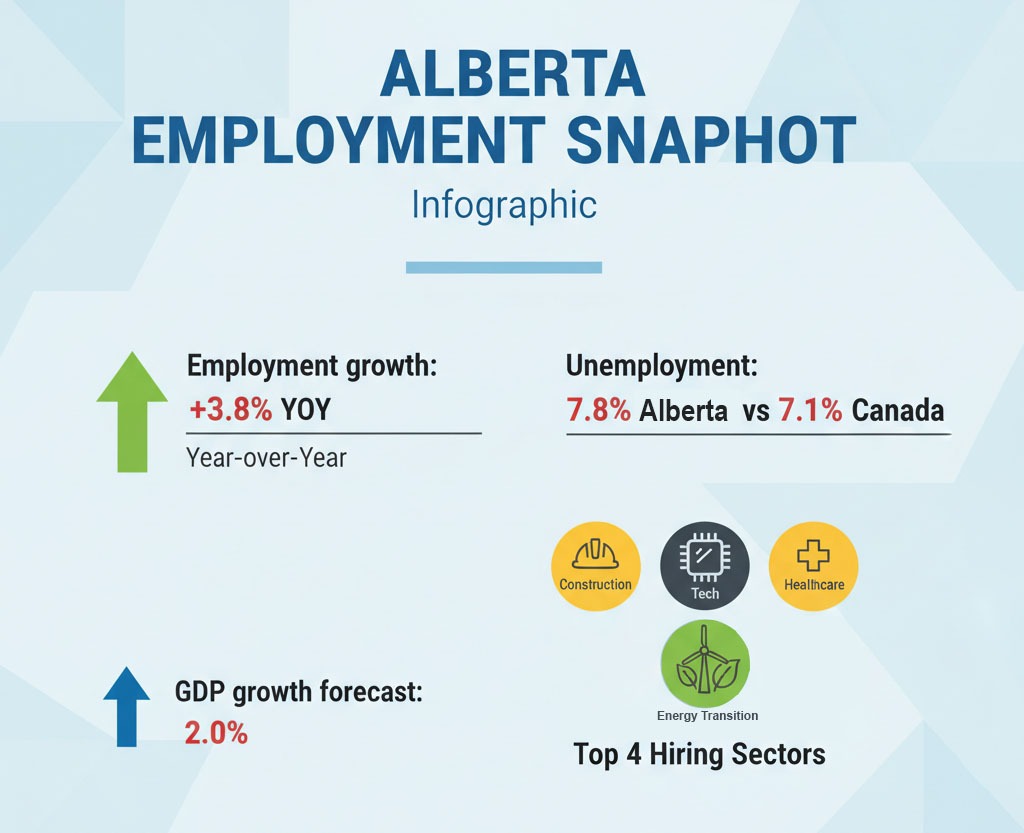
Key Highlights of Alberta’s Current Job Market
- Employment Growth: Alberta leads the nation in job creation, with a year-over-year employment growth rate of +3.8% (as of September 2025). Key sectors driving this growth are Construction, Manufacturing, and Professional, Scientific, and Technical Services.
- Elevated Unemployment: Despite this job growth, the provincial unemployment rate stands at 7.8% (September 2025), significantly higher than the national average (7.1%). This paradox is a direct result of the labour force growing faster than job vacancies, driven by record interprovincial and international migration.
- Economic Strength: Real GDP growth is forecast at 2.0% for 2025, positioning Alberta to lead Canadian provincial economic performance. This resilience is supported by high commodity prices, improved market access (Trans Mountain Expansion), and the absence of a Provincial Sales Tax (PST).
- Snapshot of Opportunities: High-value, long-term opportunities are moving beyond traditional oil and gas and are concentrating in the Skilled Trades, Energy Transition (Hydrogen, Carbon Capture), Healthcare, and Technology (AI, Cybersecurity) sectors.
Why Alberta Remains Attractive for Job Seekers in 2025
Alberta’s continued appeal rests on its competitive economic advantages: high wages, lower overall taxation (due to no PST), and a comparatively affordable cost of living, particularly regarding housing compared to Toronto and Vancouver. Multi-billion dollar industrial projects like the Dow Path2Zero Ethylene Cracker and the Air Products Net Zero Hydrogen Energy Complex establish a robust foundation for long-term, high-value employment.
2. Current Employment Landscape
The current labour market is defined by historic population inflows and an accelerated pace of industrial diversification, which together are reshaping regional employment dynamics.
2.1 Overall Employment Statistics
| Indicator | Value (September 2025) | Y-o-Y Change | National Comparison |
| Total Employment (Working Population) | 2,605,600 | +3.8% | Largest Y-o-Y job growth in Canada. |
| Current Unemployment Rate (UR) | 7.8% (Provincial) | +0.2 ppts | Above national average (7.1%). |
| Labour Force Participation Rate | 69.3% | +0.6 ppts | Higher than national average (65.2%). |
| Average Hourly Wage Growth | $36.78 per hour | +3.3% | Strong growth, helping to offset inflation. |
The high Labour Force Participation Rate underscores Alberta’s status as a highly desirable destination for working individuals. However, the 7.8% unemployment rate indicates that the labour supply, driven by historic interprovincial and international migration, is expanding faster than the rate at which job vacancies can be filled, creating absorption challenges primarily in the major cities.
2.2 Economic Context
Alberta’s GDP Performance: The province’s economy is expected to lead Canada in Real GDP growth for 2025, forecasted at 2.0%. This strength is attributed to stable energy production (bolstered by the Trans Mountain Expansion project) and robust activity in capital-intensive sectors.
Population Growth and Migration Trends: Alberta has led the country for 12 consecutive quarters in interprovincial migration, reinforcing its position as a net migration leader. While population growth (forecasted at 2.4% for 2025) is expected to moderate slightly in 2026, this demographic influx fuels residential construction and consumer spending.
Impact of Oil Price Volatility: Despite strong underlying economic activity, Alberta’s fiscal health remains susceptible to global commodity price swings. Recent moderation in oil prices (WTI prices hovering around $63.75/barrel in Q1 2025/26, down from budget expectations) has resulted in billions of dollars in lost royalty revenues and an increased budget deficit projection. For the average Albertan, while this volatility primarily impacts government revenue, strong oil performance underpins investment confidence, which translates into job security and high wages. Conversely, the lack of a PST acts as a consistent buffer, enhancing household purchasing power against inflation compared to other provinces.
Investment Climate Overview: The climate remains highly optimistic, anchored by multi-billion dollar, long-term projects. Key drivers include provincial policy changes incentivizing industrial carbon policy compliance through direct corporate reinvestment into emissions reduction (CCS and Hydrogen), signaling long-term business confidence beyond the current economic cycle.
2.3 Geographic Distribution
Job growth is heavily concentrated in the two major CMAs, though these areas also face the highest unemployment rates due to their high appeal to newcomers.
| Geographic Area | Unemployment Rate (Sep 2025) | Primary Economic Drivers |
| Edmonton CMA | 8.7% (Highest UR) | Public Administration, Petrochemicals, Hydrogen Investment, Infrastructure. |
| Calgary CMA | 8.1% | Corporate Headquarters, Financial Services, Tech Hub Development, Aviation/Aerospace. |
| Camrose–Drumheller | 5.6% (Lowest UR) | Agriculture, Regional Services, Local Trades. |
Rural vs. Urban Job Opportunities: The Calgary and Edmonton regions account for 75% of Alberta’s employment. However, lower unemployment rates in rural areas like Camrose–Drumheller (5.6%) reflect tighter, specialized labour markets in agriculture and resource extraction. Regional programs like the Rural Renewal Stream are designed to direct talent to these high-need, lower-competition regions.
3. Top Growing Industries & Sectors
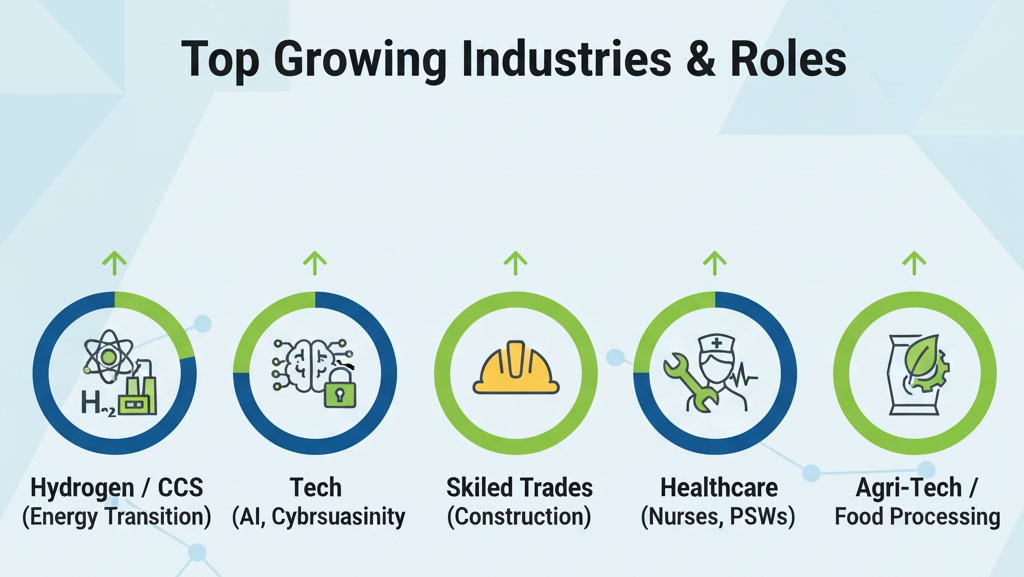
The engine of Alberta’s future employment is built upon five highly active sectors:
3.1 Energy & Natural Resources
Job growth is pivoting toward the energy transition.
- Oil and Gas Sector Evolution: Production remains robust (record crude oil output in 2025), yet traditional roles are facing headwinds due to efficiency gains and corporate restructuring (e.g., announced workforce cuts by major companies by 2027).
- Renewable Energy Expansion: Alberta is Canada’s hydrogen leader. Projects like the $1.6 billion Air Products Net Zero Hydrogen Energy Complex are creating immediate demand for specialized process engineers, construction trades, and environmental regulators.
- Carbon Capture and Storage (CCS): Government incentives are driving significant investment, with mega-projects like the proposed $16.5 billion Pathways Alliance CCS project promising long-term, high-value engineering and operational roles.
3.2 Technology & Innovation
Both Calgary and Edmonton are rapidly developing their tech ecosystems, backed by low 3.3% unemployment in the Canadian tech sector.
- In-Demand Roles: Demand is concentrated in highly specialized areas such as AI Engineers, Machine Learning Specialists, and Full-Stack Developers to support the digital transformation of energy and financial firms.
- Cybersecurity and Data Analytics: This is a crucial growth area as industrial and corporate assets require advanced protection.
- Startup Ecosystem: Specialized investment in sectors like aviation technology (Calgary Training Centre of Excellence) and agritech continues to boost software and technical job creation.
3.3 Healthcare & Life Sciences
Structural labour shortages, driven by an aging and rapidly growing population, keep healthcare a critical priority.
- Healthcare Worker Demand: There is a persistent, critical need for Registered Nurses (RNs), Nurse Practitioners (NPs), Physicians, and Personal Support Workers (PSWs) across acute, community, and long-term care settings.
- Medical Technology and Research: Provincial investment in preventative care and research is driving demand for professionals in medical technology, data management, and specialized technicians.
3.4 Construction & Infrastructure
The construction sector is a major job-growth engine, driven by both residential and industrial demand.
- Residential Construction Boom: Historic population growth has led to a near-record pace of housing starts in Calgary and Edmonton, sustaining high demand for framers, finishers, and residential construction managers.
- Skilled Trades Demand: The sector faces a persistent shortage exacerbated by a high retirement rate (estimated 21% of the current labour force retiring over the next decade). In-demand roles include Electricians, Welders, Pipefitters, and Heavy Equipment Operators.
3.5 Agriculture & Agri-Food
This sector is undergoing a technology-driven transformation.
- Agricultural Technology Adoption: The focus is shifting to Agritechnology Specialists, Data Analysts, and Farm Operations Managers skilled in implementing AI, IoT, and precision agriculture technologies.
- Food Processing Industry: Alberta is prioritizing value-added processing and export capacity, requiring specialists in quality control, food science, and supply chain management.
3.6 Professional Services
Growth in this sector directly reflects the strength and complexity of the broader provincial economy.
- Financial Services Growth: Demand is high for Financial Analysts, Senior Accountants, and Managers of Financial Planning & Analysis to support the province’s capital investment and strategic planning efforts.
- Legal and Consulting Sectors: Expansion is fueled by increased regulatory compliance requirements related to energy transition and the need for legal technology integration.
4. In-Demand Occupations
Specific occupations are experiencing critical labour shortages and are highly prioritized by provincial immigration and recruitment efforts.
4.1 High-Demand Skilled Trades
The demand is focused on certified tradespeople capable of industrial and energy-transition work.
| Occupation | Sector Focus | Key Skills/Certification |
| Electricians | Industrial, Commercial, Energy Transition | Automation/Control systems, specialized licenses. |
| Welders (Pressure/Industrial) | Oil & Gas, Petrochemicals, Hydrogen | Pressure ticket certification, specialized alloy welding. |
| Pipefitters & Steamfitters | Hydrogen, CCS, Utilities | Industrial maintenance, high-pressure system installation. |
| Construction Managers | Residential and Commercial Development | Project Management Professional (PMP) certification preferred, safety leadership. |
4.2 Healthcare Professionals
The critical shortage continues across the care continuum.
- Registered Nurses (RNs) and Nurse Practitioners (NPs): Critical need across all care settings.
- Physicians: Ongoing recruitment challenges, particularly for family doctors and specialists in regional areas.
- Medical Laboratory Technologists: Essential support for provincial testing and diagnostic demands.
- Personal Support Workers (PSWs)/Health Care Aides: High demand, especially in continuing care facilities due to the aging population.
4.3 Technology Professionals
Tech roles require specialized skills to support the province’s diversification efforts.
- Software Developers and Engineers: Demand for full-stack developers skilled in React, Python, DevOps, and Cloud platforms (AWS, Azure).
- Data Scientists and Analysts: Expertise in Python, R, SQL, Machine Learning (ML), and predictive analytics for energy and agritech.
- Cybersecurity Engineers: Needed to protect industrial and corporate data assets, with skills in network security and governance.
- UX/UI Designers: Crucial for enhancing digital products and customer experience in both the startup and corporate environments.
4.4 Business & Management Roles
These roles require adaptability and specialized knowledge across complex sectors.
- Project Managers: Required across construction, energy transition (CCS/Hydrogen), and IT for complex multi-year projects.
- Financial Analysts: Needed to support capital investment, M&A activity, and strategic planning in energy and technology firms.
- Human Resources Specialists: Focus on talent acquisition and retention strategies to address migration-driven turnover and the ongoing skills shortage.
- Supply Chain Managers: Essential for optimizing logistics, particularly in the growing Transportation and Warehousing sector.
5. Salary & Compensation Insights
Alberta remains a high-wage jurisdiction, offering a significant financial advantage over many other Canadian markets.
5.1 Average Salaries by Sector
Alberta consistently records higher average earnings, especially in specialized trades and technical roles. The average hourly wage for a full-time worker in Alberta ($36.78/hour) remains significantly above the federal median.
| Occupation Category | Average Annual Salary Range (CAD) | Median Hourly Wage |
| Plumber/Pipefitter/Steamfitter (Experienced) | $87,000 – $101,400+ | ~ $49.00 – $55.00 |
| Industrial Electrician | $81,400 – $106,861+ | ~ $45.00 – $50.00 |
| Construction Manager | $82,000 – $101,480+ | ~ $45.00 – $55.00 |
| Software Developer (Mid-Senior) | $90,000 – $135,000+ | N/A (Highly variable) |
| Utility Technician (Instrumentation/Power) | ~ $107,000 (Annual Median) | $51.28 (Utilities Sector Median) |
5.2 Cost of Living Considerations
Alberta’s competitive edge is strongly tied to housing affordability and the absence of PST, which significantly boosts purchasing power.
- Housing Costs: Alberta housing remains substantially more affordable than markets in British Columbia (BC) and Ontario (ON). Average 1-bedroom rent in Calgary is approximately $1,850/month, while Edmonton is around $1,450/month (as of May 2025). This affordability is a key driver of interprovincial migration.
- Utilities and Daily Expenses: While housing is cheaper, many newcomers note that monthly utility costs (due to long, cold winters) and auto/home insurance premiums are often noticeably higher in Alberta than in central and coastal provinces.
- Purchasing Power Analysis: The lack of Provincial Sales Tax (PST), combined with higher average wages, generally results in greater disposable income for middle-income households in Alberta.
5.3 Benefits & Perks
In late 2025, benefits packages are increasingly focused on retention through flexibility and well-being.
- Work-life Balance Initiatives: Flexible hours and hybrid work arrangements are standard in competitive sectors like tech and professional services, serving as a key retention tool.
- Wellness and Financial Perks: There is a growing trend toward investing in mental health support (therapy coverage) and financial wellness perks (savings tools, loan repayment assistance) to help employees manage the rising cost of living stress.
6. Job Search Resources & Strategies
Navigating Alberta’s competitive market requires targeted strategies, including leveraging professional networks and official government channels.
6.1 Online Job Platforms
A combination of national and provincial platforms is recommended.
- Provincial Government: Alberta Job Postings (ALIS) provides direct access to jobs verified by the government and essential career planning tools.
- Federal Government: Job Bank (Canada) offers a national database, useful for filtering by Labour Market Impact Assessment (LMIA) status.
- Strategy Tip: Experts recommend applying directly through the employer’s website or portal rather than third-party job board quick-apply functions to ensure visibility and priority processing.
6.2 Networking Opportunities
Professional associations are crucial for finding unposted jobs and accessing industry-specific training.
- Construction: Groups like the Calgary Construction Association (CCA) and Edmonton Construction Association (ECA) offer networking and training (e.g., Site Supervisor workshops) for the booming building sector.
- Energy & Renewables: Young Professionals in Energy (YPE) Calgary is a key network for career development in O&G, renewables, and energy transition.
- LinkedIn Strategies: Follow major industrial investors (Dow Chemical, Air Products), key regional economic development organizations (Calgary Economic Development), and engage directly with specialized local recruiters.
6.3 Recruitment Agencies
Agencies offer specialized knowledge in segmented markets.
- Top Firms: Global firms like Randstad and Robert Half specialize in placing contract and permanent talent in Finance & Accounting, Technology, and Skilled Trades.
- Temporary vs. Permanent Placements: Many organizations are using contract professionals (temporary placement) to address immediate skills gaps, providing a flexible entry point into key organizations.
6.4 Government Employment Services
The provincial government provides comprehensive, free resources.
- Alberta Supports Centres: Provide in-person and phone advice and referrals for career, education, and employment options.
- WorkFirst Alberta: A strategic program, including the upcoming Thrive web service, designed to connect job-ready Albertans with employment resources.
- Job Training and Upgrading Programs (ALIS): Provides access to the CAREERinsite tool and information on apprenticeships and trades training.
7. Immigration & Work Permits
Alberta’s strategy is highly targeted toward filling sector-specific labour shortages via accelerated pathways.
7.1 Provincial Nominee Programs
The Alberta Advantage Immigration Program (AAIP) is the primary PR pathway, with a focus on candidates who meet sector needs, often resulting in lower minimum Comprehensive Ranking System (CRS) scores compared to federal draws. The AAIP was granted an increased total allocation of 6,403 nominations for 2025. Recent draws in September and October 2025 have confirmed the prioritization of key streams:
- Accelerated Tech Pathway: Offers expedited processing for high-demand tech roles (e.g., Data Scientists) with minimum scores as low as 55-60.
- Dedicated Health Care Pathway: Targets nurses, physicians, and allied health professionals.
- Priority Sector Streams: Frequent draws target Construction, Agriculture, and Aviation roles.
- Rural Renewal Stream: Targets workers with a job offer in a designated rural community, providing a non-Express Entry option to drive talent outside the major CMAs.
7.2 Work Permit Requirements
Work authorization typically falls under the Temporary Foreign Worker Program (TFWP) or the LMIA-exempt International Mobility Program (IMP).
- LMIA Refusal in High-Unemployment CMAs: Due to elevated unemployment rates (Edmonton 8.7%, Calgary 8.1%), the federal government will refuse to process LMIA applications for low-wage positions in those metropolitan areas. This reinforces the need for employers in major cities to focus on high-wage or highly skilled recruitment.
- LMIA-Exempt Options (IMP): Over half of temporary work permits are LMIA-exempt, including the Post-Graduation Work Permit (PGWP) for Canadian graduates and work permits issued under trade agreements like CUSMA.
7.3 Credential Recognition
Foreign Credential Recognition (FCR) is mandatory for regulated occupations (e.g., Doctors, Engineers).
- Credential Assessment Process: This process, which verifies that foreign education and skills meet Alberta’s provincial standards for licensure, should ideally be initiated before arriving in Canada. Key bodies include APEGA (Engineers) and CPA Alberta (Accountants).
- Bridging Programs for Immigrants: Alberta offers the Immigrant Bridging Program at no cost to help eligible immigrants align foreign skills with local market demands, including occupation-related skills training and work experience. FCR Loans of up to $30,000 are also available to cover exam and licensing fees.
8. Future Outlook & Projections
Alberta’s long-term outlook remains strong, but stakeholders must prepare for technological and demographic shifts.
8.1 Short-Term Forecast (6–12 months: Q4 2025 to Q3 2026)
- Employment Growth: Forecasted to remain positive and sustained, driven by population growth and resilient energy sector performance. Alberta’s Real GDP is forecast to grow at 2.1% in 2026.
- Unemployment Rate: Expected to persist above 7.0% through 2026 as strong job creation struggles to absorb the high volume of new job seekers entering the labour market.
- Emerging Opportunities: Short-term shortages will persist in skilled trades and nursing. The Accelerated Tech Pathway will continue to be a high-priority channel for recruitment.
8.2 Long-Term Trends (2–5 years: 2027–2030)
- Automation and AI Impact: AI will create a bifurcated market. Roles involving routine cognitive tasks (data entry, basic analysis) are expected to see decline. Conversely, roles that leverage AI for higher-value activities—requiring human judgment, creativity, and complex problem-solving—will see the fastest growth, particularly for Data Scientists, AI Engineers, and specialized Engineers.
- Energy Transition Implications: This will result in a net shift in job type. The construction and operation of CCS infrastructure and hydrogen production facilities are expected to generate up to 67,200 new jobs over the next decade. Existing skilled trades and engineers will be able to transition with specialized upskilling in areas like materials handling and power grid optimization.
- Demographic Shifts: The aging workforce means retirements will necessitate the recruitment of an estimated 59,000 workers in construction alone over the next decade, placing sustained pressure on the talent pipeline.
9. Challenges & Considerations
9.1 Market Challenges
- Skills Gaps and Training Needs: A significant mismatch exists between the skills of incoming migrants and the high-demand needs of employers. A specific shortage persists for digitally skilled workers who can integrate AI/automation, and certified Skilled Trades required for major infrastructure projects.
- Economic Volatility: While the economy is diversified, Alberta remains vulnerable to global commodity price swings and geopolitical trade uncertainties, which can impact capital investment decisions in the energy sector.
9.2 Competitive Landscape
- Competition for Top Positions: Competition remains fierce for the best-paying, high-skill roles, particularly in corporate headquarters and technology fields in Calgary and Edmonton.
- International Talent Attraction: Alberta must aggressively compete with other global centres for highly specialized talent (e.g., Hydrogen Engineers, Senior Data Scientists) by leveraging its high wages and comparatively lower cost of living against global hubs.
10. Actionable Recommendations
10.1 For Job Seekers
- Skills to Develop: Prioritize skills that are AI-augmented. Focus on specialized trades certification, complex project management, and digital literacy (e.g., cloud platforms, data visualization).
- Networking Strategies: Engage directly with industry associations (e.g., ECA, YPE Calgary) for unposted opportunities, as 75% of job growth is concentrated in the CMAs.
- Application Best Practices: For regulated occupations, start the Foreign Credential Recognition (FCR) process before arrival and utilize the Immigrant Bridging Program to rapidly align skills with Alberta standards.
10.2 For Employers
- Talent Attraction Strategies: Embrace targeted immigration streams like the AAIP’s Accelerated Tech and Dedicated Health Care Pathways to fast-track permanent residency for key talent.
- Retention Initiatives: Move beyond salary by offering flexible/hybrid work models and investing in high-quality wellness and financial benefits, which are key differentiators in the 2025 market.
- Training Investments: Invest in upskilling existing staff in digital competencies and fund apprenticeships in the skilled trades to mitigate long-term, retirement-driven shortages.
10.3 For Investors
- Growth Sectors to Watch: Focus capital deployment on Energy Transition Infrastructure (CCS, Hydrogen, Renewables) and Construction/Housing which are supported by major provincial policies and demographic expansion.
- Business Opportunities: Consider opportunities in the Rural Renewal Stream communities, which offer lower labour market competition and government support for businesses filling localized labour gaps. As a business owner incorporated in Alberta, these strategic areas represent the highest potential for subsidized labour attraction and long-term provincial support.
11. Conclusion
The Alberta job market in late 2025 is defined by a paradoxical mix of record job creation and structural labour imbalances. The strength of its economy, driven by diversified capital investment and demographic momentum, provides a highly resilient base. However, successfully navigating the future requires strategic action: job seekers must focus on acquiring specialized, in-demand skills, and employers must actively leverage immigration programs and retention strategies to bridge the persistent skills gap. Alberta remains a beacon of opportunity in Canada, but future prosperity depends on the ability of all stakeholders to adapt to the profound technological and energy shifts already underway.
Sources and Links of the Article
- Statistics Canada (StatCan) / Job Bank: Primary source for Labour Force Survey (LFS) data, including total employment, unemployment rates, and hourly wage statistics.
- Alberta.ca Economic Highlights and Job Market Forecasts: Official source for provincial economic dashboard metrics, GDP performance, and government-verified job opportunities (ALIS).
- ATB Financial Economic Outlook: Source for real GDP forecasts and comprehensive economic analysis on energy and provincial investment climate.
- Alberta Advantage Immigration Program (AAIP): Official government information regarding the Provincial Nominee Program, specific draw scores, and priority sector pathways (Tech and Healthcare).
- Robert Half / Industry Recruitment Reports: Used for salary insights, median hourly wages in specialized fields (like finance and technology), and retention/benefit trends.
- Link: General search for “Robert Half Canada Salary Guide”
- Alberta Foreign Credential Recognition (FCR): Information regarding the assessment process for regulated occupations and access to the Immigrant Bridging Program.
- Canada.ca – Foreign Credential Recognition (FCR) Loans: Details on the financial assistance available to immigrants for licensing and credential costs.
- Business Council of Alberta (BCA) / Construction Labour Relations Alberta (CLRA): Sources providing sector-specific analysis on skills gaps, especially in the skilled trades and construction/infrastructure projects.
- The Canadian Press (via YouTube): Specific citation used to illustrate the impact of oil price volatility on the provincial budget and deficit projections.
- Agriculture and Agri-Food Canada: Used for details on the Agri-Food sector’s focus on technology adoption and export growth opportunities.