

For decades, the global perception of Alberta’s economy was tethered strictly to the price of a barrel of Western Canadian Select. When oil was up, the province thrived; when it dipped, the “For Sale” signs multiplied. However, a quiet revolution has been brewing in the laboratories of the University of Alberta and the glass-walled offices of Calgary’s Beltline. While the broader North American venture capital (VC) market has entered a “VC Winter”—with funding levels dropping significantly from their 2021 peaks—Alberta’s Machine Learning (ML) and Artificial Intelligence (AI) sector is experiencing a “Silicon Prairie” renaissance.
This isn’t the speculative bubble of “Web3” or the fleeting hype of consumer social apps. Instead, Alberta’s tech ecosystem is doubling down on “Industrial AI”—the application of complex algorithms to solve high-stakes, multi-billion dollar problems in energy, agriculture, and logistics. This article explores the mechanics of this resilience, the educational foundations that made it possible, and why investors are looking past the traditional tech hubs to find value in the Canadian Prairies.
The following economic facts are based on current Alberta provincial data and market trends.
1. The Macro-Economic Landscape: Why Alberta is Different
To understand the current boom, one must first understand the context of the global tech slowdown. In 2023 and early 2024, rising interest rates caused investors to flee from “growth-at-all-costs” startups. In Silicon Valley, this led to massive layoffs and “down rounds.”
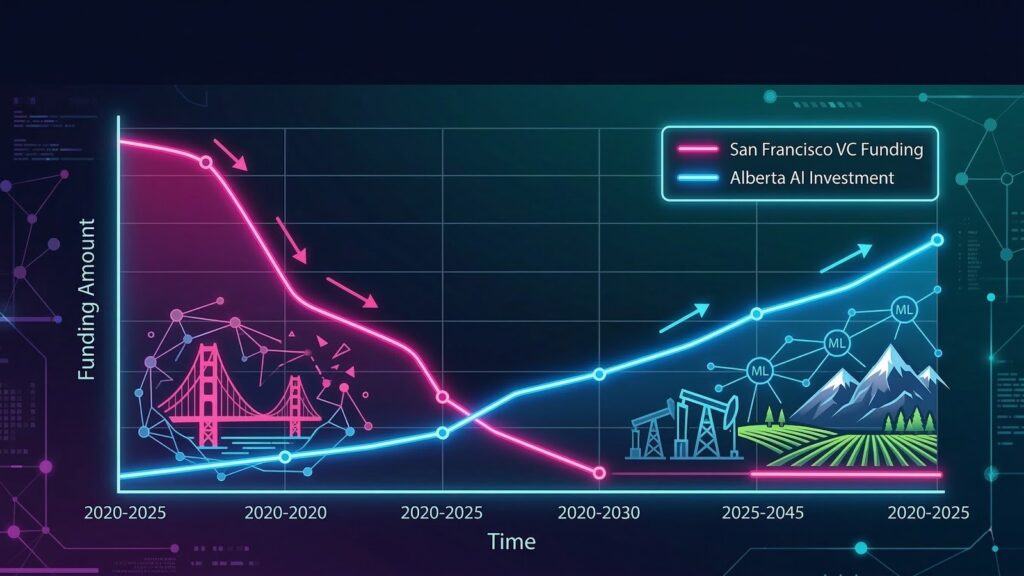
However, Alberta has remained remarkably resilient. According to data from the Canadian Venture Capital and Private Equity Association (CVCA), Calgary and Edmonton have consistently punched above their weight in recent quarters. The reason is simple: Product-Market Fit. While a San Francisco startup might struggle to monetize a new photo-sharing app, an Edmonton startup that uses Reinforcement Learning (RL) to reduce a pipeline’s energy consumption by 5% provides an immediate, massive ROI for its clients.
The Shift from Consumer to Industrial
In the educational context of economic development, we categorize “Industrial AI” as technology that integrates with physical infrastructure. Alberta’s advantage lies in its proximity to “The Lab”—the massive industrial operations of the oil sands and the sprawling agricultural lands of the south. This proximity allows for a feedback loop between data scientists and field engineers that is impossible to replicate in a purely digital hub.
2. The Amii Factor: Edmonton’s Unfair Advantage
You cannot discuss Alberta’s AI prowess without mentioning the Alberta Machine Intelligence Institute (Amii). Founded in 2002, long before “AI” was a buzzword, Amii is one of the three centers of excellence in Canada’s Pan-Canadian AI Strategy.
The Legacy of Reinforcement Learning
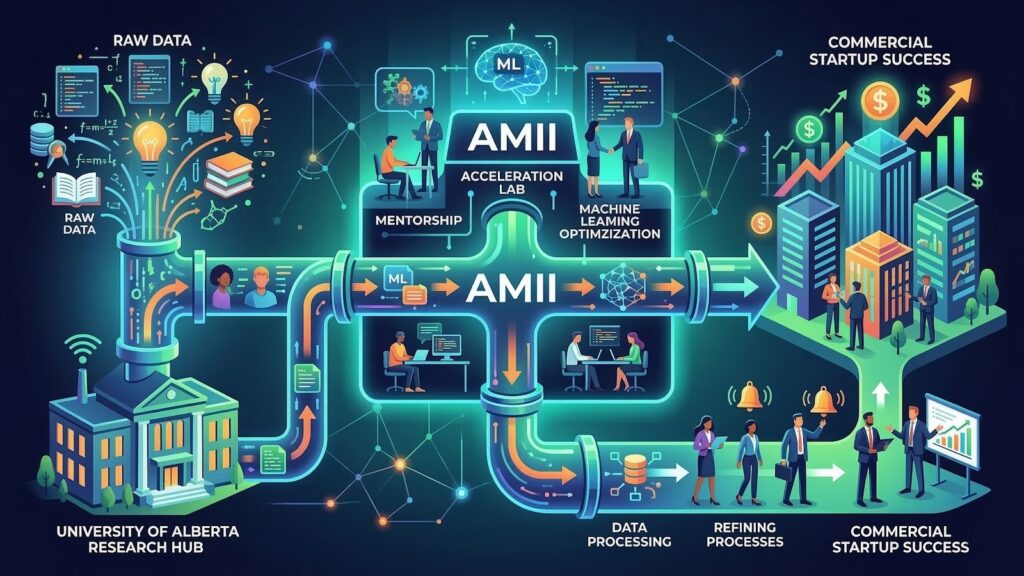
Edmonton is globally recognized as a pioneer in Reinforcement Learning (RL), a subset of machine learning where an “agent” learns to make decisions by receiving rewards or penalties. This is the same technology that powered DeepMind’s AlphaGo.
- The University of Alberta (U of A): Consistently ranked in the top 5 globally for AI and machine learning research.
- Rich Sutton: Often called the “Father of Reinforcement Learning,” his presence in Edmonton acted as a magnet for global talent.
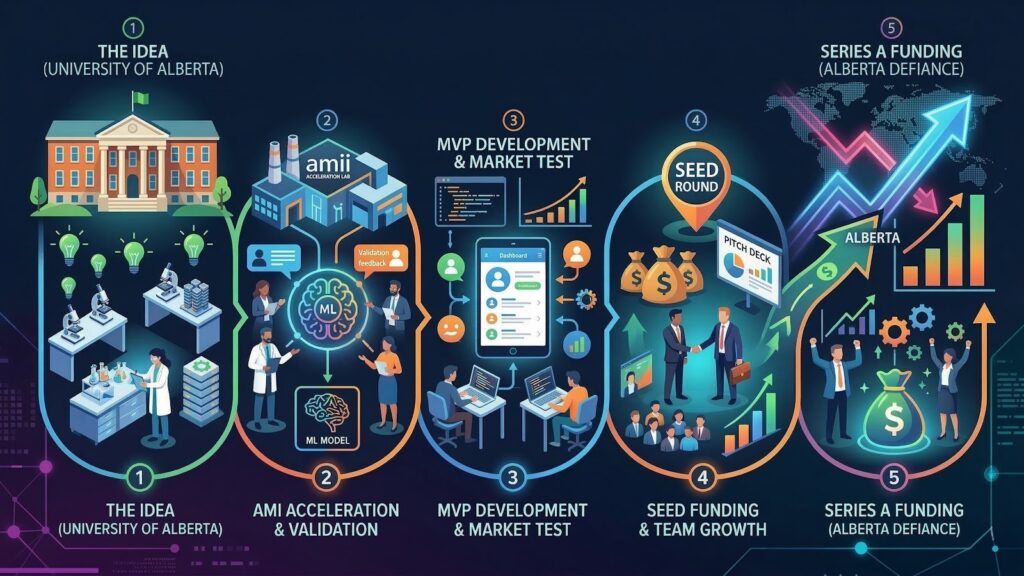
For investors, this academic pedigree acts as a de-risking mechanism. When a startup emerges from the U of A ecosystem, it is often backed by decades of peer-reviewed research rather than just a clever pitch deck.
3. Sector Deep Dive: Energy and the “Green” Transition
The most significant defiance of the funding crunch is seen in the energy sector. As global pressure for ESG (Environmental, Social, and Governance) compliance grows, oil and gas majors are turning to AI to optimize operations.
Predictive Maintenance and Emissions Reduction
Startups like amii-backed ventures and others in the Calgary ecosystem are developing ML models that can:
1.Predict Equipment Failure: Using sensor data to identify when a pump or turbine will fail weeks before it happens, saving millions in downtime.
2.Autonomous Drilling: Utilizing ML to adjust drilling parameters in real-time, reducing the time spent on-site and lowering the carbon footprint.
3.Carbon Capture Optimization: Using AI to simulate and optimize the chemical processes involved in Carbon Capture, Utilization, and Storage (CCUS).
These startups are securing funding because they are viewed as “Efficiency Plays.” In a high-interest-rate environment, technologies that cut costs and improve margins are the most attractive assets for private equity and venture capital.
4. Ag-Tech: The New Frontier of the Silicon Prairie
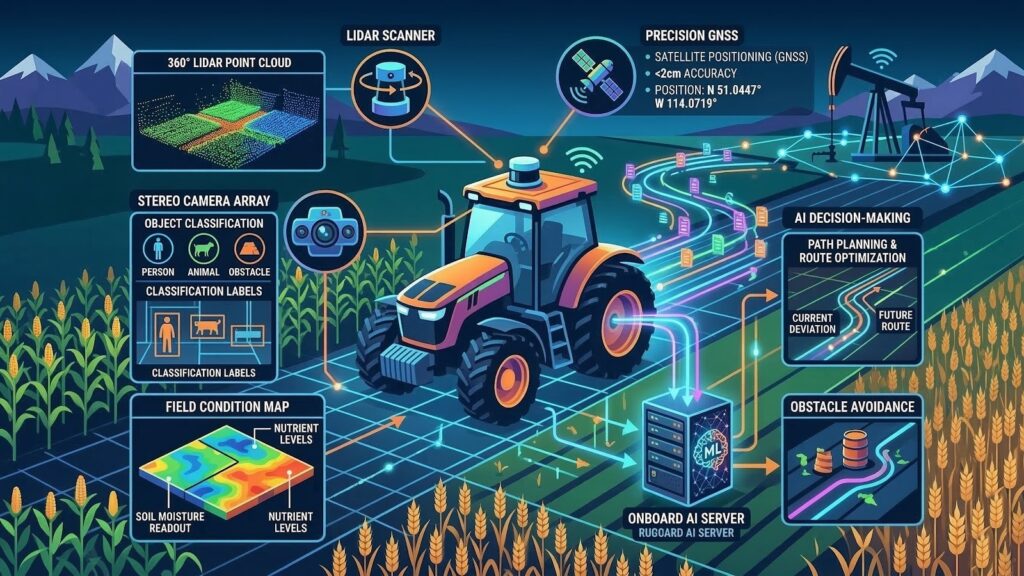
Agriculture is Alberta’s second-largest industry, and it is ripe for a machine-learning overhaul. The “Silicon Prairie 2.0” is defined by the integration of computer vision and satellite imagery into the daily life of the Alberta farmer.
Precision Agriculture Mechanics
- Computer Vision for Crop Health: Startups are using drones equipped with AI to identify specific weed species or nutrient deficiencies in a 10,000-acre field. This allows for “variable rate application,” where chemicals are only sprayed where needed, reducing costs by up to 40%.
- Yield Prediction Models: By analyzing historical weather data, soil moisture levels, and satellite imagery, ML models can provide highly accurate yield forecasts, allowing farmers to hedge their commodity prices more effectively.
Why Investors Love Prairie Ag-Tech
Unlike consumer tech, Ag-Tech is “sticky.” Once a farmer integrates a software platform into their multi-million dollar machinery, the cost of switching is high. This creates predictable, long-term recurring revenue—the holy grail for tech investors.
5. Navigating the Funding Maze: Beyond Traditional VC
One of the educational takeaways for any entrepreneur in Alberta is that the “Funding Crunch” is often a “Traditional VC Crunch.” Alberta has pioneered a hybrid funding model that blends government support with strategic corporate investment.
Alberta Innovates and Federal Grants
The Alberta government, through Alberta Innovates, provides significant non-dilutive funding. This means startups can receive hundreds of thousands of dollars to prove their concept without giving up equity.
- SR&ED Credits: The Scientific Research and Experimental Development tax incentive remains a cornerstone for AI startups, effectively subsidizing the high cost of hiring PhD-level data scientists.
Strategic Corporate Venture Capital (CVC)
In Alberta, the “VC” often comes from the customers themselves. Companies like ATCO, Suncor, and TC Energy have their own venture arms. They aren’t just looking for a financial return; they are looking for technology they can deploy within their own operations. This “Customer-First” funding model is much more stable than the hype-driven cycles of Silicon Valley.
6. The Talent War: Retention and the “Brain Drain” Myth
A common skepticism regarding Alberta’s tech scene is the fear of “Brain Drain”—the idea that once a student graduates from the U of A, they immediately move to Seattle or San Francisco.
The Reality of the Cost of Living
The educational and economic narrative is shifting. While a senior ML engineer might earn $250,000 USD in San Francisco, the average home price there is $1.5 million. In Edmonton or Calgary, that same engineer can earn a competitive salary ($150,000 – $180,000 CAD) while purchasing a home for $450,000.
- The Remote Work Effect: Many Alberta-based engineers are now working for global firms while staying in the province, keeping their tax dollars and local spending within the Alberta economy.
- Quality of Life: Proximity to the Rockies and a lack of soul-crushing commutes are becoming major selling points for “Silicon Prairie” recruitment.
7. How to Invest or Build in Alberta’s AI Sector
For those looking to enter this market—whether as an engineer, an investor, or a business owner—the path is different than in other tech hubs.
For Investors:
1.Look for “Boring” Problems: The most profitable AI startups in Alberta are solving logistics, thermodynamics, or chemical engineering problems.
2.Leverage Ecosystem Partners: Engage with organizations like Platform Calgary or Edmonton Unlimited to find vetted startups.
3.Understand the Regulatory Environment: Alberta has a unique regulatory sandbox for energy and drone technology, making it easier to test hardware-software integrations.
For Engineers/Entrepreneurs:
1.Specialization is Key: Generalist AI skills are becoming commoditized. Deep knowledge in “AI for Geoscience” or “AI for Protein Folding” is where the value lies.
2.Bridge the Gap: There is a massive need for “Translators”—people who understand both the high-level mathematics of ML and the operational realities of a drilling rig or a commercial farm.
8. Conclusion: The Future of the Silicon Prairie
The “Silicon Prairie 2.0” is not a dream of the future; it is a functioning, resilient economic engine of the present. By focusing on industrial applications, leveraging a world-class academic foundation, and utilizing a unique hybrid funding model, Alberta’s AI startups are doing more than just defying a funding crunch—they are rewriting the province’s economic DNA.
As we look toward 2030, the goal is clear: Alberta will no longer just be a provider of raw natural resources, but a provider of the high-level intelligence required to manage those resources sustainably and efficiently for the entire world.
Sources and References
- Amii (Alberta Machine Intelligence Institute): Annual Impact Reports (2022-2023).
- Canadian Venture Capital and Private Equity Association (CVCA): “Venture Capital Market Overview – Q3 2023.”
- Alberta Innovates: “Technology and Innovation Strategy 2024.”
- University of Alberta: Department of Computing Science – Global Ranking Reports.
- Statistics Canada: “Tech Sector Employment and Compensation Trends in Western Canada.”
- Calgary Economic Development: “The Rise of the Creative Economy and Tech Hubs.”