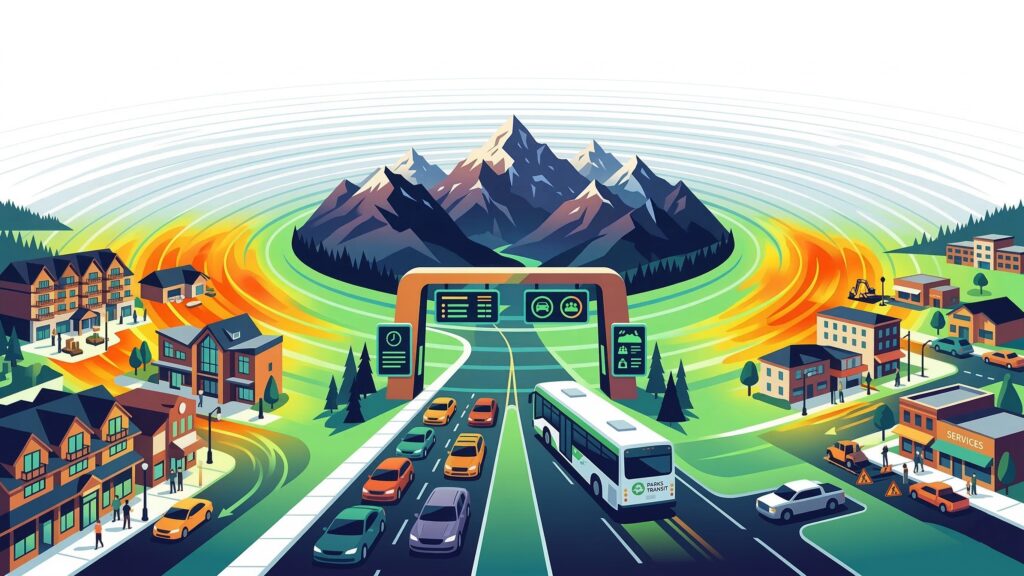

The Canadian Rockies have long served as the crown jewel of Alberta’s economic portfolio. For decades, the strategy was simple: attract as many international and domestic visitors as possible to the breathtaking vistas of Banff and Jasper National Parks. However, the success of this strategy has led to a paradoxical crisis. With visitation numbers hitting record highs—Banff alone sees over 4 million visitors annually—the infrastructure is buckling, the ecological integrity is at risk, and the “visitor experience” is being diluted by traffic congestion and overcrowding.
In response, a new economic era has dawned in the mountains: the era of Managed Access. From the closure of Moraine Lake road to private vehicles to the implementation of complex reservation systems and increased transit fees, the “free and open” mountain experience is being replaced by a “gated and scheduled” model. This article provides an in-depth educational analysis of how these constraints are reshaping the hospitality industry, shifting labor demographics, and creating a massive economic “spillover” effect into neighboring municipalities like Canmore and Hinton.
The following economic facts are based on current Alberta provincial data and market trends.
1. The Macro-Economic Reality of Alberta Mountain Tourism
To understand the ripple effect of tourism caps, one must first understand the sheer scale of the industry. Tourism in Alberta is a multi-billion dollar engine, with the “Rockies” region accounting for a significant portion of non-resident spending.
The GDP Contribution
Tourism contributes approximately $10 billion annually to Alberta’s GDP. The mountain parks are the primary “hook” that draws international capital into the province. When a visitor from London or Tokyo books a trip to Banff, the economic benefit extends far beyond the park gates—impacting airlines at YYC, car rentals, and Calgary-based retail.
The “Jasper Factor” and Wildfire Resilience
The 2024 Jasper wildfires served as a grim reminder of the vulnerability of these economic hubs. With roughly 30% of the townsite’s structures damaged and the tourism season cut short, the economic focus has shifted from growth to “resilient sustainability.” This catastrophe accelerated the conversation around visitation caps; if a town cannot safely evacuate its current population and visitors during an emergency, its “carrying capacity” has been exceeded.
2. The Mechanics of Managed Access: How Caps Work
Managed access is an economic tool used to solve the “Tragedy of the Commons.” When a resource (the view of Moraine Lake) is free and open, it becomes over-consumed, leading to degradation.
The Shift to Transit-Only Models
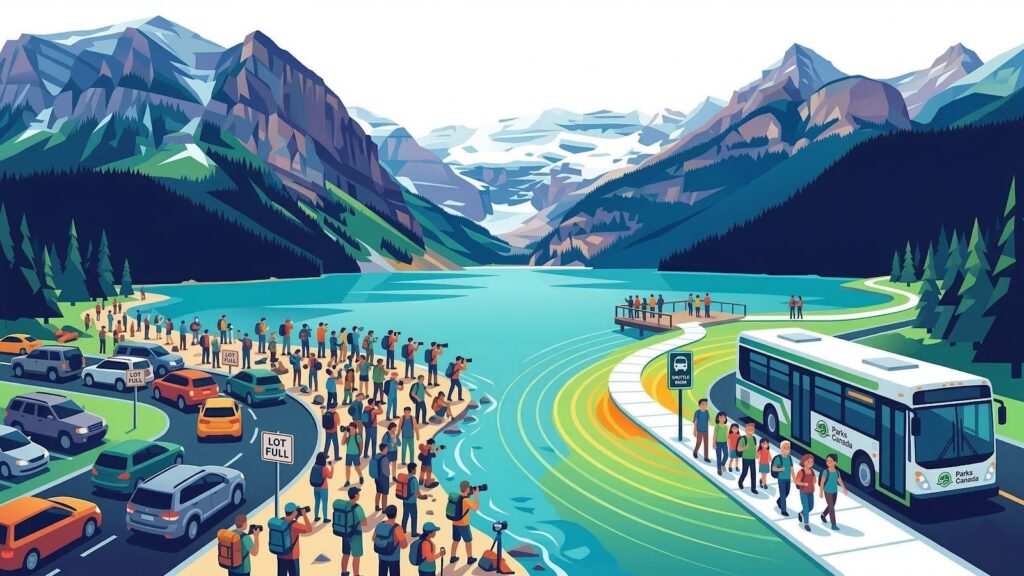
Parks Canada’s decision to restrict private vehicles from Moraine Lake is the most prominent example of a “hard cap.”
- The Goal: Reduce carbon emissions and physical congestion.
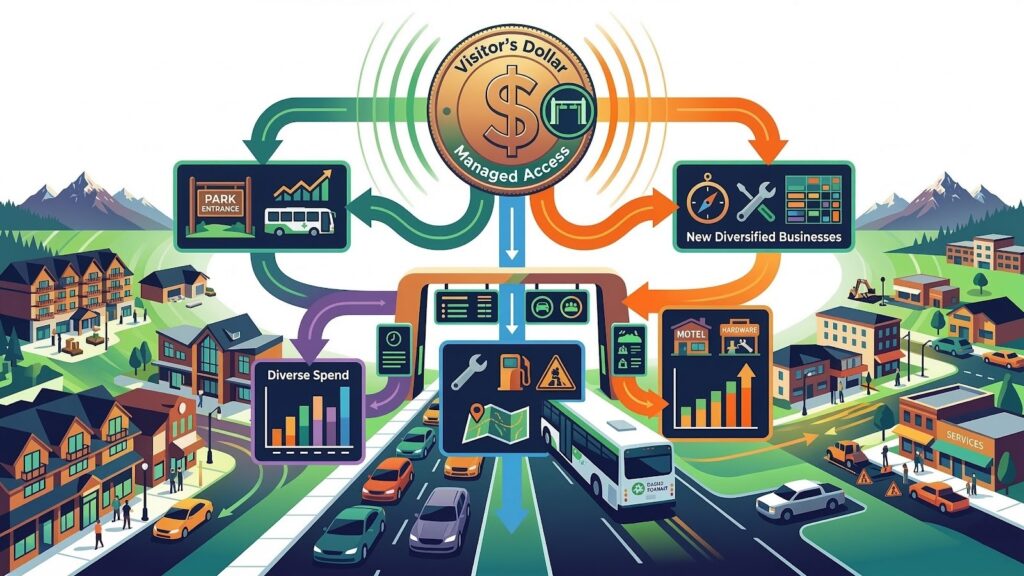
- The Economic Result: The creation of a secondary “shuttle economy.” Private tour operators and public transit systems now capture the revenue that was previously “lost” to individual car travel.
- The Cost to Consumer: A “free” visit now carries a per-person transit fee, effectively raising the “entry price” of the park without technically raising the entry fee.
Reservation Systems as Demand Smoothing
By requiring reservations for camping and popular day-use areas, Parks Canada uses “demand smoothing.” Instead of 10,000 people showing up on a Saturday in July, the system caps it at a manageable number, pushing the “excess demand” to Tuesdays in October or to other regions entirely.
3. Impact on the Hospitality and Service Sector
The hospitality industry in Banff and Jasper operates on high volumes and tight margins. When visitation is capped, the business model must pivot from “Volume” to “Value.”
From Mass Market to Premium Experience
If a hotel can no longer rely on an infinite stream of walk-in tourists due to parking and access restrictions, they must increase the “Average Daily Rate” (ADR). We are seeing a trend where mountain hospitality is becoming increasingly “premiumized.”
- Yield Management: Hotels are using sophisticated AI to price rooms based on real-time park capacity data.
- Ancillary Revenue: With guests staying longer due to the difficulty of re-entering the park, resorts are focusing on in-house dining and spa services to capture a larger “share of wallet.”
The Staffing Crisis and the “Mountain Tax”
The most significant constraint on the hospitality sector isn’t just the visitor cap—it’s the housing cap.
1.Fixed Inventory: In Banff, the “Need to Reside” clause and strict development boundaries mean the supply of housing is essentially fixed.
2.Wage Inflation: To attract workers to a town where a studio apartment costs $2,500/month, businesses must pay significantly above the provincial average.
3.Service Reductions: Many restaurants in the Rockies now close two days a week, not due to a lack of customers, but due to a lack of staff who can afford to live near the job.
4. The “Spillover” Towns: Canmore and Hinton
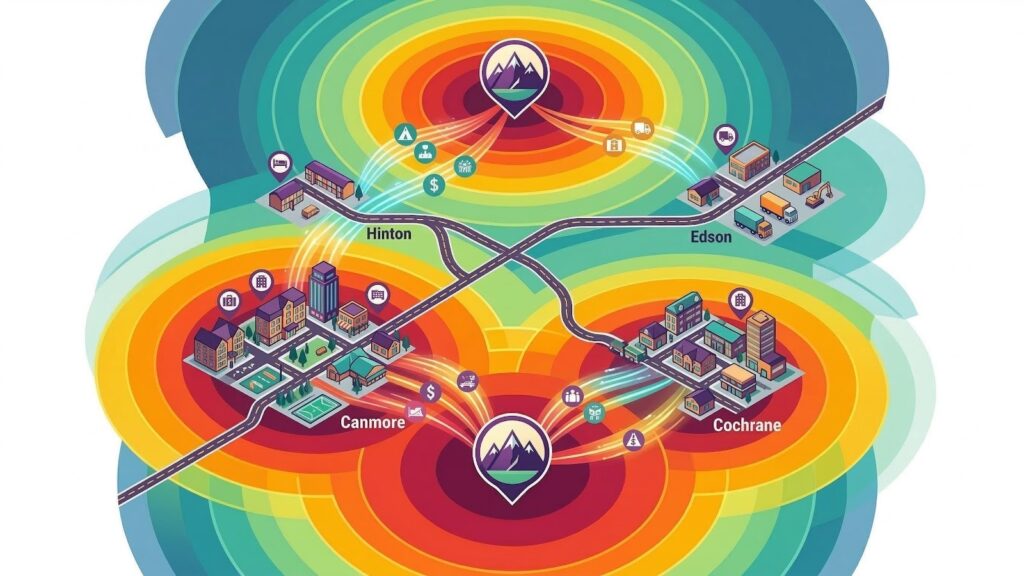
As the “Core” (Banff/Jasper) becomes more expensive and restricted, the “Periphery” (Canmore/Hinton) experiences an economic transformation.
Canmore: The Secondary Core
Canmore has transitioned from a sleepy mining town to a global destination in its own right. However, it bears the brunt of Banff’s overflow.
- The Shadow Population: Canmore’s infrastructure is built for 14,000 residents but often services 30,000+ people on weekends.
- Real Estate Divergence: Canmore’s real estate market is now decoupled from the rest of Alberta, mirroring Vancouver or Toronto prices. This is driven by “secondary suite” investors looking to capture the Airbnb market that is heavily restricted inside the National Park.
Hinton: The Value Proposition
To the north, Hinton is positioning itself as the “Gateway to the Rockies” for the budget-conscious traveler.
- Industrial Transition: As forestry and mining face regulatory hurdles, Hinton is pivoting toward “Service Exporting”—providing the lodging and amenities that Jasper can no longer sustain.
- Infrastructure Investment: We are seeing increased provincial interest in highway improvements and hotel development in the Hinton corridor to accommodate the “Jasper Spillover.”
5. The Engineering of Tourism: Transit and Infrastructure
For technical engineers and urban planners, Alberta’s mountain caps represent a massive logistical challenge. The future of the Alberta mountain economy is an engineering problem.
The Hydrogen and Electric Pivot
To maintain the “pristine” brand of the parks while moving thousands of people via shuttle, there is significant movement toward zero-emission transit.
- Pilot Projects: Alberta is a leader in hydrogen technology; the implementation of hydrogen-powered coach buses for the Banff-Calgary corridor is a key area for provincial investment.
- Smart Parking: The use of IoT (Internet of Things) sensors to manage parking at the “edge” of parks (like the Minnewanka loop) allows for real-time data flow to visitor smartphones, reducing “idling” time.
Wildlife Overpasses and Economic Externalities
Building a $10 million wildlife overpass isn’t just an environmental act; it’s an economic preservation act. Reducing animal-vehicle collisions keeps the Trans-Canada Highway—Alberta’s primary commercial artery—moving. Every hour of closure due to an accident costs the provincial economy millions in delayed freight.
6. Investor Outlook: Risks and Opportunities
For investors looking at the Alberta mountain corridor, the landscape is complex.
The “Bust” Risk: Wildfire and Climate
Insurance premiums in the Rockies are skyrocketing. Any investment in physical assets (hotels, retail) must now account for the “Burn Probability” and the potential for “Smoke Seasons” to nullify summer revenue.
The “Boom” Opportunity: Tech-Enabled Tourism
There is a massive opening for “PropTech” and “TravelTech” companies that can solve the friction of managed access.
- Unified Booking: A platform that integrates park entry, shuttle transit, and dinner reservations into a single QR code.
- Off-Peak Incentives: Dynamic pricing models that reward visitors for choosing less-congested regions of the province (e.g., the Crowsnest Pass or David Thompson Country).
7. Conclusion: The New Equilibrium
The implementation of visitation caps and reservation systems in Alberta’s mountains is not a temporary measure; it is a permanent shift in the provincial economic strategy. We are moving away from the “Extraction Model” of tourism—where we extract as much value as possible from every square inch of land—toward a “Stewardship Model.”
For the business owner, this means focusing on high-margin services. For the worker, it means navigating a high-cost environment with the hope of better provincial housing policy. For the visitor, it means the end of the spontaneous road trip and the beginning of the “curated journey.”
Ultimately, by “Pricing the Peaks,” Alberta is ensuring that its most valuable natural assets remain viable for the next century, even if it means the “No Vacancy” sign is lit a little more often.
Sources and References
1.Travel Alberta: 2023-2024 Tourism Performance Report.
2.Parks Canada: Banff National Park Management Plan (2022 Update).
3.Statistics Canada: Labour Force Survey – Alberta Resource Regions.
4.Town of Canmore: 2023 Economic Development Strategy.
5.Alberta Economic Development: Impact Analysis of the 2024 Jasper Wildfire Complex.
6.Conference Board of Canada: Regional Tourism Outlook for the Canadian Rockies.