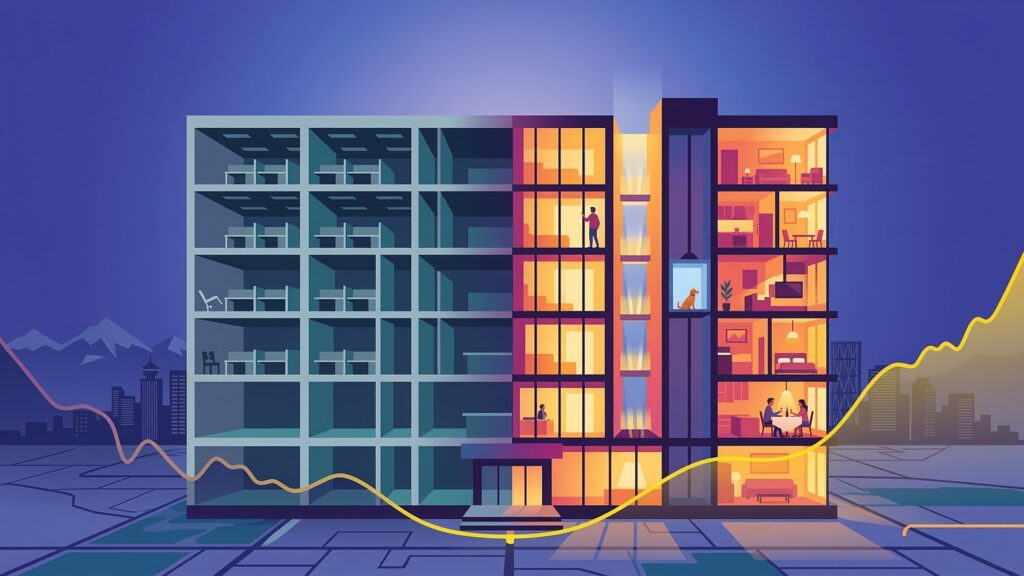

The year is 2026. For anyone who walked the streets of downtown Calgary in the bleak winter of 2021, the transformation is nothing short of a structural metamorphosis. Where the “hollow core” once echoed with the silence of empty cubicles and boarded-up retail fronts, there is now the hum of residential life—grocery bags rustling, dogs barking in elevators, and the warm glow of floor-to-ceiling windows illuminating the night sky.
Calgary’s ambitious gamble—the Downtown Calgary Development Incentive Program—was born out of necessity. Facing a staggering 32% office vacancy rate and a tax base in freefall, the municipal government pivoted from being a passive observer to an active market participant. The goal was simple but Herculean: remove 6 million square feet of office space and replace it with thousands of homes.
As we assess the landscape in 2026, the question remains: Is the “Calgary Model” a blueprint for urban survival or an expensive band-aid on a structural wound? This report examines the technical, financial, and social outcomes of the world’s most aggressive office-to-residential conversion strategy.
The following economic facts are based on current Alberta provincial data and market trends.
1. The Genesis: Why Calgary Had No Choice
To understand the success or failure of 2026, we must revisit the crisis of the early 2020s. Calgary’s downtown was built for a 20th-century oil and gas economy. It was a monoculture of H-shaped towers designed for 9-to-5 commuters. When the 2014 energy price crash collided with the 2020 pandemic-induced shift to remote work, Calgary found itself with nearly 14 million square feet of empty office space.
The Economic Death Spiral
A “death spiral” occurs when vacant buildings lose value, leading to lower property tax assessments. To make up the shortfall, the city must raise taxes on remaining businesses, who then flee, causing further vacancies. By 2021, Calgary’s downtown property value had plummeted by $16 billion.
The Policy Pivot
The City of Calgary responded by earmarking $153 million for the Downtown Calgary Development Incentive Program. The program offered developers $75 per square foot to convert office space into residential units. This was not a “handout” but a strategic buy-down of the massive risk associated with re-engineering old towers.
2. The 2026 Progress Report: By the Numbers
The downtown area has experienced significant positive change across key metrics between 2021 and 2026:
| Metric | 2021 Baseline | 2026 Current Data | Trend/Change |
| Downtown Population | Approximately 14,000 | Approximately 22,500 | Significant Increase |
| Residential Units Added | Fewer than 500 | Over 4,200 | Major Growth |
| Office Vacancy Rate | 32.5% | 21.8% | Substantial Decrease |
| Ground Floor Retail Vacancy | 24% | 11% | More than Halved |
| Average Property Assessment | Decreasing (-4%) | Increasing (+3.2%) | Reversal to Positive Growth |
Key Project Milestones
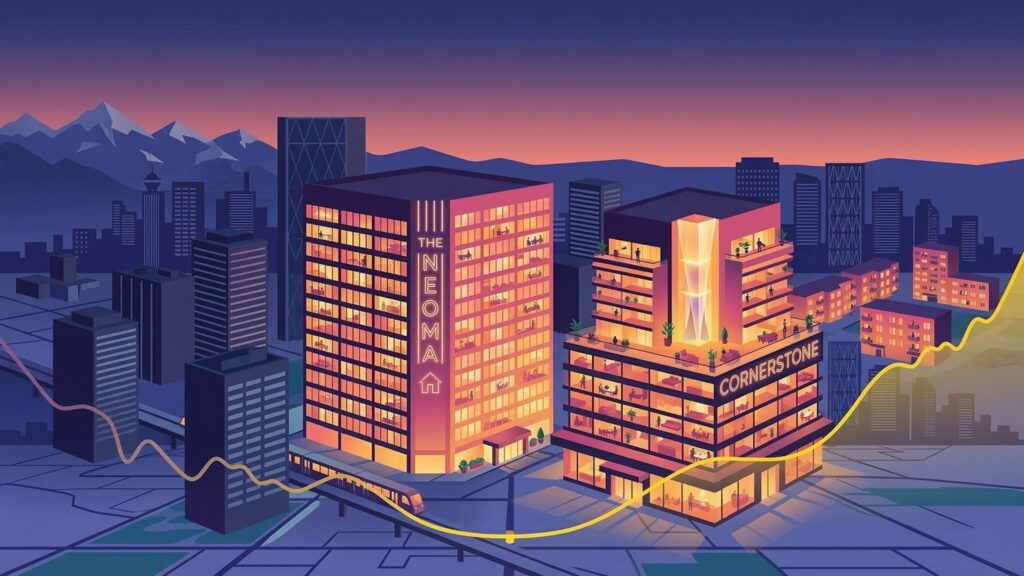
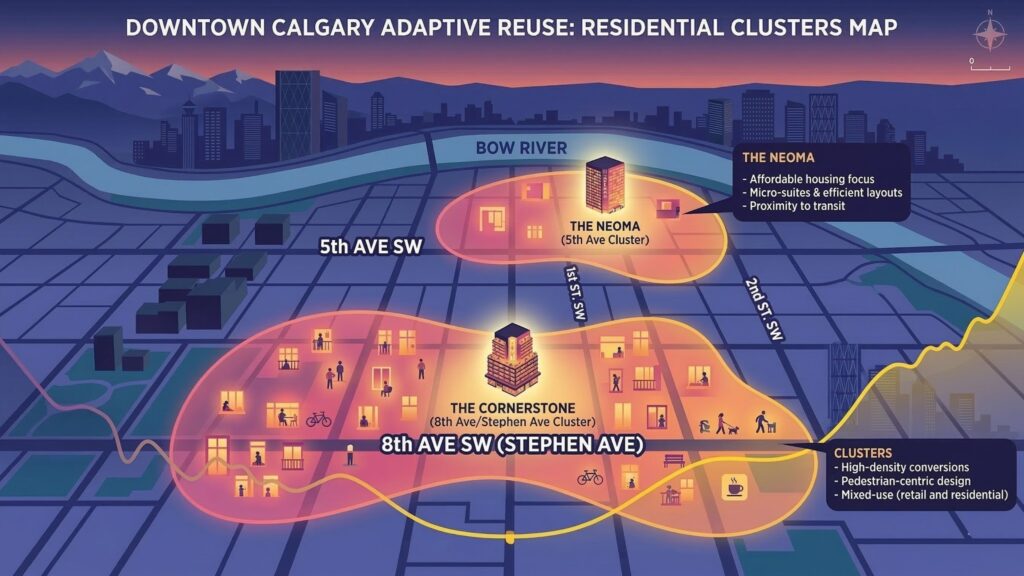
- The Neoma (HomeSpace): One of the first to cross the finish line, converting the old Sierra Place into 82 units of affordable housing.
- The CornerStone (Peoplefirst Developments): A massive conversion of the Barron Building, blending heritage preservation with modern luxury rentals.
- The Petro-Fina Building: A technical marvel that successfully navigated the challenges of a 1950s-era mechanical core.
3. The Engineering Challenge: Why It’s Not Just “Adding Walls”
For the engineers and technical professionals in our audience, the “conversion” is less about aesthetics and more about a complete mechanical lobotomy of the building.
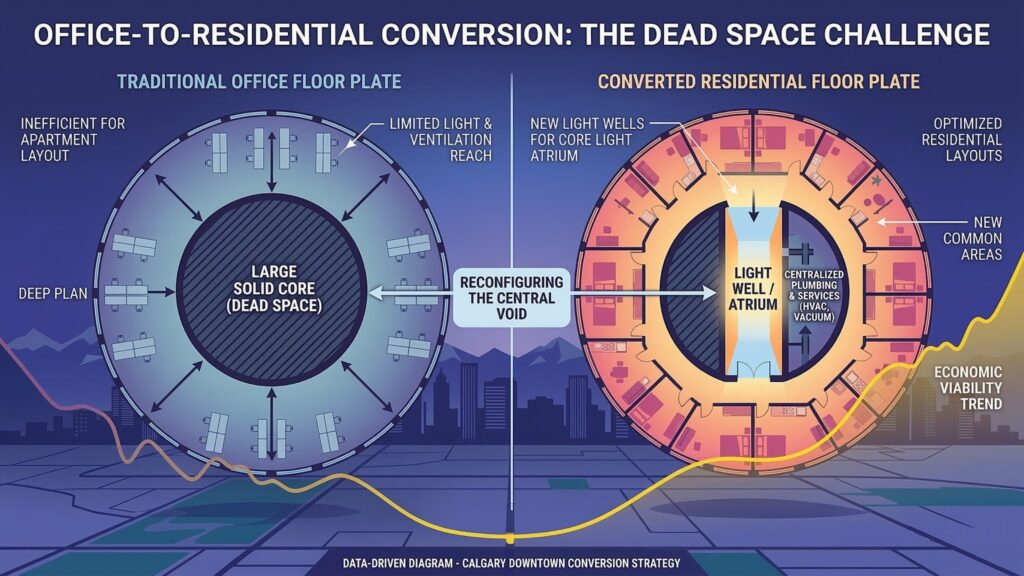
The Deep Floor Plate Problem
Commercial buildings are deep. Office workers don’t mind being 40 feet from a window, but residents do. Architects in Calgary have solved this in 2026 through:
1.Light Wells: Cutting massive vertical shafts through the center of the building to bring sunlight to interior units.
2.Extended Hallways: Using the “dead space” in the building’s core for storage, gyms, or communal theaters.
3.The “Texas Wrap” Adaptation: Placing bedrooms on the interior with glass transoms to borrow light from the living area.
Plumbing and HVAC
An office building is designed for two bathrooms per floor. A residential building requires 40 to 60. In 2026, the most successful conversions utilized vacuum plumbing systems and decentralized HVAC units, allowing developers to bypass the need for massive, centralized boiler systems that were inefficient for individual unit control.
4. Developer Profitability: Are the Books Balancing?
In 2026, the financial post-mortem of the first wave of conversions shows a bifurcated reality.
The “Sweet Spot” for Profit
The most profitable conversions shared three traits:
- Purchase Price: The building was acquired for less than $40 per square foot.
- Floor Plate Size: The building was a Class B or C asset with a footprint smaller than 15,000 square feet.
- Grant Utilization: The $75/sq ft city grant covered approximately 25-30% of the total construction cost.
The Cost of Construction
By 2026, the cost of conversion has stabilized at approximately $280 to $350 per square foot. Without the municipal incentive, the “Internal Rate of Return” (IRR) for most projects would fall below the 12% threshold required by institutional investors. With the incentive, developers are seeing IRRs of 15-18%, making these projects competitive with greenfield suburban developments.
The Risk of “Stuck” Assets
Some developers who attempted to convert Class A towers (newer, larger buildings) have struggled. The sheer cost of stripping high-performance glass and re-coring massive concrete slabs led to cost overruns that the $75/sq ft grant could not fully mitigate.
5. Affordability: Housing the People or the Elite?
A primary criticism of the strategy in 2024 was that it would only create “luxury lofts.” In 2026, the market has settled into a more diverse ecosystem.
1.The Incentive Mandate: To receive city funding, developers were often required to contribute to an affordable housing fund or dedicate a percentage of units to below-market rates.
2.The “New Supply” Effect: By adding 4,000+ units to the core, the rapid upward pressure on rents in nearby Beltline and Mission neighborhoods has decelerated.
3.Micro-Suites: To maintain profitability, many conversions (like the United Way building project) focused on 450-sq-ft micro-suites. These are currently renting for $1,400–$1,600—expensive for the square footage, but the lowest absolute price point for a new build in the city center.
6. The Foot Traffic Factor: Is the “Pulse” Back?
The ultimate metric for the “Alberta Economic Pulse” is the vitality of the street.
The 18-Hour Economy
In 2021, downtown Calgary was a “9-to-5” economy. By 5:01 PM, it was a ghost town. In 2026, we are seeing the emergence of the 18-hour economy.
- Grocery Stores: Two new mid-sized urban grocers have opened in the West End to serve the new residential population.
- The “Pedestrianization” of 8th Ave: Increased residential density has allowed the city to justify more permanent patio spaces and reduced vehicle lanes.
- Retail Shift: Dry cleaners, pet grooming, and late-night bistros have replaced the “commuter sandwich shops” that previously dominated.
Data Insight: Cell Phone Pings
Anonymized mobility data from 2026 shows that evening and weekend foot traffic in the Downtown Core is up 42% compared to 2022 levels. Crucially, this traffic is local—residents walking to dinner, rather than tourists or commuters.
7. Lessons for Investors and Other Cities
As Edmonton, Winnipeg, and even Denver look to Calgary as the “Gold Standard” for office conversion, several lessons have emerged:
- Speed is a Feature: Calgary’s “no-red-tape” approach to rezoning conversions was as important as the money. Approvals that take 24 months in Toronto took 6 months in Calgary.
- The “Cluster” Effect: Converting one building is a risk; converting five in a three-block radius creates a neighborhood. Investors should look for “cluster” opportunities where the public realm is also being upgraded.
- The Limits of Conversion: Not every building can be saved. In 2026, we are seeing the first round of strategic demolitions—buildings that were too structurally unsound for conversion are being torn down to create urban parks or purpose-built residential towers.
8. Conclusion: The Verdict
Is Calgary’s Downtown Office Conversion Strategy actually paying off?
The answer is a resounding, yet qualified, yes.
It has paid off for the City, which has successfully halted the erosion of its tax base and stabilized the downtown property market. It has paid off for Residents, who now have high-quality housing options in a walkable, amenity-rich environment. It has paid off for Engineers and Architects, who have pioneered a new field of specialized “adaptive reuse” that is now a major Alberta export.
However, it has not been a “silver bullet.” The vacancy rate remains above 20%, and the city will likely need to continue incentives for another five years to reach its goal of 10 million square feet removed.
Calgary has proven that with enough political will and a well-structured financial bridge, the “Texas of the North” can reinvent itself. The cubicles are gone, the condos are here, and for the first time in a decade, the heart of Calgary is beating with a steady, residential rhythm.
Sources and References
- Municipal & Economic Reports:
- City of Calgary’s Downtown Development Incentive Program Annual Report (2025/2026).
- Calgary Economic Development’s Real Estate Market Outlook: The Shift to Residential.
- Real Estate & Construction Data:
- CBRE Calgary’s Office Vacancy and Absorption Report – Q2 2026.
- Alberta Real Estate Association’s Quarterly Statistics – Downtown Residential Absorption Rates.
- Altus Group’s Construction Cost Guide 2026: Adaptive Reuse and Conversions.
- Academic Research:
- The Impact of Office-to-Residential Conversion on Municipal Tax Bases: A Case Study of Calgary (Journal of Urban Economics).