

For decades, the silhouette of Alberta’s economy was defined by the pumpjack and the drilling rig. The province’s prosperity rose and fell with the global price of Western Canadian Select. However, a new silhouette has emerged against the backdrop of the Canadian Rockies and the sprawling prairies: the camera crane and the soundstage. While Alberta has long been a preferred destination for Westerns and rugged outdoor epics, the arrival of HBO’s The Last of Us signaled a seismic shift. This wasn’t just another production; it was a $141 million proof-of-concept that transformed the province into a global heavyweight in the prestige television era.
The “Last of Us” legacy is not merely found in the accolades or the viewership numbers; it is etched into the ledgers of small-town hardware stores, the occupancy rates of rural hotels, and the career trajectories of thousands of Albertan tradespeople. As the province seeks to diversify its economic base, the film and television sector has moved from a peripheral “nice-to-have” industry to a central economic pillar.
The following economic facts are based on current Alberta provincial data and market trends.
1. The Macro-Economic Landscape: From Niche to Necessity
To understand the scale of the current boom, one must look at the trajectory of investment. In the 2022-23 fiscal year alone, film and television production in Alberta reached record highs, with total spending exceeding $500 million. This represents a staggering increase from a decade ago, when the industry was often viewed as a seasonal occupant of the province’s scenic vistas.
The Catalyst: The Alberta Film and Television Tax Credit (FTTC)
The primary engine behind this growth is the transition from a grant-based system to a refundable tax credit model.
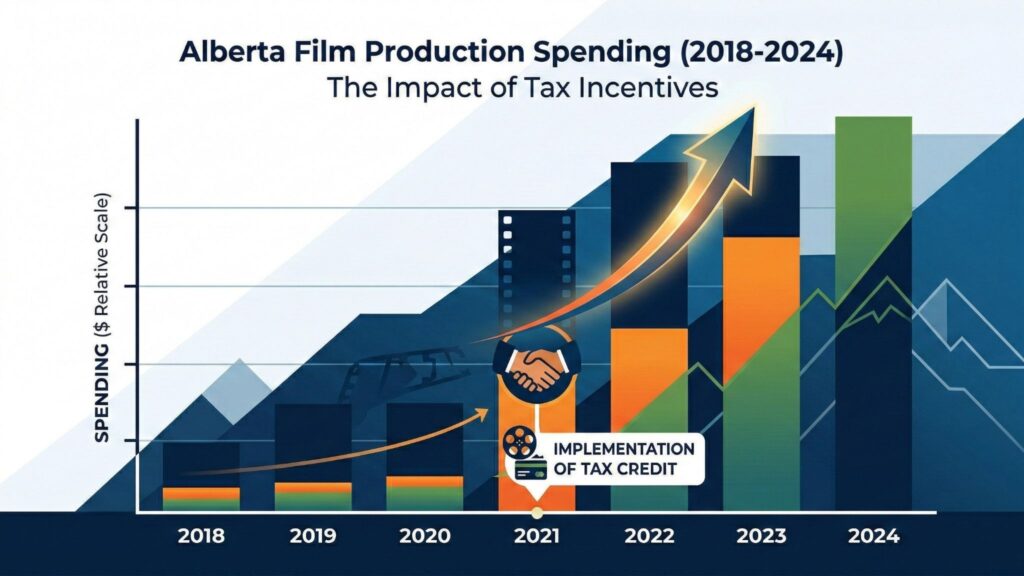
- The Mechanic: The FTTC offers a refundable tax credit of 22% or 30% on eligible Alberta production and labor costs.
- The “Bonus” Factor: Productions that utilize rural filming locations or employ diverse crews can often hit the higher 30% tier.
- Investor Appeal: For major studios like HBO, Netflix, and Disney, the predictability of a tax credit is far more attractive than a capped grant system. It allows for scalable budgeting and long-term planning.
2. The “Last of Us” Effect: A Case Study in Scale
When HBO chose Alberta to stand in for a post-apocalyptic United States, it initiated the largest television production in Canadian history. The sheer scale of the project acted as a stress test for the provincial economy, which it passed with flying colors.
The Direct Spend
According to data from Oxford Economics, The Last of Us Season 1 generated over $141 million in expenditures across Alberta. This wasn’t concentrated solely in the urban hubs of Calgary and Edmonton. The production traveled to 18 different municipalities, spreading the wealth across the geographic breadth of the province.
Employment Mechanics
The production supported over 1,000 jobs for Albertans. However, the educational value lies in which jobs were created. This wasn’t just “Hollywood” talent flown in from Los Angeles.
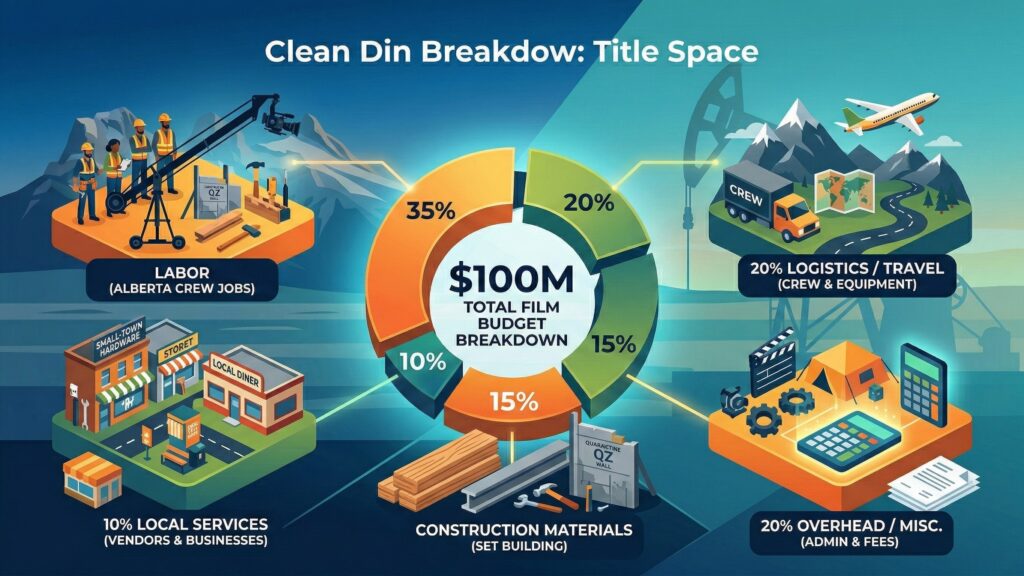
1.Technical Trades: Welders, carpenters, and electricians were required to build massive sets, including the “QZ” (Quarantine Zone) walls and interior soundstage environments.
2.Logistics and Transport: Hundreds of drivers and logistics coordinators managed the movement of equipment across the province.
3.Post-Production: The surge in filming has led to a secondary boom in digital effects and editing suites within the Calgary tech corridor.
3. Hidden Economics: The Ripple Effect in Small-Town Alberta
While the “glamour” of the film industry stays with the actors, the “grit” of the economics stays with the local business owners. This is most evident in towns like Fort Macleod, High River, and Canmore.
The Fort Macleod Phenomenon
Fort Macleod, with its historic 24th Street, has become a darling for location scouts. When a crew of 300 to 500 people descends on a town of 3,000, the economic injection is immediate and profound.
The Hardware Store Multiplier:
A common misconception is that film sets are built elsewhere and shipped in. In reality, production designers prefer to source materials locally to save on logistics.
- Lumber and Paint: A single production can exhaust the local supply of plywood, specialized fasteners, and paint. This provides a massive revenue spike for local hardware stores that typically rely on steady, slow-moving residential sales.
- Custom Fabrication: Local machine shops are often hired to create brackets, rigs, and structural supports for camera equipment.
The Hospitality Surge:
- Hotels: During the filming of The Last of Us and Ghostbusters: Afterlife, hotel occupancy in surrounding areas hit 100% during the traditional “off-season.”
- Catering and Groceries: While large productions have their own catering, the “per diem” spending of the crew flows into local cafes, restaurants, and grocery stores. Industry estimates suggest that a crew member spends an average of $50–$100 per day in the local community outside of provided meals.
The “Film Tourism” Tail
The economic impact doesn’t end when the cameras stop rolling. “The Last of Us” has created a legacy of film tourism. Fans now travel to Fort Macleod to see the street where the frantic opening sequence was filmed, or to the Canmore Engine Bridge. This provides a long-term, sustainable revenue stream for the provincial tourism sector, diversifying away from traditional ski and hike tourism.
4. Infrastructure Development: Building the “Texas of the North”
For Alberta to sustain this boom, it requires more than just pretty mountains; it requires “purpose-built” infrastructure. The province is currently undergoing a massive expansion of its studio capacity.
Calgary’s Film Centre and Beyond
The Calgary Film Centre has been a cornerstone, but private investment is now flowing into new facilities.
- The Rocky Mountain Film Studio: This facility provides the massive square footage required for high-budget “tentpole” films.
- Edmonton’s Growth: While Calgary has traditionally led the charge, Edmonton is rapidly catching up, utilizing its industrial spaces for soundstages and focusing on independent and mid-tier productions.
The Technical Engineer’s Perspective: Specialized Infrastructure
From an engineering and construction standpoint, a modern soundstage is a marvel of technical specifications.
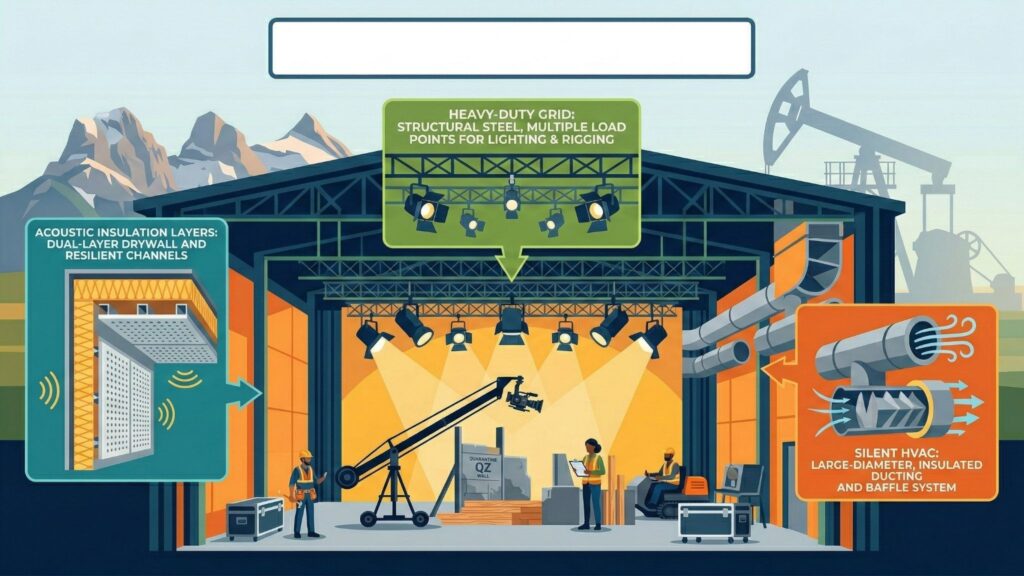
1.Acoustic Engineering: Walls must have a high STC (Sound Transmission Class) rating to block out the Alberta wind and nearby industrial noise.
2.HVAC Systems: These must be “silent” yet powerful enough to cool a room filled with hundreds of high-output LED lights and a crew of 200 people.
3.Power Grids: Productions require massive, stable power draws, often necessitating dedicated substations or sophisticated mobile power management systems.
5. Labor Force Transition: From Oil Patch to Film Set
One of the most compelling educational aspects of the Alberta film boom is the “transferability of skills.” Alberta possesses a workforce with a high concentration of technical trades—skills honed in the oil and gas sector that are surprisingly applicable to film production.
Skill Mapping
- Heavy Equipment Operators: The same skills used to move earth on a well site are used to position massive cranes and “technocranes” on a film set.
- Project Managers: The rigorous safety and scheduling standards of the energy sector translate perfectly to the high-pressure environment of a $100M film production.
- Medics and Safety Officers: Alberta’s robust industrial safety culture has provided a ready-made pool of “Set Medics” and “Safety Coordinators” who understand provincial OH&S (Occupational Health and Safety) regulations.
Training and Education
Institutions like SAIT (Southern Alberta Institute of Technology) and Bow Valley College have recognized this shift. They are offering specialized programs in film production, set decoration, and digital post-production. This ensures that the “Last of Us” legacy isn’t just a one-off event, but the foundation of a permanent, skilled labor pool.
6. The Competitive Edge: Why Alberta?
In the global market for film production, Alberta competes with British Columbia, Ontario, Georgia, and New Mexico. To remain competitive, the province leverages several unique advantages:
1.The “Golden Hour”: Alberta’s northern latitude provides longer periods of “magic hour” light during the summer, a dream for cinematographers.
2.Diversity of Biospheres: Within a three-hour drive of Calgary, a production can access alpine peaks, badlands (dinosaur country), rolling foothills, and modern urban skylines. This reduces travel costs for productions needing multiple looks.
3.The “No PST” Advantage: For large-scale productions, the absence of a Provincial Sales Tax (PST) in Alberta represents a direct 5% to 8% saving on all local procurement compared to other Canadian provinces.
7. Risks and Skepticism: The Volatility of Art
As an economic analyst, one must also address the risks. The film industry is notoriously fickle.
- Tax Credit Wars: If a neighboring jurisdiction (like Saskatchewan or BC) significantly increases their tax credit, productions may migrate. Alberta must maintain a “competitive-enough” stance without entering a “race to the bottom” that erodes the tax base.
- The “Service Industry” Trap: Currently, Alberta is largely a “service” destination—meaning we host American productions. To truly solidify the economy, Alberta needs to foster “IP (Intellectual Property) Ownership,” where Albertan companies create, own, and distribute their own content globally.
- Labor Shortages: A sudden influx of three “Last of Us” sized productions simultaneously would currently break the provincial labor capacity. Steady, incremental growth is required to avoid “overheating” the sector.
8. Conclusion: The New Alberta Narrative
The “Last of Us” legacy is a story of economic evolution. It proves that Alberta’s greatest resource is not just what lies beneath the ground, but the versatility and ingenuity of its people and the breathtaking scale of its landscape.
For the investor, the film boom offers a diversified entry point into the Canadian creative economy. For the resident, it offers high-paying, creative jobs that don’t depend on the price of oil. For the small-town business owner, it offers a lifeline and a chance to showcase their community to a global audience.
As the province moves forward, the “hidden” economics of film will continue to become more visible. Every time a “Coming Soon” trailer features the familiar peaks of the Rockies or the streets of an Alberta town, it is a signal that the province has successfully scripted a new chapter in its economic history.
Sources and References
- Alberta Economic Development and Trade: Annual Reports on the Film and Television Tax Credit (FTTC).
- Oxford Economics: The Economic Impact of The Last of Us in Alberta (2023 Study).
- Creative Alberta / Alberta Film Commission: Production statistics and infrastructure development maps.
- IATSE Local 212: Labor statistics and member diversification reports.
- Motion Picture Association of Canada (MPA-Canada): Yearly spend data for international productions in Canadian provinces.
Town of Fort Macleod: Municipal economic impact statements regarding recent major productions.