

In the bustling corridors of Red Deer’s manufacturing hubs and the sun-drenched storefronts of Lethbridge’s downtown, a silent shift has occurred. The year 2026 has ushered in a reality where the digital perimeter of a family-owned ag-tech firm is scrutinized with the same intensity as a Tier-1 financial institution in Calgary’s downtown core. For the Alberta small business owner, the “Wild West” of the internet has become a regulated frontier where survival is no longer just about the quality of your product, but the strength of your encryption and the validity of your insurance policy.
The following economic facts are based on current Alberta provincial data and market trends.
1. The Decentralized Target: Why Red Deer and Lethbridge?
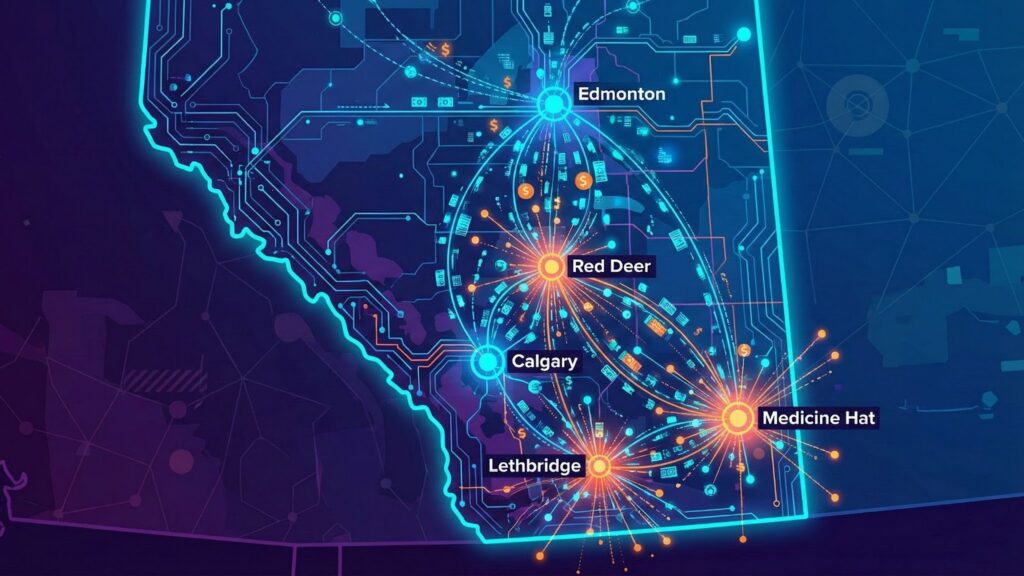
Historically, small business owners in Alberta’s secondary markets felt a sense of “geographic immunity.” The prevailing logic suggested that hackers in Eastern Europe or East Asia were hunting for the “big fish” in Toronto or Vancouver. However, the economic data of 2025 and 2026 has shattered this myth.
The “Soft Target” Economic Theory
Hackers have pivoted toward “volume-based” attacks. A small business in Lethbridge often possesses the same valuable data—employee Social Insurance Numbers, customer credit card info, and proprietary vendor contracts—as a large corporation, but typically lacks the million-dollar cybersecurity budget. In economic terms, the “Cost per Breach” for a hacker is significantly lower when targeting a mid-sized retail chain in Central Alberta than it is targeting a major bank with a 24/7 Security Operations Center (SOC).
The Connectivity Factor
Alberta’s aggressive push for rural high-speed internet and the “Silicon Prairie” initiative has moved local commerce online. From GPS-guided precision farming in the Palliser Triangle to automated inventory systems in Red Deer’s industrial parks, the “attack surface” has expanded. Every connected device is a potential entry point for ransomware, making cyber-insurance not a luxury, but a mandatory line item on the balance sheet.
2. The Anatomy of Cyber-Insurance Premiums in 2026
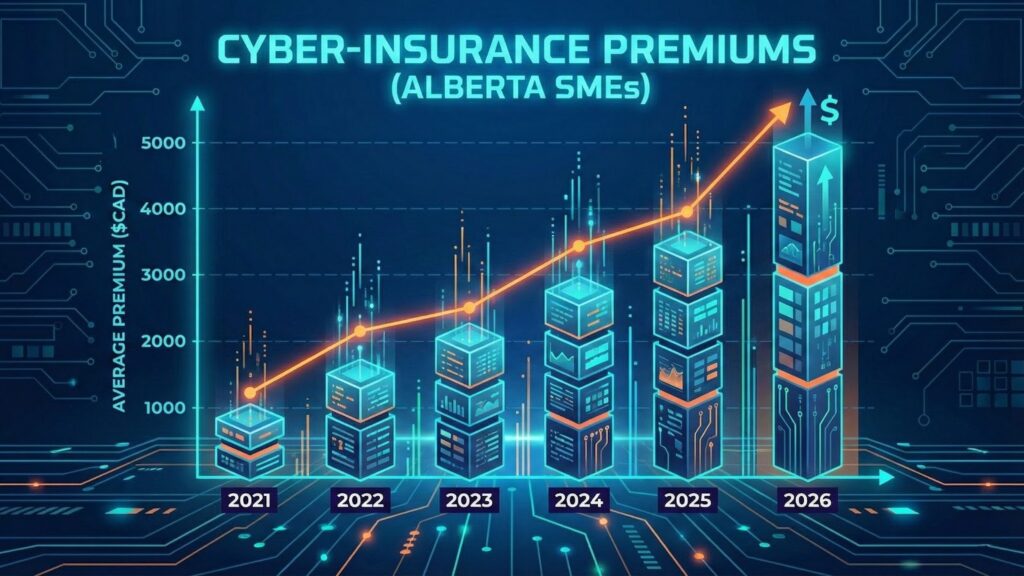
The cost of cyber-insurance in Alberta has seen a compound annual growth rate (CAGR) of nearly 25% over the last three fiscal years. To understand why your broker is quoting higher figures, we must look at the actuarial shifts within the Canadian insurance market.
From “Silent Cyber” to Explicit Coverage
In the early 2020s, many businesses relied on “silent cyber”—the idea that their general liability policy might cover a digital breach. Those days are gone. Alberta insurers now explicitly exclude cyber events from General Liability (GL) and Property policies. You must now buy a standalone Cyber Liability Insurance (CLI) policy.
The Three Pillars of Premium Pricing:
1.Revenue and Data Volume: Insurers calculate the “potential for loss” based on how much sensitive data you store. A small accounting firm in Red Deer with 500 high-net-worth clients may pay more than a large landscaping company with 5,000 low-data interactions.
2.Industry Risk Profile: Healthcare, Finance, and Manufacturing are currently flagged as “High Risk” in Alberta. Manufacturing is particularly targeted due to the rise of “Operational Technology” (OT) attacks that can shut down a physical assembly line.
3.Security Posture (The “Discount” Lever): This is the only area where the business owner has control. In 2026, insurers are using “Inside-Out” scanning—tools that check your network vulnerabilities before they even offer a quote.
3. The “Minimum Security Standards”: The New Barrier to Entry
Perhaps the most significant change for the Alberta small biz landscape is that insurance is no longer “guaranteed issue.” In 2026, if you do not meet the “Minimum Security Standards,” many carriers will simply refuse to quote you. This has created a “security floor” that every business must reach.
Multi-Factor Authentication (MFA)
MFA is no longer a suggestion; it is a hard requirement. Insurers require MFA on:
- Remote Access: Any VPN or remote desktop tool.
- Privileged Accounts: Any account with administrative rights.
- Cloud Applications: Office 365, Google Workspace, and accounting software like Xero or QuickBooks Online.
Endpoint Detection and Response (EDR)
Standard antivirus software is considered obsolete by 2026 standards. Alberta insurers now look for EDR solutions. Unlike traditional antivirus, which looks for known “viruses,” EDR uses AI to monitor behavior. If a computer in a Lethbridge law firm suddenly starts encrypting files at 2:00 AM, the EDR shuts it down automatically.
The “3-2-1” Backup Rule (With a Twist)
Insurers now demand proof of Immutable Backups. This means the backup cannot be changed or deleted, even by someone with admin credentials. This is the primary defense against ransomware; if your data is locked, you can simply “roll back” without paying the ransom.
Employee Training and Phishing Simulations
Because 85% of breaches involve a human element, insurers want to see that your staff in Red Deer aren’t clicking on links promising “Free Tim Hortons Gift Cards.” Quarterly phishing simulations are now a standard requirement for premium discounts.
4. PIPA and the Legal Cost of a Breach in Alberta
Alberta’s Personal Information Protection Act (PIPA) remains one of the most stringent provincial privacy laws in Canada. For a small business, a data breach isn’t just a technical headache; it’s a legal minefield.
Mandatory Breach Notification
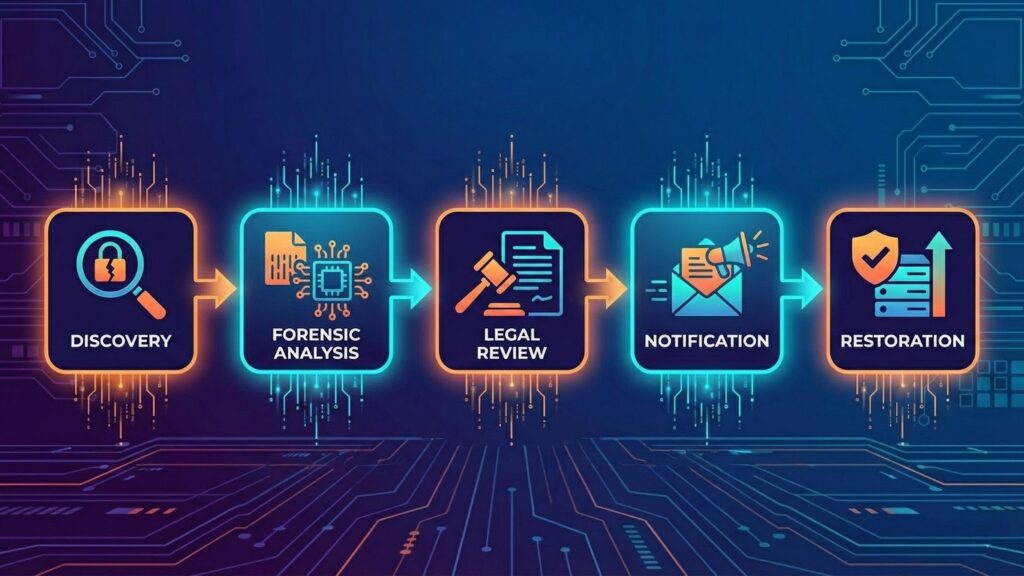
Under PIPA, if there is a “real risk of significant harm” to individuals, you must notify the Information and Privacy Commissioner of Alberta. This process is expensive. It involves:
- Forensic Investigation: Hiring “digital detectives” to find out what happened ($250 – $500/hour).
- Legal Counsel: Ensuring you meet provincial and federal reporting timelines.
- Credit Monitoring: Providing affected customers with 12–24 months of credit monitoring services.
Cyber-insurance covers these “First-Party” costs, which frequently exceed $100,000 for even minor breaches. Without insurance, these costs are paid directly out of the business’s cash flow, often leading to insolvency.
5. Case Study: The Lethbridge Retailer vs. The Red Deer Manufacturer
To illustrate the economic impact, let’s look at two hypothetical Alberta businesses in 2026.
Case A: “Bridge-Way Clothing” (Lethbridge)
- Profile: Boutique retail with an e-commerce wing.
- The Incident: A staff member’s email is compromised via a sophisticated “Man-in-the-Middle” attack. The hacker diverts $40,000 in vendor payments.
- The Insurance Outcome: Because they had Social Engineering Coverage (an add-on to cyber-insurance), the $40,000 was reimbursed, minus a $5,000 deductible. Without it, the loss would have erased their entire Q3 profit margin.
Case B: “Central Alta Parts” (Red Deer)
- Profile: Small CNC machining shop.
- The Incident: Ransomware shuts down the server that controls the CNC machines. Production stops for 10 days.
- The Insurance Outcome: Their policy included Business Interruption Coverage. The insurance company paid for the lost revenue during the 10-day downtime and hired a recovery firm to restore the systems from their immutable backups.
6. How to Secure Coverage: A Guide for the Alberta Entrepreneur
Navigating the 2026 insurance market requires a proactive strategy. You cannot wait until your renewal date to think about cybersecurity.
Step 1: Conduct a “Gap Analysis”
Work with a local Managed Service Provider (MSP) in Red Deer or Lethbridge to compare your current setup against the “Minimum Standards” listed in Section 3. Do this six months before your insurance renewal.
Step 2: Formalize Your Incident Response Plan (IRP)
Insurers want to see a written document that explains exactly what you will do if a breach occurs. Who do you call first? Who is your legal contact? Where are the backups? Having a written IRP can lower premiums by 5-10%.
Step 3: Review the “Exclusions”
Not all cyber policies are created equal. In the Alberta market, pay close attention to:
- War Exclusions: With global tensions rising, some insurers try to exclude attacks “sponsored by a nation-state.” Ensure your policy covers “Cyber Terrorism.”
- Brick Coverage: Does the policy pay to replace hardware that is physically destroyed or “bricked” by a virus?
7. The Future: AI-Driven Risk and the Alberta Advantage
As we look toward the late 2020s, the Alberta economy is uniquely positioned. Our resilience, born from decades of navigating boom-and-bust energy cycles, is being applied to digital security.
The Rise of “Active Insurance”
We are moving toward a model of “Active Insurance,” where the insurer provides the business with security tools as part of the policy. For a small shop in Lethbridge, this means getting “Enterprise-Grade” security tools that they otherwise couldn’t afford, bundled into their insurance premium.
Conclusion: The Digital Utility
In 2026, we must view cybersecurity and its subsequent insurance as a “digital utility”—as essential as electricity or heat. For the small businesses that form the backbone of Red Deer and Lethbridge, the “Cyber-Insurance” era is not a burden, but a necessary evolution. By meeting these high standards, Alberta’s small businesses aren’t just protecting themselves; they are building a more robust, sophisticated, and investable provincial economy.
Sources and References
- Alberta Information and Privacy Commissioner: 2025-2026 Annual Report on Data Breaches.
- Insurance Bureau of Canada (IBC): “State of the Cyber Insurance Market in Western Canada.”
- Cybersecurity & Infrastructure Security Agency (CISA): Small Business Ransomware Guide.
- Statistics Canada: Digital Technology Adoption in the Canadian Prairies (2025 Data).
- Conference Board of Canada: Economic Impact of Cyber Crime on SMEs.