

The Alberta of 2026 presents a striking contradiction that has left economists, policymakers, and families searching for answers. On one hand, the provincial skyline is a forest of cranes; the energy sector has successfully diversified into hydrogen and carbon capture, and the tech hubs of Calgary and Edmonton are rivaling North American stalwarts. On the other hand, a shadow hangs over the province’s most vital resource: its youth. While the general unemployment rate sits at a healthy 5.4%, youth unemployment (ages 15–24) has stubbornly climbed to nearly 15%.
This article explores the mechanics of this “Youth Employment Paradox,” analyzing why a booming economy is failing to absorb its youngest workers and what this means for the long-term structural health of the Wild Rose Country.
The following economic facts are based on current Alberta provincial data and market trends.
1. The Statistical Disconnect: Boom vs. Barrier
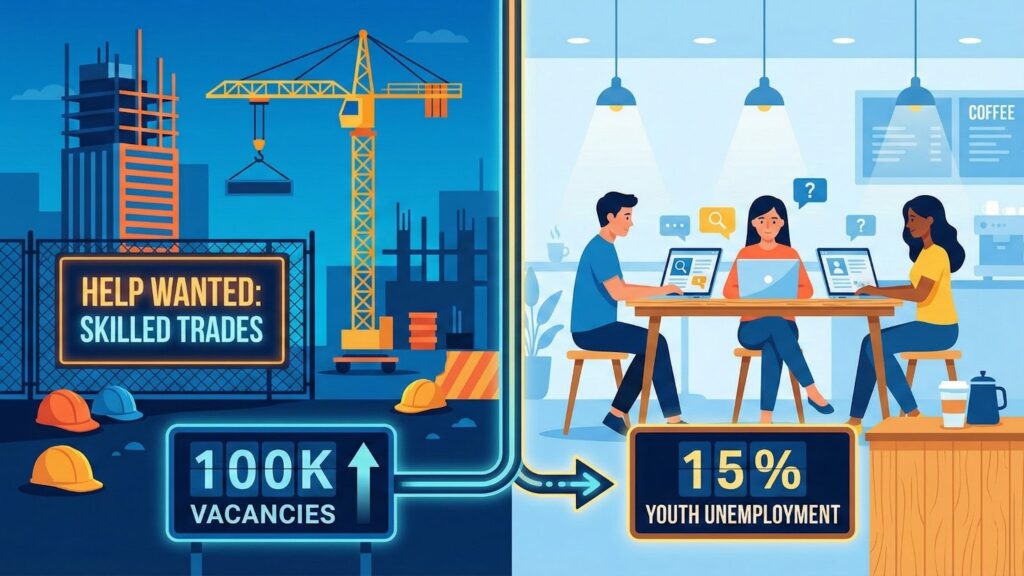
To understand the paradox, one must first look at the raw data defining the 2026 economic landscape. Alberta’s GDP growth is projected to lead the country for the third consecutive year. However, the “headline” numbers mask a deep-seated structural issue within the labor market.
The 15% Problem
In early 2026, the Alberta Youth Unemployment Rate hit 14.8%. To put this in perspective, during the height of the 2014 oil price collapse, youth unemployment hovered around 11%. We are currently seeing a higher rate of youth joblessness during an economic expansion than we did during a major recession.
Sectoral Vacancies
Simultaneously, the Alberta Chamber of Commerce reports over 100,000 unfilled positions across the province. The breakdown of these vacancies is telling:
- Skilled Trades: 35,000 vacancies (Electricians, Pipefitters, Heavy Duty Mechanics).
- Healthcare: 22,000 vacancies (Registered Nurses, LPNs, Diagnostic Imaging).
- Construction: 18,000 vacancies (Framers, Project Managers).
- Technology: 12,000 vacancies (Cybersecurity, AI Integration).
2. The Experience Trap and the “Junior” Myth
One of the primary drivers of the paradox is the death of the “entry-level” position. In the 2026 market, the definition of entry-level has shifted significantly due to increased operational costs and the rapid integration of Artificial Intelligence.
The Credential Inflation
Educational analysis shows that positions that required a high school diploma in 2015 now require a specialized diploma or a degree. Furthermore, “entry-level” job postings in Alberta’s tech and corporate sectors now frequently list “3–5 years of experience” as a mandatory requirement. This creates a logical impossibility for recent graduates.
The Cost of Training
Alberta businesses, facing high interest rates and increased carbon tax compliance costs, have become “training-averse.” Rather than hiring a green apprentice or a junior analyst and investing 18 months into their development, firms are competing for a limited pool of “mid-career” professionals. This has led to wage inflation for the 35–50 age demographic while leaving the under-25 demographic in a state of “frictional unemployment.”
3. The Skills Mismatch: Digital Natives in an Analog Infrastructure
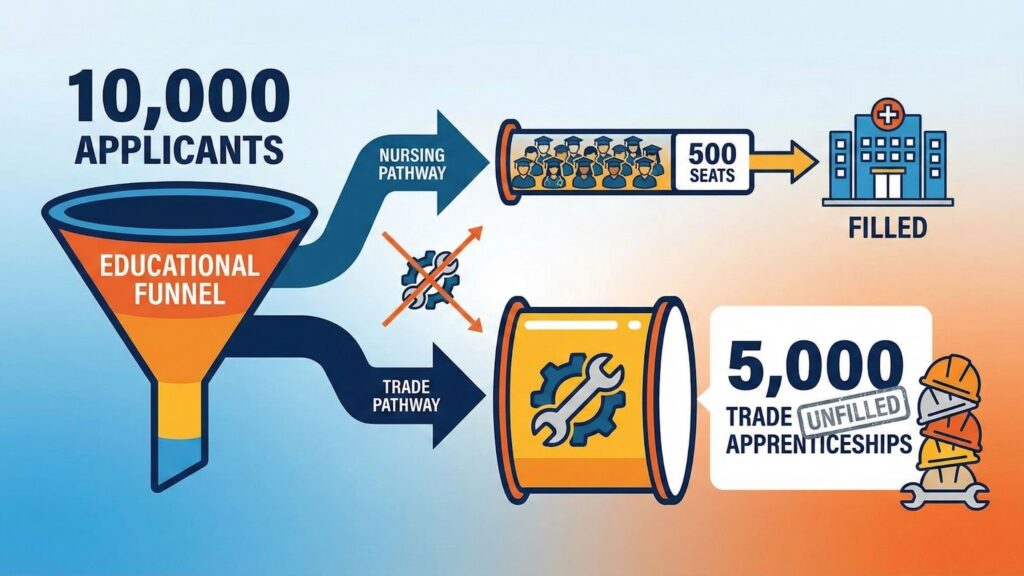
Alberta’s economy remains rooted in the physical world—moving molecules, building homes, and providing bedside care. However, the current generation of workers is the most digitally focused in history.
The “Trades” Stigma
Despite high-six-figure earning potential, the vocational trades continue to suffer from a perception problem. Educational data suggests that while 70% of Alberta high school students aim for university, only 30% of the available high-paying jobs in the province require a traditional four-year liberal arts or business degree.
The Healthcare Bottleneck
In healthcare, the paradox is systemic. While the province “screams” for staff, the bottleneck exists at the post-secondary level. Alberta’s nursing and medical programs are operating at 100% capacity, yet they cannot graduate students fast enough to replace the retiring Baby Boomer cohort. Young people want these jobs, but the “educational infrastructure” is not wide enough to let them through.
4. The Migration Factor: The “Alberta is Calling” Aftermath
The massive success of the “Alberta is Calling” campaigns of 2023–2025 brought hundreds of thousands of newcomers to the province. While this fueled the housing market and increased the tax base, it created intense competition for “first-step” jobs.
Inter-provincial Competition
Newcomers from Ontario and BC often arrive with several years of work experience but are willing to take entry-level roles to get a “foot in the door” in the Alberta market. This displaces local youth who have zero experience.
International Newcomers
International migration has also surged. Many of these individuals arrive with advanced degrees but face credential recognition barriers. Consequently, they take jobs in the service and retail sectors—the traditional “starter jobs” for youth—effectively raising the bar for employment in what used to be the most accessible part of the economy.
5. The Role of Automation and AI in Entry-Level Displacement
In 2026, the impact of Generative AI on the Alberta workforce is no longer a prediction; it is a reality.
Clerical and Administrative Erosion
Historically, young people entered the corporate world through administrative, data entry, or junior research roles. These roles have been largely automated. A single AI-integrated software suite can now perform the tasks that previously required a team of three junior clerks.
The Service Sector Shift
In the hospitality and retail sectors—major employers of youth—self-checkout and automated ordering kiosks have reduced the required headcount by approximately 25% per location compared to 2019 levels. This “efficiency” directly translates to fewer shifts for students and first-time job seekers.
6. Economic Implications: The Long-Term Risks
The youth employment paradox is not merely a social issue; it is a long-term economic risk for the province of Alberta.
1. The “Scarring” Effect
Economists note that entering the labor market during a period of high unemployment has a “scarring” effect on lifetime earnings. If a 20-year-old in Red Deer or Lethbridge cannot find meaningful work for two years, their projected earnings over the next 30 years drop by an average of 8-12%.
2. Brain Drain to the South
Alberta risks losing its brightest young minds to the United States or other jurisdictions where the “cost of entry” for junior talent might be lower. If the “Alberta Advantage” does not apply to the under-25s, they will seek an advantage elsewhere.
3. Social Cohesion and Housing
With high unemployment, the ability of the younger generation to enter the housing market—even with Alberta’s relatively lower prices compared to Vancouver or Toronto—becomes impossible. This leads to a delayed “launch” into adulthood, impacting everything from birth rates to local consumer spending.
7. Educational Pivot: How to Navigate the 2026 Market
For young Albertans and their parents, the path to employment requires a strategic shift in how “career prep” is viewed. The “Educational” tone of this analysis suggests the following pivots:
The Rise of Micro-Credentials
The traditional four-year degree is being supplemented (and in some cases replaced) by micro-credentials. Short, intensive certifications in specific technologies (e.g., “Methane Emissions Monitoring” or “BIM Modeling for Construction”) are currently yielding higher immediate employment rates than general degrees.
Embracing the “High-Tech” Trade
The 2026 mechanic does not just use a wrench; they use a diagnostic computer. The 2026 farmer uses drone swarms and GPS-guided soil analysis. Young people who can bridge the gap between “digital fluency” and “physical labor” are finding themselves in the top 5% of earners.
Networking in a Post-Digital World
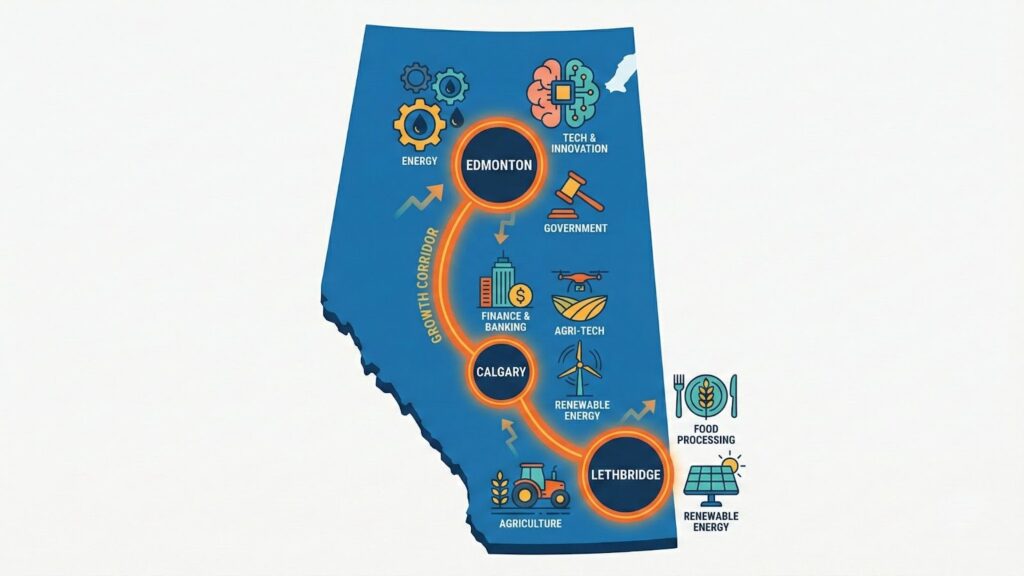
Despite the rise of AI, Alberta remains a “who you know” economy. The paradox shows that jobs are often filled before they are even posted. For youth, the “how-to” of employment in 2026 involves aggressive networking, attending industry mixers in the Calgary Beltline or Edmonton’s Ice District, and securing co-op placements early.
8. Policy Recommendations for Business Leaders
To resolve the paradox, the private sector and the provincial government must collaborate on “de-risking” the young worker.
- The “Training Tax Credit”: Expanding provincial grants that specifically reimburse companies for the first six months of a junior hire’s salary.
- Apprenticeship Reform: Streamlining the process for high school students to earn “dual credit” for trade hours, ensuring they enter the workforce at age 18 with a year of experience already under their belt.
- Credential Recognition: Speeding up the process for newcomers to get their professional designations recognized, moving them out of “youth-starter” jobs and into the high-skilled roles they were trained for.
9. Conclusion: A Call for Structural Realignment
The Youth Employment Paradox of 2026 is a symptom of an economy in transition. Alberta has successfully moved from a pure “oil and gas” play to a diversified energy and tech powerhouse. However, the “human operating system” has not been updated at the same speed.
The jobs are there. The talent is there. The disconnect lies in the bridge between the two. For Alberta to maintain its status as the economic engine of Canada, it must ensure that its youngest citizens are not just spectators of the boom, but active participants in it.
The paradox will only be solved when we stop asking “Why aren’t they working?” and start asking “How do we make them hirable in a world that no longer values the ‘beginner’?”
Sources and References
- Alberta Treasury Board and Finance (2026): Economic Outlook and Labor Market Review.
- Statistics Canada (January 2026): Labour Force Survey – Alberta Supplementary Data.
- Calgary Economic Development: 2026 Tech Sector Talent Gap Analysis.
- BuildForce Canada: Construction and Maintenance Looking Forward – Alberta Forecast.
- University of Alberta, Department of Economics: The Impact of Generative AI on Entry-Level Clerical Positions in Western Canada.