
1. Executive Summary
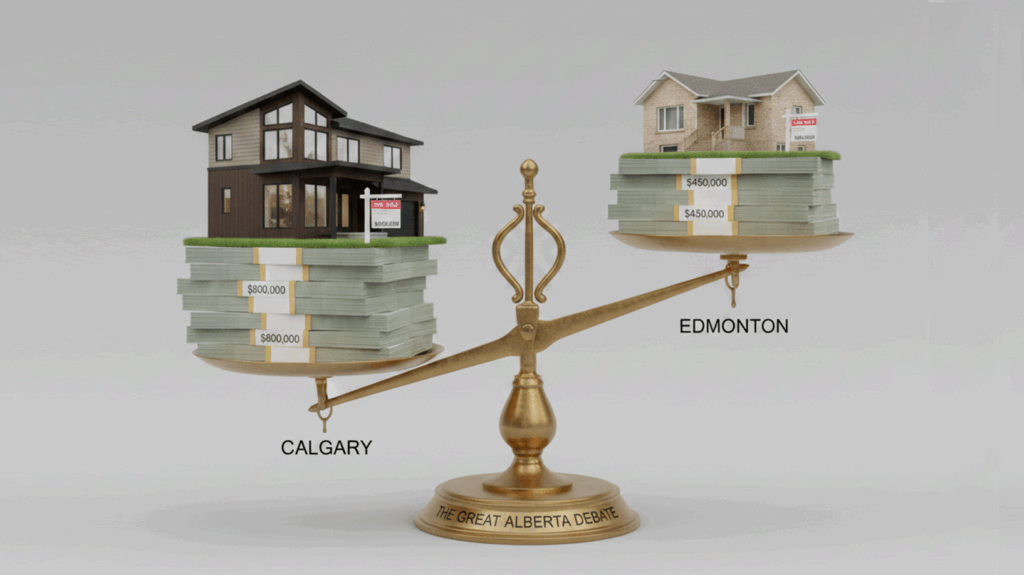
The “Great Alberta Debate” between Calgary and Edmonton often boils down to a simple trade-off: Calgary offers higher incomes and bigger-city amenities but comes with a significantly higher cost of living, driven almost entirely by housing. Edmonton, the provincial capital, presents a more stable, affordable, and family-friendly cost base, particularly for those seeking homeownership and lower financial stress.
1.1 Key Findings at a Glance
- Dominant Cost Factor: Housing is the single largest differentiator. As of 2025, a single-family home in Calgary costs approximately $150,000 to $200,000 more than a comparable home in Edmonton.
- Income vs. Affordability: Calgary generally boasts higher average salaries (approx. 12%+ premium), particularly in corporate, finance, and tech roles. Edmonton’s economy, anchored by a large public sector, offers more stability and a lower entry point for homeownership.
- Rental Market: The rental gap is also significant. A one-bedroom apartment in Calgary costs, on average, $250 – $400 more per month than in Edmonton.
- Taxes: This is a tie. Both cities benefit from the “Alberta Advantage”—no provincial sales tax (PST), low provincial income taxes, and no land transfer tax.
- Lifestyle & Climate: Calgary’s identity is tied to its proximity to the Rocky Mountains (1.5 hours to Banff) and its corporate energy. Edmonton is defined by its vast River Valley (the largest urban parkland in North America) and its vibrant arts and festival scene.
- Safety: Statistically, Calgary has a lower Crime Severity Index (CSI) than Edmonton, though both cities have rates higher than the national average.
1.2 Who Should Choose Calgary?
- Professionals in corporate head offices (energy, finance, logistics, tech).
- Individuals seeking the highest salary potential.
- Outdoor enthusiasts who prioritize immediate access to the Rocky Mountains.
- Those who prefer a faster-paced, corporate urban environment.
1.3 Who Should Choose Edmonton?
- First-time homebuyers seeking affordability.
- Families prioritizing lower housing costs and maximizing disposable income.
- Individuals seeking stable employment in the public sector (government, healthcare, education).
- Real estate investors looking for stronger cash flow and higher rental yields.
2. Introduction
2.1 Why This Comparison Matters
For decades, Alberta has been a beacon of economic opportunity in Canada, drawing hundreds of thousands of new residents with the promise of high wages and a high quality of life. At the heart of this migration are its two largest cities: Calgary and Edmonton. While only three hours apart, they offer surprisingly different lifestyles, economic engines, and, most critically, cost structures.
This comparison is essential for anyone considering a move—be it from another province or another country—as well as for investors and business owners looking to understand the unique advantages of each market.
2.2 Methodology & Approach
This article provides a definitive comparison based on a comprehensive analysis of 2024 and 2025 data.
- Data Sources: We have synthesized data from municipal and provincial government reports, real estate boards (CREB, REA), national bodies (Statistics Canada, CMHC), and reputable market analysts.
- Cost Categories: We analyze every major expense category, from the high-impact costs of housing and taxes to the daily expenses of transportation, groceries, and childcare.
- Currency: All figures are in Canadian Dollars (CAD). Data is reflective of the 2024-2025 period unless otherwise noted.
2.3 City Overview: Calgary
- Population: ~1.6 million (City); ~1.8 million (Metropolitan Area) as of 2025.
- Economic Drivers: Canada’s undisputed energy capital, housing the corporate headquarters of most major oil and gas companies. Its economy has rapidly diversified into finance, technology (fintech, ag-tech), logistics, and transportation.
- Geographic Advantages: Gateway to the Rockies. Its strategic position within an hour of the mountains and a major international airport makes it a hub for tourism and logistics.
2.4 City Overview: Edmonton
- Population: ~1.1 million (City); ~1.5 million (Metropolitan Area) as of 2025.
- Economic Drivers: As the provincial capital, its economy is built on a large, stable base of public administration, healthcare (Alberta Health Services), and education (University of Alberta). It is also a major hub for petrochemical processing, manufacturing, and supply chain logistics for northern Alberta.
- Strategic Position: Known as the “Gateway to the North,” Edmonton is the logistical and service center for Alberta’s vast northern resource projects.
3. Housing Costs: The Decisive Factor
Housing is the single largest differentiator in the cost of living between Alberta’s two major cities. Calgary has consistently maintained a higher price point, driven by different market dynamics, tighter supply, and strong inter-provincial migration. Edmonton, in contrast, remains one of Canada’s most affordable major urban housing markets.
3.1 Single-Family Home Prices
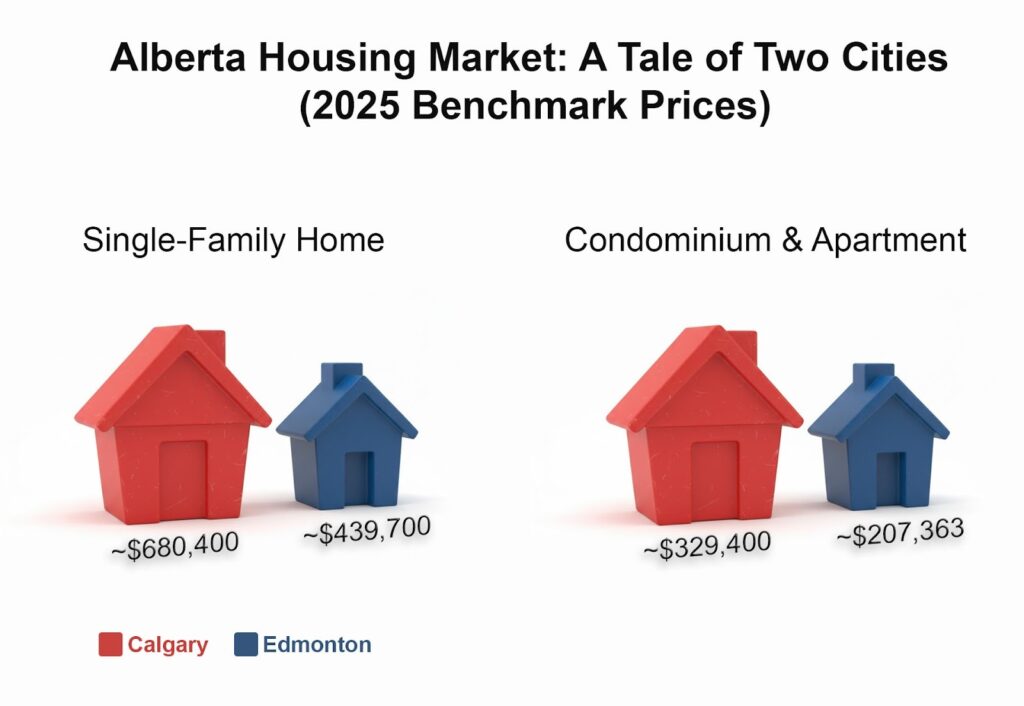
As of mid-to-late 2025, the price gap for a single-family detached home is significant.
- Calgary: The benchmark price for a single-family home was approximately $680,400.
- Edmonton: The market is considerably more accessible, with a benchmark price of approximately $439,700.
The consensus is that buyers can expect to pay approximately $150,000 to $200,000 more for a comparable single-family home in Calgary.
3.2 Condominium & Apartment Prices
The affordability gap is even more pronounced in the condominium market.
- Calgary: The average price for a condo/apartment was $329,400 as of September 2025.
- Edmonton: The average price for a condo/apartment was significantly lower at $207,363.
3.3 Rental Market Analysis
Rental prices follow the same trend as home prices, with Calgary being notably more expensive.
3.3.1 One-Bedroom Apartments
Data from July 2025 for unfurnished one-bedroom units shows:
- Calgary: Average rent of $1,559 per month.
- Edmonton: Average rent of $1,304 per month.
3.3.2 Two-Bedroom Apartments
Reports indicate Calgary’s 2-bedroom rent is approximately $500 more per month than Edmonton’s.
3.3.3 Three-Bedroom Houses
- Calgary: Average 3-bedroom rent is estimated between $2,400 and $2,800.
- Edmonton: Average 3-bedroom rent is estimated between $2,200 and $2,600.
3.4 Property Taxes & Municipal Fees
- Calgary: The 2025 residential municipal mill rate is 0.0038066. The final (total) mill rate, including the provincial education tax, is 0.00618030. On a “typical” residential home valued at $700,000, the municipal portion is $2,665 annually ($222 per month), plus the education tax.
- Edmonton: While 2025 mill rates are different, analysis of taxes on similarly valued homes suggests Edmonton’s property taxes are comparable or slightly higher for the same assessed value, but the lower overall assessment values mean the average homeowner’s tax bill is often lower than in Calgary.
3.5 Home Insurance Costs
Insurance is a significant and rising cost in Alberta due to weather-related damages. However, there is a stark difference between the two cities based on 2024 data:
- Calgary: Average annual home insurance premium was $2,374.
- Edmonton: Average annual home insurance premium was $1,712.
Edmonton’s lower rate is due to a perceived lower risk of catastrophic weather events, such as the major hail storms that have hit Calgary.
3.6 Mortgage & Down Payment Requirements
Mortgage rules and the federal stress test are consistent across Canada. However, the difference in home prices directly impacts mortgage payments.
- **Calgary Single-Family Home ($680,400):** A 20% down payment ($136,080) leaves a mortgage of $544,320.
- **Edmonton Single-Family Home ($464,955):** A 20% down payment ($92,991) leaves a mortgage of $371,964.
This difference of over $172,000 in the principal loan amount results in substantially lower monthly payments for Edmonton homeowners.
4. Income & Employment Opportunities
While Calgary has a higher cost of living, it generally offsets this with higher average incomes and a larger corporate headquarters presence. Edmonton’s economy is often considered more stable, with a strong public sector base.
4.1 Median & Average Household Income
Incomes in Calgary are consistently higher on average than in Edmonton.
- Average Individual Salary (2025):
- Calgary: $58,243
- Edmonton: $51,965
- Median Household Income (2021 Census): The provincial median household income was $96,000, with Calgary’s median typically tracking above the provincial average and Edmonton’s tracking slightly below or at the average.
4.2 Major Industries & Employers
4.2.1 Calgary’s Economic Landscape
Calgary is the undisputed centre of Canada’s energy sector, hosting the corporate headquarters of major oil and gas companies. This fuels a large ecosystem of related industries.
- Major Industries: Energy (Oil & Gas), Finance, Transportation & Logistics, Technology, Legal Services, and Construction.
- Major Employers: Suncor, Cenovus Energy, Enbridge, WestJet, CPKC Rail, ATCO, PCL Constructors, ENMAX.
4.2.2 Edmonton’s Economic Landscape
As the provincial capital, Edmonton has a large, stabilizing public sector base. Its economy is also heavily industrial, focusing more on the processing, manufacturing, and servicing side of the energy sector.
- Major Industries: Public Administration (Government of Alberta), Healthcare, Education, Petrochemical & Manufacturing, Construction, and Arts & Culture.
- Major Employers: Alberta Health Services (AHS), Government of Alberta, City of Edmonton, University of Alberta, PCL Constructors, EPCOR.
4.3 Salary Comparison by Profession
Provincial average salaries from 2025 serve as a baseline, with Calgary roles (especially in tech, finance, and management) often paying a premium above these averages.
- Software Engineer: $93,454
- Registered Nurse (R.N.): $72,818
- Pharmacist: $86,047
- Administrative Assistant: $46,915
- Human Resources Specialist: $69,906
4.4 Job Market Conditions
- Unemployment Rates (2025): The job market has seen fluctuations. At various points in 2025, Edmonton’s unemployment rate (e.g., 8.7% in Sept) trended higher than Calgary’s (e.g., 7.2% in March).
- Job Vacancy Rates: Calgary’s labour market has been “easing” in 2025, with a job vacancy rate of 2.9% in late 2024, indicating more job seekers for each available position than in the previous year.
- Growth Sectors: Provincially, the construction and health care sectors have been primary drivers of new jobs in 2025.
4.5 Career Advancement Potential
- Calgary: Offers strong advancement potential in corporate roles (finance, legal, marketing, management) due to the high concentration of national headquarters.
- Edmonton: Provides very stable and strong career paths in the public sector (government, education) and healthcare, as well as in industrial and petrochemical operations.
5. Transportation Costs
Transportation costs are a mixed bag. Calgary’s public transit passes are more expensive, but drivers in Calgary face notoriously high downtown parking costs.
5.1 Public Transit Systems
5.1.1 Calgary Transit (CTrain & Bus)
Calgary’s system is anchored by the C-Train (LRT), one of the most extensive light rail systems in North America.
- Monthly Pass Pricing (2025):
- Adult: $118.00
- Youth: $86.00
- Park-and-Ride: Many lots are free, but high-demand lots require a paid monthly reservation of $90.00 per month.
- System Expansion: The massive Green Line LRT project is under construction.
5.1.2 Edmonton Transit Service (LRT & Bus)
Edmonton’s system features a growing LRT network (including the new Valley Line) and a re-designed bus network.
- Monthly Pass Pricing (2025):
- Adult: $102.00
- Youth (ages 6-24): $66.00
- Park-and-Ride: ETS provides a large number of free park-and-ride stalls at its LRT stations.
- System Expansion: The Valley Line West is the city’s primary transit construction project.
5.2 Vehicle Ownership Costs
- Vehicle Insurance: Car insurance in Alberta is expensive. 2025 sample quotes suggest Edmonton’s premiums can be slightly higher than Calgary’s, with the provincial average premium around $1,759 in 2024.
- Gasoline Prices: Prices are almost identical in both cities and move in lockstep.
- Parking Costs (Downtown): This is a major win for Edmonton. Calgary notoriously has some of the highest downtown parking rates in North America, with monthly passes easily ranging from $300 to over $500. Edmonton’s monthly passes are significantly cheaper, often in the $350 range.
- Vehicle Registration: Fees are standardized across Alberta ($93.00 for 1 year as of 2025) and are not a differentiating factor.
5.3 Commute Times & Distances
Average commute times are very similar, with 2025 data showing both cities in the 26-28 minute range. Both cities have major ring roads (Stoney Trail in Calgary, Anthony Henday Drive in Edmonton) that have significantly improved cross-city travel.
5.4 Alternative Transportation
Both cities have growing cycling networks and seasonal e-scooter/e-bike share programs. Calgary is well-known for its extensive multi-use pathway system along the Bow and Elbow Rivers. Car-sharing (Zipcar) and ride-sharing (Uber/Lyft) are available and comparably priced in both.
6. Food & Grocery Costs
The cost of food is remarkably consistent across both cities, as they are served by the same major national supermarket chains (Superstore, Safeway, Sobeys, Costco, Walmart).
6.1 Supermarket Price Comparison
There is no significant, consistent price difference between Calgary and Edmonton for a standard “basket” of groceries. 2025 estimates for Alberta suggest a single person spends approximately $350 per month, while a family of four might spend between $800 and $1,000 per month.
6.2 Farmers Markets & Local Produce
Both cities have a vibrant farmers’ market culture. Calgary is home to the Calgary Farmers’ Market and Crossroads Market; Edmonton is famous for the Old Strathcona Farmers’ Market and Bountiful Farmers’ Market. Prices are generally higher than at discount supermarkets but are competitive for high-quality, local goods.
6.3 Dining Out & Restaurant Costs
Dining out costs are marginally higher in Calgary, particularly in the mid-range and fine dining categories, reflecting the slightly higher average incomes.
- Casual Dining / Fast Food: Prices are virtually identical.
- Mid-Range Restaurant: A three-course meal for two might be $80 in Calgary, and comparably $70-$80 in Edmonton.
- Fine Dining: Calgary’s high corporate density supports a large number of high-end steakhouses, which can make its scene feel more expensive overall.
6.4 Coffee Shops & Cafes
The price of a standard beverage from a chain like Tim Hortons or Starbucks is identical. Both cities also have a thriving local, independent coffee scene with comparable (higher) pricing.
7. Utilities & Essential Services
Costs for telecommunications are identical. Energy and water, however, are managed by different municipal entities (ENMAX in Calgary, EPCOR in Edmonton), leading to minor differences.
7.1 Electricity Costs
Alberta has a deregulated electricity market. Consumers can choose a variable Regulated Rate Option (RRO) or a competitive fixed-rate contract. There is no significant, predictable cost difference for electricity between the two cities. The choice of plan will have a far greater impact on a monthly bill than the city of residence.
7.2 Natural Gas Heating
This is a key difference. While the per-unit cost of natural gas is identical, Edmonton residents will almost certainly have higher heating bills. Edmonton is consistently colder than Calgary (which benefits from warm “Chinook” winds), leading to greater natural gas consumption.
7.3 Water & Sewer
Municipal water and waste services are billed by the city.
- Calgary: In 2025, the “typical monthly water bill” (including water, sewer, and stormwater) for a residential home was reported as $114.89.
- Edmonton: Costs are broadly comparable to Calgary’s.
7.4 Internet & Cable
The market is dominated by Telus and Rogers. Competition and pricing are identical in both cities. The average cost for a mid-range internet plan in 2025 is approximately $60-$70 per month, while high-speed fibre plans are around $110-$125.
7.5 Cell Phone Plans
All national carriers (Bell, Rogers, Telus) and their sub-brands have a strong presence. There is no cost difference between Calgary and Edmonton. Competitive 2025 plans frequently offer 50GB-60GB of data for approximately $45 – $50 per month.
8. Healthcare & Childcare
8.1 Public Healthcare Access
Public healthcare is administered provincially by Alberta Health Services (AHS). The system is the same for both cities, and both face similar challenges, such as a shortage of family doctors and significant ER wait times. As the two major hubs, Calgary and Edmonton have the highest concentration of specialists in the province.
8.2 Private & Supplementary Health Services
Costs for services not covered by the provincial plan (dental, vision, physiotherapy) are guided by provincial fee guides and are standardized across the province.
- Dental Exam (Recall): $137.65 (2025)
- Physiotherapy Assessment: $125 (2025)
- Eye Exam: $100 – $150 (2025)
8.3 Childcare Costs
This is a major financial factor that has dramatically changed. As of 2025, Alberta’s move to a flat-fee model for licensed care has equalized costs for younger children in both cities.
8.3.1 Daycare & Preschool (Ages 0 – Kindergarten)
Under the federal-provincial agreement, licensed daycare for children aged 0 to kindergarten is a flat fee of $15 per day, which amounts to $326.25 per month for full-time care. This applies equally in Calgary and Edmonton.
8.3.2 Before/After School Programs
This is the key distinction: The $15/day flat-fee model does not apply to “Out of School Care” for children in Grades 1-6. These costs remain high and vary by provider. For example, 2025-2026 rates for the YMCA in Edmonton for AM & PM care average **$693 per month**. Rates in Calgary are comparable.
8.3.3 Subsidy Programs
For before/after school care, an income-based subsidy program remains available for families earning less than $90,000 gross annually.
9. Education Costs
Both cities have highly-regarded public and private education systems, with costs for post-secondary education being very similar.
9.1 Public School System
- Quality: Both cities boast high-performing public schools. 2025 Fraser Institute rankings show top-tier schools in both cities, including Edmonton’s “Old Scona” (#1 in the province) and Calgary’s Western Canada and Dr. E. P. Scarlett (Top 20).
- School Fees: Public education is “free,” but parents pay fees for extras like optional courses (e.g., $175 for a “Foods” course) or team sports ($155 for a basketball season). These fee structures are similar in both cities.
- School Choice: Both boards (CBE and EPS) have robust “school choice” policies, allowing parents to apply for specialty programs or schools outside their boundary via lottery.
9.2 Private & Alternative Schools
Alberta’s private school sector is strong. 2025 data shows average annual tuition in Alberta ranging from $8,000 to $16,000 for elementary and $15,000 to $25,000 for high school. Elite schools in both cities are at the top end of this range.
9.3 Post-Secondary Education
9.3.1 Universities
The University of Calgary (UofC) and the University of Alberta (UofA) are large, public, research-intensive universities with comparable costs.
- Tuition (2024-2025): A typical domestic undergraduate Arts student at the UofA can expect to pay approximately $8,956 per year (tuition + fees). UofC’s costs are in the same range.
- International Students: Costs are significantly higher, starting around $33,968 per year (plus fees) for an Arts degree.
9.3.2 Colleges & Technical Institutes
SAIT (Southern Alberta Institute of Technology) in Calgary and NAIT (Northern Alberta Institute of Technology) in Edmonton are direct equivalents. Both are leaders in polytechnic education and have similar program costs.
10. Entertainment, Recreation & Lifestyle
10.1 Fitness & Gym Memberships
- Commercial Gyms: Costs are identical. A standard membership at a chain like GoodLife Fitness typically costs between $70 – $80 per month in 2025.
- City Recreation Centers: Both cities have outstanding municipal facilities with comparable membership or drop-in fees.
- Boutique Fitness: Specialty studios (yoga, spin) are popular in both cities, with unlimited memberships around $145/month.
10.2 Sports & Recreation Facilities
Ice rinks, pools, and community sports leagues are widely available and similarly priced in both cities.
10.3 Cultural Attractions
- Museums: Edmonton is home to the Royal Alberta Museum ($21 admission). Calgary’s Glenbow Museum is undergoing a major renovation and is slated to offer permanently free admission upon its full reopening.
- Theaters: Both cities have a thriving scene (e.g., Citadel Theatre in Edmonton, Theatre Calgary in Calgary).
- Festivals: This is Edmonton’s strength. It’s known as “Canada’s Festival City,” famous for the Edmonton International Fringe Theatre Festival (largest in North America) and K-Days. Calgary’s identity is defined by the Calgary Stampede.
10.4 Outdoor Activities
- Proximity to Mountains: This is Calgary’s undisputed advantage.
- Calgary to Banff: ~1.5 hours
- Edmonton to Jasper: ~4 hours
- Provincial Parks: Both cities have incredible urban park systems. Edmonton has the vast North Saskatchewan River Valley, while Calgary has Fish Creek Provincial Park and an extensive river pathway system.
- Ski Passes: 2025/26 season passes are similarly priced (Lake Louise near Calgary: $1,699; Marmot Basin near Jasper: $1,625), but the access from Calgary is far more convenient.
10.5 Nightlife & Entertainment
Both cities have vibrant nightlife districts (17th Ave in Calgary, Whyte Ave in Edmonton). Drink prices are similar, with an average domestic pint around $7.00 – $8.00.
10.6 Shopping & Retail
- Sales Tax: This is a major advantage for both cities. Alberta has no Provincial Sales Tax (PST). Residents pay only the 5% federal Goods and Services Tax (GST).
- Major Shopping Centers: Edmonton is home to the world-renowned West Edmonton Mall, a tourist attraction in itself. Calgary’s primary destination is Chinook Centre, which has a more high-end, luxury focus.
11. Taxes & Government Fees
This is a category where Alberta residents, in both cities, share a significant, combined advantage over almost every other province.
11.1 Provincial Income Tax
As of 2025, Alberta has a progressive tax system with a new 8% bracket, lowering the tax burden for most earners.
- Alberta 2025 Provincial Tax Brackets:
- 8% on the first $60,000
- 10% on income from $60,000.01 to $151,234
- 12% on income from $151,234.01 to $181,481
- (And higher brackets up to 15%)
11.2 Federal Income Tax
All residents of Canada pay the same federal income tax, which is applied in addition to the provincial tax.
- Canadian 2025 Federal Tax Brackets:
- 15% on income up to $57,375
- 20.5% on income from $57,375.01 to $114,750
- (And higher brackets up to 33%)
11.3 Sales Taxes
This is Alberta’s single greatest competitive advantage. Residents pay only the 5% federal GST. There is no PST, unlike in B.C. (12% total tax) or Ontario (13% total tax). This benefit is identical in both Calgary and Edmonton.
11.4 Business & Corporate Taxes
Alberta is widely considered the most tax-friendly province for businesses, with a general corporate tax rate of 8%, the lowest in Canada. This applies to both cities.
12. Climate & Seasonal Cost Considerations
While the cities are only a 3-hour drive apart, their winter climates are notably different, which has a direct impact on lifestyle and costs.
12.1 Temperature & Weather Patterns
- Summer: Both cities have warm, pleasant summers with long daylight hours.
- Winter: This is the key difference. Edmonton is significantly colder.
- Edmonton: January average temperature is -9.5°C. The cold is deep, stable, and persistent.
- Calgary: January average is -6.3°C. The defining feature is the Chinook wind, a warm, dry wind from the Rockies that can raise temperatures from -15°C to +10°C in hours, melting snow and providing a psychological break from winter.
12.2 Heating & Cooling Costs by Season
- Winter Heating: Due to its consistently colder winters and lack of Chinooks, Edmonton residents will pay significantly more for natural gas heating than Calgary residents.
- Summer Cooling: A/C is becoming more common, but summer cooling costs are a minor expense and are comparable in both cities.
12.3 Seasonal Lifestyle Expenses
These costs are nearly identical for both cities.
- Winter Clothing: High-quality insulated parkas and boots are essential.
- Vehicle Winter Maintenance: A set of winter tires (approx. $900+) is a critical safety investment. An engine block heater (installation $200-$300+) is considered essential in Edmonton and highly recommended in Calgary.
13. Quality of Life Factors (Non-Financial)
13.1 Safety & Crime Statistics
Both cities have crime rates higher than the national average, but Edmonton’s is consistently higher than Calgary’s.
- Crime Severity Index (CSI) (2023):
- Calgary: ~79.9
- Edmonton: ~103.8
Like any large city, crime is often concentrated in specific inner-city areas.
13.2 Air Quality & Environment
- Air Quality: By global standards, the air quality in both cities is excellent. The primary issue for both is seasonal wildfire smoke in the summer.
- Green Space: Both cities are renowned for their park systems. Edmonton has the North Saskatchewan River Valley, the longest expanse of connected urban parkland in North America. Calgary has an extensive pathway system (over 1,000 km) along its rivers and large parks like Fish Creek Provincial Park.
13.3 Community & Social Environment
- Diversity: Both are highly diverse, major metropolitan hubs and key destinations for immigrants, with large communities from South Asia, the Philippines, China, and Africa.
- Community: Edmonton is “Canada’s Festival City,” with a year-round calendar of major events. Calgary’s identity is strongly tied to the Calgary Stampede and a high-energy, volunteer-driven spirit.
13.4 Work-Life Balance
- Commute: Average commute times are similar (26-28 minutes) and manageable.
- Recreation Access: This is a key lifestyle differentiator. Calgary offers unparalleled, quick access to the Rocky Mountains. Edmonton’s recreation is more internally focused on its River Valley and festival culture.
14. Real Estate Investment Perspective
For an investor, the two cities present a classic Canadian real estate trade-off: Calgary for appreciation vs. Edmonton for cash flow.
14.1 Rental Yield Comparison
- Edmonton: Because property prices are substantially lower while rents are only moderately lower, it is much easier to find properties that generate positive cash flow. Gross rental yields and cap rates are typically higher.
- Calgary: Higher property prices have compressed yields, making it more difficult to find a property that cash-flows from day one.
14.2 Appreciation Potential
- Calgary: This is where Calgary has been the clear winner, especially in recent years. The market saw explosive price growth from 2023-2025, driven by record-breaking inter-provincial migration.
- Edmonton: The market has been far more stable, seeing modest, steady, single-digit price gains but missing the dramatic boom of Calgary.
14.3 Vacancy Rates & Tenant Demand
Both markets heavily favour landlords in 2024-2025, with vacancy rates at historic lows.
- Calgary (2024): 1.4%
- Edmonton (2024): 2.4%
Rapid population growth in both cities ensures strong, consistent tenant demand.
14.4 Investor Considerations
- Condo Fees: This is a major expense for investors in both cities. Older condo buildings can have very high monthly fees ($500-$900+) that can destroy cash flow.
- Market Liquidity: In 2024-2025, Calgary has been the “faster” market, with low “days on market.” Edmonton’s market moves more slowly.
15. Total Cost of Living Scenarios
Here are three estimated monthly budget scenarios based on 2025 data.
Assumptions: Incomes are estimates. Net pay is after approx. 28-32% deduction. Housing is based on 2025 rental data. Family childcare assumes one child in $15/day daycare ($326.25) and one in unsubsidized before/after school care (~$693).
15.1 Single Professional (e.g., Accountant)
- Estimated Monthly Take-Home Pay: ~$4,460
| Expense Category | Calgary (Monthly) | Edmonton (Monthly) | Notes |
| Housing (1-Bed Rent) | $1,716 | $1,353 | The single biggest cost difference. |
| Car Insurance | $145 | $150 | Edmonton premiums often slightly higher. |
| Gasoline | $80 | $80 | Identical. |
| Downtown Parking | $400 | $300 | Assumes professional parks downtown. |
| Utilities (Heat/Elec/Water) | $200 | $230 | Edmonton is colder, increasing heating costs. |
| Telecom (Phone & Internet) | $135 | $135 | Identical. |
| Groceries | $350 | $350 | Identical. |
| Discretionary (Gym/Dining) | $330 | $330 | Identical. |
| Tenant Insurance | $25 | $25 | Identical. |
| TOTAL MONTHLY EXPENSES | $3,381 | $2,953 | |
| ESTIMATED MONTHLY SAVINGS | $1,079 | $1,507 |
Annual Difference: The single professional in Edmonton could save an estimated $5,136 more per year, driven by cheaper rent and parking.
15.2 Young Couple (e.g., Nurse & Electrician)
- Estimated Monthly Take-Home Pay: ~$8,550
| Expense Category | Calgary (Monthly) | Edmonton (Monthly) | Notes |
| Housing (2-Bed Rent) | $2,086 | $1,639 | Rent gap remains the primary differentiator. |
| Transportation (2 Cars) | $450 | $460 | Insurance ($290/$300) + Gas ($160/$160). |
| Utilities (Heat/Elec/Water) | $240 | $270 | Slightly higher consumption for a larger space. |
| Telecom (Phone & Internet) | $180 | $180 | Two phone plans + internet. |
| Groceries | $700 | $700 | Identical. |
| Discretionary (Gym/Dining) | $660 | $660 | |
| Tenant Insurance | $40 | $40 | |
| TOTAL MONTHLY EXPENSES | **$4,356** | $3,949 | |
| ESTIMATED MONTHLY SAVINGS | $4,194 | $4,601 |
Annual Difference: The couple in Edmonton could save an estimated $4,824 more per year.
15.3 Family of Four (e.g., Engineer & Teacher)
- Estimated Monthly Take-Home Pay: ~$10,800
| Expense Category | Calgary (Monthly) | Edmonton (Monthly) | Notes |
| Housing (3-Bed Rent) | $2,600 | $2,400 | The gap for family-sized homes is smaller. |
| Childcare | $1,019 | $1,019 | Identical cost ($326 + $693). |
| Transportation (2 Cars) | $500 | $510 | Insurance ($300/$310) + Gas ($200/$200). |
| Utilities (Heat/Elec/Water) | $320 | $360 | Higher heating costs for a 3-bed house. |
| Telecom (Phone & Internet) | $180 | $180 | |
| Groceries | $1,000 | $1,000 | |
| Discretionary (Kids/Dining) | $650 | $650 | |
| Tenant Insurance | $50 | $50 | |
| TOTAL MONTHLY EXPENSES | $6,319 | $6,169 | |
| ESTIMATED MONTHLY SAVINGS | $4,481 | $4,631 |
Annual Difference: The cost for a family is remarkably similar, with only a ~$1,800 annual savings advantage for Edmonton. The standardized $15/day childcare has largely equalized the family cost equation.
16. Special Considerations for Newcomers & Immigrants
16.1 Settlement Services & Support
Both cities are major destinations for immigrants and have excellent, well-established support systems, including:
- Calgary: Calgary Catholic Immigration Society (CCIS), Immigrant Services Calgary (ISC), Centre for Newcomers.
- Edmonton: Edmonton Immigrant Services Association (EISA), Catholic Social Services, Mennonite Centre for Newcomers.
16.2 Cultural Communities
Both are highly diverse cities with large and growing communities from South Asia (India, Pakistan), the Philippines, China, Nigeria, and the Middle East.
16.3 Initial Setup Costs
- Rental Deposit: Legally capped at one month’s rent. This will be a higher one-time cost in Calgary.
- Vehicle Purchase: In 2025, the average price of a used car in Alberta is around $35,000. This is a major expense to budget for.
- Professional Licensing: Costs to transfer credentials can be high. For example, applying to APEGA (the provincial engineering body) involves a $500 application fee.
16.4 Employment Pathways
- Choose Calgary if your background is in: Corporate headquarters (finance, accounting, HR), energy sector head offices, investment banking, data science, and senior management.
- Choose Edmonton if your background is in: Public sector (provincial government, healthcare, education), manufacturing, industrial trades, petrochemical operations, logistics, and supply chain management.
17. Business & Entrepreneurship Considerations
17.1 Cost of Operating a Business
- Commercial Rent: Commercial real estate prices generally follow residential trends, which would make Edmonton significantly more affordable for office or retail space.
- Utilities: Electricity rates are nearly identical. Natural gas heating bills will be higher in Edmonton due to the colder climate.
- Labour Costs: Wage expectations are generally higher in Calgary for corporate, finance, and senior tech roles, while Edmonton has a deep, stable talent pool in public administration, healthcare, and industrial trades.
17.2 Startup Ecosystem
Both cities have robust startup support systems.
- Calgary: Is rapidly becoming Western Canada’s tech hub, home to Platform Calgary and Innovate Calgary. It is the clear leader in venture capital funding, particularly in cleantech and fintech.
- Edmonton: The ecosystem is strong, with close ties to R&D at the University of Alberta.
- Grants: Both cities have equal access to powerful federal (NRC-IRAP) and provincial (Alberta Innovates) grant programs.
17.3 Customer Base & Market Size
- Demographics: Calgary’s population has seen explosive growth (5.6% in 2023). 2025 forecasts point to “boosted household consumption” in Calgary, while Edmonton’s outlook suggests more “restrained consumer spending,” giving Calgary an edge for B2C businesses.
18. Future Outlook & Trends
18.1 Population Growth Projections
The long-term outlook for Alberta is one of massive growth. Provincial projections from 2025 estimate Alberta will add ~2.0 million residents by 2051, with this growth concentrated in the two major cities, ensuring strong, long-term demand for housing and services.
18.2 Economic Development Plans
- Calgary: The city’s 2025 economic strategy is aggressively focused on attracting talent and capital, positioning Calgary as the “heart of Canada’s energy transition.”
- Edmonton: The strategy leverages its core strengths: public administration, educational services, and transportation & warehousing.
18.3 Housing Market Forecasts
- Short-term (1-3 years): CMHC forecasts a general rebound and continued growth in sales and prices for Calgary starting in 2025. Edmonton’s 2026 forecast is for “stabilization and moderate growth” in the 2-4% range, rather than a boom.
- Risk Factors: The primary risks to the housing market are trade policy uncertainty, potential changes to immigration targets, and the impact of AI on the job market.
18.4 Climate & Energy Transition Impact
The green energy sector is a cornerstone of Alberta’s future. A 2025 report projects a $143 billion to $205 billion investment opportunity in Canadian renewables over the next decade, with Alberta as a key market. Calgary is actively branding itself as the national leader in this transition.
19. Expert Recommendations & Final Verdict
The choice between Calgary and Edmonton is a choice between two different life paths. There is no universally “better” city; there is only the “better” city for you.
19.1 Choose Calgary If…
- …Your career is in energy, finance, logistics, or a corporate head-office role.
- …You are seeking the highest possible salary and career advancement potential.
- …The non-negotiable cornerstone of your lifestyle is quick access to the Rocky Mountains for skiing, hiking, and biking.
- …You prefer the feel of a high-energy, fast-growing, corporate city.
- …You can comfortably afford housing costs that are $150k-$200k higher.
19.2 Choose Edmonton If…
- …Affordability is your #1 priority.
- …You are a first-time homebuyer and want to enter the market without being “house poor.”
- …You work in the public sector, healthcare, education, or industrial trades.
- …You value a stable, family-friendly, and community-oriented atmosphere.
- …You are a real estate investor focused on strong monthly cash flow and higher rental yields.
- …You love the idea of a massive urban park (the River Valley) and a vibrant festival scene.
19.3 The Hybrid Strategy
The rise of remote work has created a new option: live in an affordable Edmonton suburb and earn a Calgary-based remote salary. This “geographic arbitrage” can offer the best of both worlds, though it requires a remote-friendly job and a willingness to be 3 hours away from the corporate office.
19.4 Making Your Decision: Key Questions
- What is my real budget? Be honest. Can you truly afford a $680,000 mortgage (Calgary) or is a $460,000 mortgage (Edmonton) a safer path to financial freedom?
- Where are the jobs for my industry? A 12% average salary bump in Calgary is useless if your specific industry is based in Edmonton.
- How often will I actually go to the mountains? Many Calgarians go every weekend. Many others go twice a year. Be honest with yourself.
- Is a stable, colder winter (Edmonton) better or worse than a volatile, milder winter (Calgary)? (P.S. Chinooks can trigger migraines).
20. Conclusion
20.1 Summary of Key Findings
The “Battle of Alberta” is not a battle one city can win. It is a tale of two distinct economic and lifestyle models. Calgary is the high-octane corporate hub where you pay a premium for higher salaries and mountain proximity. Edmonton is the stable, affordable capital where you sacrifice mountain access for a much lower cost of entry, especially into the housing market.
With the federal-provincial childcare agreements equalizing family costs, the decision for most people—from newcomers to investors—now rests squarely on the housing vs. income trade-off.
20.2 Taking Action: Next Steps
- Visit Both Cities: Spend a weekend in each. Drive from a suburb to downtown in rush hour. Walk through Whyte Ave in Edmonton and 17th Ave in Calgary.
- Research Neighborhoods: Look at rental and purchase prices in specific communities you’re considering.
- Connect with Locals: Use forums like Reddit (r/calgary, r/edmonton) to ask specific questions of people who live there.
20.3 Additional Resources
- City Websites: City of Calgary | City of Edmonton
- Economic Development: Calgary Economic Development | Edmonton Global
- Real Estate Boards: Calgary Real Estate Board (CREB) | REALTORS® Association of Edmonton (RAE)
- Newcomer Services: Immigrant Services Calgary | Edmonton Immigrant Services Association (EISA)
21. Frequently Asked Questions (FAQ)
Q: Is Calgary or Edmonton more expensive overall?
A: Calgary is more expensive. While some costs are identical (groceries, taxes, cell phones), Calgary’s housing costs are so much higher that they make it the more expensive city by a significant margin.
Q: How much cheaper is housing in Edmonton compared to Calgary?
A: As of 2025, a benchmark single-family home in Edmonton is approximately $150,000 to $200,000 cheaper than in Calgary. A one-bedroom apartment is $250 to $400 cheaper per month.
Q: Which city has better job opportunities?
A: It depends entirely on your industry.
- Calgary is better for corporate, finance, tech, and energy head-office roles.
- Edmonton is better for government, healthcare, education, and industrial/manufacturing roles.
Calgary’s job market has seen stronger growth recently, but Edmonton’s is often considered more stable due to its large public sector.
Q: What is the salary difference between Calgary and Edmonton?
A: On average, individual salaries in Calgary are about 12% higher than in Edmonton. However, this premium is often erased by the higher cost of housing.
Q: Are property taxes higher in Calgary or Edmonton?
A: The mill rates are different, but the final tax bill depends on your home’s assessed value. Because Edmonton’s home values are much lower, the average homeowner’s total property tax bill is often lower than the average Calgarian’s, even if the rate is comparable.
Q: Which city is better for families?
A: Edmonton often wins for families on a budget due to its affordable housing. The $15/day childcare program has made costs very similar for families with young children in both cities. However, many families choose Calgary for its proximity to mountain activities.
Q: How do winters compare between the two cities?
A: Edmonton’s winter is consistently colder and longer. Calgary’s winter is milder and more volatile due to frequent, warm Chinook winds that can melt all the snow in a day, even in January.
Q: Is public transit better in Calgary or Edmonton?
A: They are different but comparable.
- Calgary (C-Train): Has higher ridership and is very efficient for moving large numbers of people, but its adult monthly pass is more expensive ($118).
- Edmonton (ETS): Has a cheaper monthly pass ($102) and is expanding its LRT network, but its system is generally more bus-centric.
Q: Which city is safer?
A: Statistically, Calgary is safer. Based on 2023 Statistics Canada data, Calgary’s Crime Severity Index (CSI) of 79.9 was significantly lower than Edmonton’s (103.8).
Q: What are the best neighborhoods for newcomers in each city?
A:
- Calgary: Popular areas for young professionals and renters include the Beltline, Mission, and Bridgeland (close to downtown). Families often look to suburban communities like Arbour Lake, Mahogany, or Royal Oak for lake access and schools.
- Edmonton: Old Strathcona (Whyte Ave) and Garneau are popular with young professionals and students (near the University). Families often choose affordable and amenity-rich suburbs like Summerside (with a lake), Windermere, or Terwillegar Towne.
Q: Which city is better for real estate investment?
A: It depends on your strategy:
- Edmonton is better for cash flow. Lower purchase prices mean it’s much easier to have a property where the rent covers the mortgage and other expenses.
Calgary is better for appreciation. It has historically seen much stronger and faster price growth, though its high prices make positive cash flow difficult to achieve.