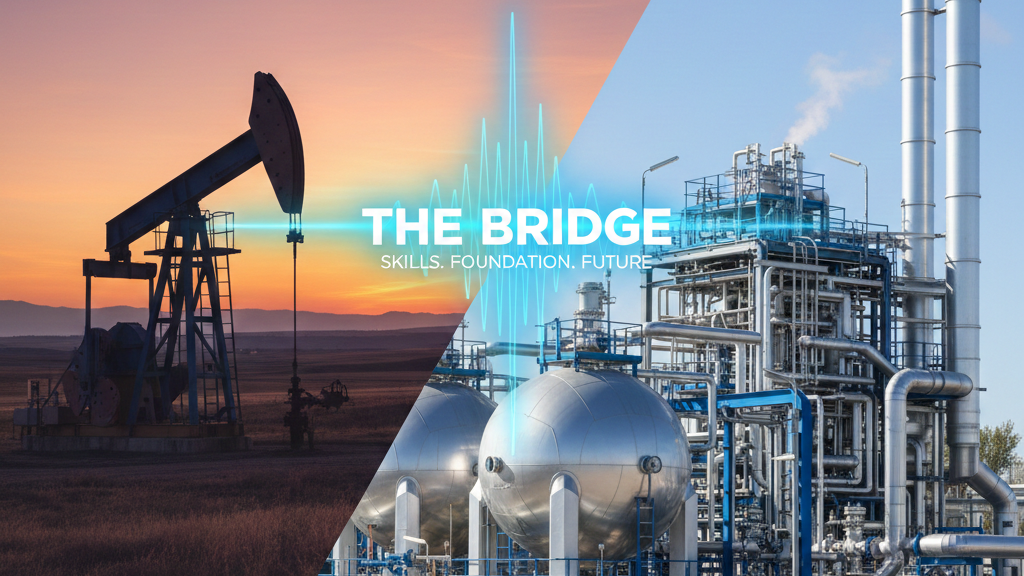

If you’ve spent any time on a site in Alberta, you know the look of a pump jack against the prairie sky or the complex skyline of a processing plant lit up at night. These aren’t just job sites; they’re symbols of an industry built over decades by world-class engineers, operators, pipefitters, and technicians.
You also know that the winds are changing. Talk of “energy transition,” “decarbonization,” and “hydrogen” is everywhere.
For the skilled workers on the front lines, this can sound like a threat. But this isn’t an obituary for your career; it’s a blueprint for its evolution. The province that built its prosperity on fossil fuels is now positioning itself to become a global hydrogen powerhouse, and the skills you’ve developed in the oil patch are precisely what this new industry needs.
This isn’t just talk. The worldwide hydrogen market is estimated to be worth over $2.5 trillion by 2050, and major projects like Air Products’ $1.6 billion net-zero hydrogen complex in Edmonton are already creating thousands of jobs.
This guide is for you—to demystify the shift, show how your skills are the bridge, and outline the practical realities of this change.
The Big Picture: Why Hydrogen? Why Now?
This shift isn’t happening in a vacuum. It’s a response to a global market that is increasingly demanding lower-carbon energy. Alberta is uniquely positioned to capture this massive economic opportunity for four key reasons:
- Abundant Feedstock: We have vast, low-cost natural gas reserves—the primary ingredient for “blue hydrogen.”
- World-Class Geology: Our province has some of the best geology in the world for Carbon Capture, Utilization, and Storage (CCUS), the essential partner technology for blue hydrogen.
- Existing Infrastructure: We already have a massive network of pipelines and established industrial corridors, like Alberta’s Industrial Heartland.
- A World-Class Workforce: (This is the most important one). We are already Canada’s largest hydrogen producer. Our workforce knows how to handle large-scale energy projects safely and efficiently.
The plan isn’t to stop being an energy leader; it’s to expand what that leadership means.
Hydrogen 101: What Workers Need to Know
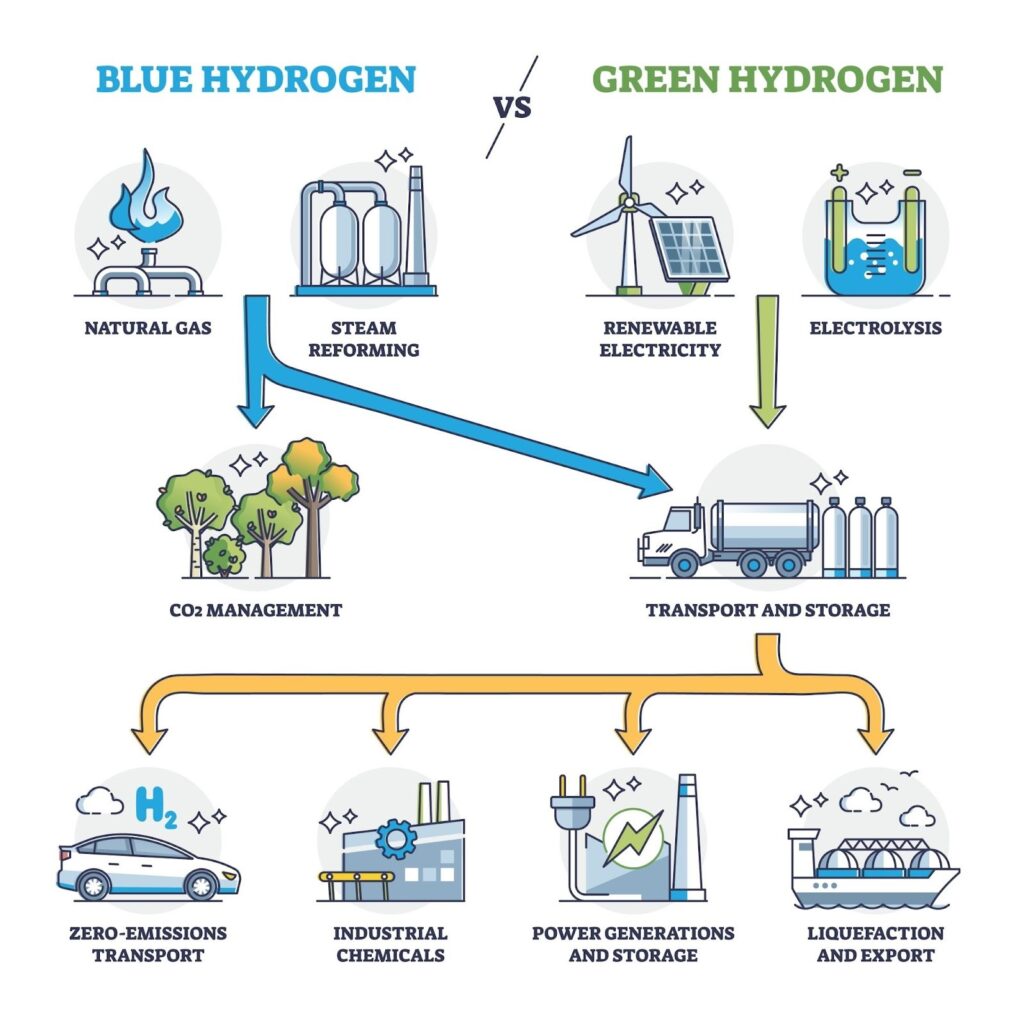
Hydrogen production isn’t one-size-fits-all. Understanding the “colors” helps you grasp where Alberta fits in the global market:
- Grey Hydrogen: Produced from natural gas (steam methane reforming) without capturing the CO2 emissions. This is the traditional, carbon-intensive method.
- Blue Hydrogen: The same process as grey, but the CO2 emissions are captured and permanently stored underground (CCUS). This is Alberta’s primary focus, leveraging our natural gas and geology.
- Green Hydrogen: Produced by splitting water (electrolysis) using renewable electricity (like wind or solar). As Alberta’s renewable grid grows, so will this opportunity.
Shutterstock
The main production method for blue hydrogen involves Steam Methane Reforming (SMR) or Auto-Thermal Reforming (ATR), which uses high-temperature steam and a catalyst to turn methane (natural gas) into hydrogen (H2) and carbon dioxide (CO2). The “blue” part is capturing that CO2 instead of releasing it.
A Tale of Two Plants: What’s the Same, What’s Different?
Imagine standing between a traditional refinery and a new blue hydrogen plant. A lot would look and feel familiar, but some key elements would be new.
The Familiar Foundation
At its core, a hydrogen plant is a large-scale industrial facility. The non-negotiable culture of safety, the focus on process control, and the core engineering are identical. Your experience with:
- Health, Safety, and Environment (HSE) protocols
- Project Management and cost controls
- Pressure vessels, pumps, and rotating equipment
- Process controls, P&IDs, and fluid dynamics
- Pipeline integrity and maintenance planning
…is the bedrock. The “job site” and its rigorous standards are the same.
The New Frontier
The differences lie in the “recipe” and one of the ingredients.
- The Process: Instead of fractional distillation of crude, the core of a blue hydrogen plant is the SMR or ATR.
- The Key Partner (CCUS): This is the critical new piece. To make the hydrogen “blue” (low-carbon), the CO2 produced is captured, compressed, and then permanently sequestered deep underground.
- The Handling (Hydrogen vs. Natural Gas): Hydrogen is not more dangerous than natural gas, but it’s different.
- Properties: It’s non-toxic and 14 times lighter than air. If it leaks, it dissipates up and away instantly, unlike propane or gasoline fumes which pool on the ground.
- Challenges: It’s a tiny molecule, making it harder to contain (requiring different seals and metallurgy to prevent hydrogen embrittlement). It also has a wider flammability range, a lower ignition energy, and burns with a nearly invisible flame.
- The Takeaway: This simply means new, specific safety protocols, advanced leak detection, and different materials—all things a skilled workforce is perfectly capable of mastering.
Your Toolkit: How “Oil and Gas” Skills Translate Directly
The most common myth is that this requires starting from scratch. Industry analyses suggest over 90% of the oil and gas workforce have skills that are highly transferable.
This table maps your current role to its future equivalent.
| Current O&G Role | Target Role in New Sectors | What to Add (The “Top-Up”) |
| Plant/Field Operator | Hydrogen Plant Operator; CCUS Capture Tech | Hydrogen-specific safety, electrolyzer/reformer basics, CO₂ capture unit operations. |
| E&I Technician | Hydrogen Instrumentation; Protection & Control Tech | H₂ sensors, hazardous area classification for H₂, BESS (Battery) codes, arc-flash studies. |
| Pipeline Tech | CO₂ Pipeline Integrity; H₂ Distribution Tech | Materials science (for embrittlement), high-pressure H₂ leak detection, CO₂ compression. |
| Process/Power Engineer | Hydrogen Process Engineer; Grid Integration | Electrolyzer/reformer sizing, CCS mass balance, interconnection studies. |
| HSE/PSM Specialist | Hydrogen/CCUS Safety Lead | H₂ hazard classification (HAZOP), M&V (Monitoring & Verification) for CCUS. |
| Construction/PM | EPC PM for Hydrogen/CCUS/Renewables | Commissioning protocols for H₂/CCUS, utility interconnection coordination. |
| Mechanical/Piping | Hydrogen Maintenance Tech; Reliability Engineer | H₂ compression, materials (embrittlement), valve/seal standards for H₂. |
Career Pathways and Planning: A Step-by-Step Guide
Here is a practical plan for making the transition.
Step 1: Assess Your Current Skills (1-2 weeks)
Conduct an honest inventory. What tickets do you hold? What systems have you operated or maintained? What’s your expertise in safety, management, or logistics? Platforms like Iron & Earth’s Climate Career Portal can help you see how your skills map.
Step 2: Identify Knowledge Gaps (1-2 weeks)
Look at the “What to Add” column in the table. This is your gap. Do you need H₂-specific safety? CCUS fundamentals? New sensor knowledge?
Step 3: Create a Training Plan (2-4 weeks)
You don’t need a new four-year degree. Focus on targeted upskilling. Alberta’s polytechnics are already offering these programs:
- Northern Alberta Institute of Technology (NAIT): Offers programs like the “Clean Energy Professional Upskilling program,” process operator training, and power engineering certificates.
- Southern Alberta Institute of Technology (SAIT): Provides industry-driven micro-credentials like “Entry-Level Technical Applications in Hydrogen” for mid-career professionals, plus programs in chemical and instrumentation engineering.
- Iron & Earth: Offers worker-led training programs for solar, wind, and other clean energy sectors.
Step 4: Secure Funding (2-4 weeks)
Don’t pay for it all yourself. Use available support:
- Canada-Alberta Job Grant: Can reimburse employers up to two-thirds of training costs (up to $10,000). If you’re unemployed, it can cover up to 100% (up to $15,000).
- Government of Canada’s Sectoral Workforce Solutions Program: Provides funding to organizations like Iron & Earth to offer training.
- Employment Insurance (EI): You may be eligible for training benefits while unemployed.
Step 5: Complete Training & Network (Ongoing)
Commit to the learning. While training, update your LinkedIn and resume. Connect with people at companies like Air Products, Linde, and ATCO. Join the Canadian Hydrogen and Fuel Cell Association (CHFCA).
Step 6: Position Yourself as a “Bridge Candidate”
Emphasize your unique value: you have deep energy sector experience plus new hydrogen-specific knowledge. You are not a new trainee; you are an experienced professional who has upskilled.
Timing Your Career Move: Advice by Career Stage
- Early Career (0-10 years experience): You have time to build broad expertise. Consider two-year technical diplomas in energy technology or a full degree. The industry will mature with you, offering decades of opportunity.
- Mid-Career (10-25 years experience): You are the prime candidate. Your deep experience is exactly what’s needed. Focus on targeted short courses (3-6 months) and micro-credentials to fill specific gaps. Leverage your leadership and mentorship abilities.
- Late Career (25+ years experience): Your decades of experience are invaluable, especially in high-stakes roles. One worker, hired at 55, found success producing hydrogen from oil fields. Focus on hydrogen-specific safety tickets and consider supervisory, training, or consulting roles where you can mentor the next generation.
Real Talk: Job Opportunities & Salary Expectations
This is already happening, and the jobs are real. The Government of Alberta estimates the hydrogen economy “could bring tens of thousands of jobs and billions of dollars of economic activity” by 2030.
- Salary Expectations: Salaries are competitive with traditional oil and gas roles.
- Operators and Technicians: Job postings show ranges from $71,000 to $147,000, with hourly rates of $45+ being common.
- Engineering Roles: Typically command $90,000 – $150,000+ depending on experience.
- Management Positions: Often exceed $150,000 annually.
- Major Projects & Employers:
- Air Products: Building a $1.6B net-zero hydrogen complex near Edmonton (creating 2,500 construction jobs).
- Linde: Investing over $2B in a clean hydrogen facility to supply Dow’s Path2Zero project.
- Suncor & ATCO: Partnering on a potential world-scale clean hydrogen facility in the Industrial Heartland.
- Imperial Oil: Integrating hydrogen from Air Products into its Strathcona refinery.
- Heartland Generation: Converting the Battle River Generating Station to run on 100% clean hydrogen.
- Geographic Hotspots:
- Edmonton Region (Alberta Industrial Heartland): This is the undisputed centre of Canada’s hydrogen economy. Fort Saskatchewan, Strathcona County, and Sturgeon County are the primary hubs.
- Calgary Region: A task force identified $4.6 billion/year in market potential, focusing on transportation and industrial use.
Real Talk: Challenges and Considerations
This transition isn’t without risks. Be realistic and plan accordingly.
- Job Security: The initial wave of jobs (like the 2,500 at Air Products) is in construction, which is project-based. The long-term operational jobs are more stable but fewer in number (e.g., 30 permanent jobs for that specific project).
- Geographic Relocation: The major projects are heavily concentrated in the Edmonton Industrial Heartland. If you live in other parts of the province, you may need to relocate or plan for camp/commute scenarios.
- Financial Planning: If you pursue full-time training, you may face a temporary income disruption. You must budget for this. Use the government grants, but also have a personal financial plan.
- Project Timelines: Large industrial projects can face delays due to regulations, financing, or market shifts. Stay flexible and don’t pin all your hopes on one single project’s announced start date.
Conclusion: Building the Next Generation of Alberta Energy
This isn’t just theory. This is real, and it is happening now.
The future of Alberta’s energy sector isn’t being built by someone else. It’s being built by you. The same hands, the same skills, and the same unshakeable work ethic that built this province into an energy superpower are the exact ones needed to lead its next evolution.
The oil fields taught you how to work hard, solve problems, and operate complex systems safely. The hydrogen plants will ask you to apply those same skills to different molecules. The work isn’t unrecognizably different—it’s recognizably similar.
Your Action Checklist & Key Resources
Action Checklist
- [ ] Pick 2 target roles from the mapping table.
- [ ] Inventory your skills using ALIS or the Iron & Earth portal.
- [ ] Research 1-2 training programs at NAIT or SAIT.
- [ ] Apply for the Canada-Alberta Job Grant or check EI eligibility.
- [ ] Update your resume with the keywords “hydrogen,” “CCUS,” and “energy transition.”
- [ ] Follow 3-5 target companies (Air Products, Linde, ATCO, etc.) on LinkedIn.
Key Resources
1. Training Programs and Institutions
- Northern Alberta Institute of Technology (NAIT): nait.ca (Process operations, power engineering, instrumentation)
- Southern Alberta Institute of Technology (SAIT): sait.ca (Micro-credentials, chemical/instrumentation tech)
- Iron & Earth: ironandearth.org (Worker-led transition support, Climate Career Portal)
- University of Alberta: ualberta.ca (Graduate programs in sustainable energy)
2. Government Assistance Programs
- Canada-Alberta Job Grant: alberta.ca/canada-alberta-job-grant (Email: jobgrant@gov.ab.ca)
- Alberta Works: alberta.ca/alberta-works (Employment counseling, training information)
- Tradesecrets Alberta: tradesecrets.alberta.ca (Apprenticeship and certification)
3. Industry Associations and Networks
- Canadian Hydrogen and Fuel Cell Association (CHFCA): chfca.ca (Industry updates, job boards, networking)
- Energy Safety Canada: energysafetycanada.com (Safety training and certifications)
- Building Trades of Alberta: buildingtradesalberta.ca (Apprenticeship and construction jobs)
- APEGA: apega.ca (For engineers and geoscientists)
4. Job Boards and Career Planning
- Iron & Earth’s Climate Career Portal: ironandearth.org (Connects your skills to new jobs)
- Alberta Labour Market Information (ALIS): alis.alberta.ca (Career exploration, salary info)
- Company Career Pages: Air Products, Linde, ATCO, Suncor, Imperial Oil, Dow.
General Job Boards: Indeed, LinkedIn, ZipRecruiter (use keywords “hydrogen,” “CCUS,” “Fort Saskatchewan”).